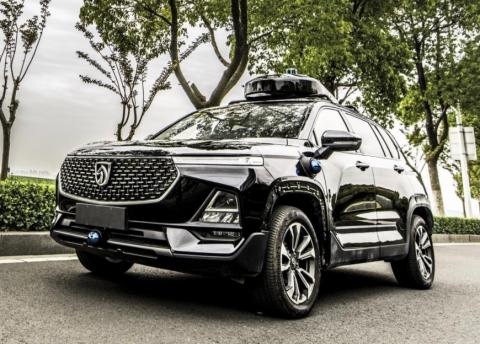
On Friday, June 12, safe-speed autonomous mobility company Venti Technologies announced that it successfully deployed two autonomous SUVs at a school at Nanning City, the capital of Guangxi Province, China.
The product of SAIC-GM-Wuling Automobile (SGMW), the joint venture formed by Chinese automakers SAIC and Wuling, along with GM, the SUVs provide shuttle transportation services to students and visitors. They are booked via a hailing app for destinations along a 9-station loop, and run on a 3K loop in opposite directions.
Autonomous Vehicles
Autonomous Vehicles
Chinese construction machinery manufacturer XCMG unveils autonomous Road Roller
Following successful tests conducted at the end of May, Chinese construction machinery manufacturer XCMG has unveiled its autonomous Road Roller, which it developed in collaboration with the Sichuan Railway Investment Group and Tsinghua University.
The autonomous Road Roller made its debut along the Panda Expressway, which is currently under construction between Panzhihua, Sichuan Province and Dali, Yunnan Province.
“Over 81% of Panda Expressway consists of bridges and tunnels, making it one of China's key smart transportation infrastructure projects,” says Cui Jisheng, general manager of XCMG Road Machinery.

JTA, Florida State College at Jacksonville expanding JTA's autonomous vehicle program
Through new testing and educational initiatives on the campuses of Florida State College at Jacksonville (FSCJ), the Jacksonville Transportation Authority (JTA) and FSCJ have agreed to expand the JTA’s autonomous vehicle program.
The JTA Board of Directors approved a memorandum of understanding with FSCJ on May 28. The MoU includes the expansion of the Ultimate Urban Circulator (U2C) Test & Learn Program to FSCJ’s Commercial Driver’s License Test Track on the school’s Cecil Center Campus; the development of an autonomous vehicle deployment or “Agile Plan” on an FSCJ campus; and the development of curriculum and educational initiatives relative to autonomous vehicles, and related technology.
Weekend Roundup: May 29, 2020
This Week in the Unmanned Systems and Robotics World
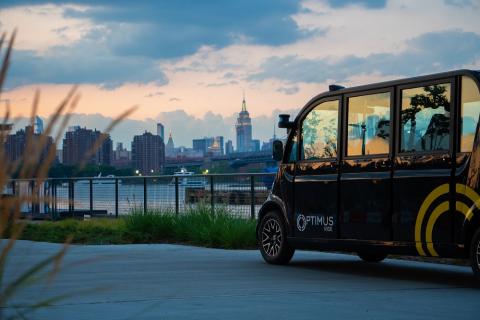
In an effort to help families in need, Optimus Ride will use its self-driving shuttles to deliver meals to a waterfront development in Washington, D.C. called the Yards. Optimus Ride’s fleet will distribute the meal kits to the families on a weekly basis, serving a total of 5,000 meals. (VentureBeat)
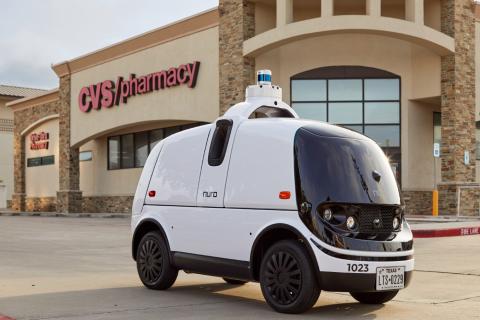
Nuro to deliver prescriptions and essential items using autonomous vehicles in Houston
Nuro has officially entered into the health space with its announced partnership with CVS Pharmacy.
Starting in June, Nuro’s fleet of autonomous vehicles will be used to deliver prescriptions and essentials across three zip codes in Houston, Texas.
“We see this moment as an important stepping stone toward delivering all kinds of goods, beyond food and groceries,” Nuro says.
“It is progress towards building a future where through moving goods instead of people, we can lessen the need for unnecessary trips, save time, and create a safer and more convenient way of getting the things we need.”
Weekend Roundup: May 22, 2020
This Week in the Unmanned Systems and Robotics World
Drones were used to show thanks and appreciation for health care heroes, frontline workers and first responders on the evening of Friday, May 15 at Vanderbilt Stadium in Nashville, Tennessee. 140 coordinated drones lit the sky in formations depicting inspiring words and images. (Vanderbilt University)

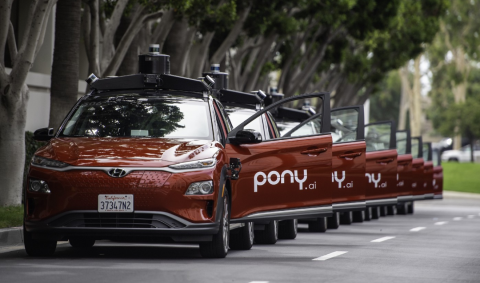
Pony.ai to equip its robotaxi fleet with the NVIDIA DRIVE AGX Pegasus platform
To meet the massive computing demands required to bring robotaxis to market, Pony.ai will equip its robotaxi fleet with the NVIDIA DRIVE AGX Pegasus platform, the company recently announced.
According to Pony.ai, DRIVE AGX Pegasus achieves an unprecedented 320 TOPS (trillions of operations per second) of deep learning. The platform integrates two NVIDIA Xavier SoCs and two NVIDIA Turing Tensor Core GPUs; both of which achieved top results in MLPerf Inference, the first industry-standard, independent AI benchmarks.
UT Dallas professor awarded grant to develop autonomous driving hardware and software
The National Science Foundation (NSF) has awarded Dr. Yang Hu, assistant professor of electrical engineering at The University of Texas at Dallas, a five-year, $500,000 grant to develop new hardware and software capable of handling the complexity of an automated driving ecosystem in which cars not only communicate with other cars, but with roadside information nodes as well.
A member of the Erik Jonsson School of Engineering and Computer Science (ECS) since 2017, Hu earned the NSF Faculty Early Career Development (CAREER) Award for his project, “Rethinking the Architectures and Systems for Autonomous Driving Infrastructure.”

Weekend Roundup: May 15, 2020
This Week in the Unmanned Systems and Robotics World
To further commercialize its autonomous aerial vehicles (AAVs), EHang has entered into a strategic partnership with a Shenzhen-listed tourism platform company called LN Holdings. EHang will integrate its Urban Air Mobility (UAM) platforms into LN Holdings’ hotel/tourism businesses. (EHang)

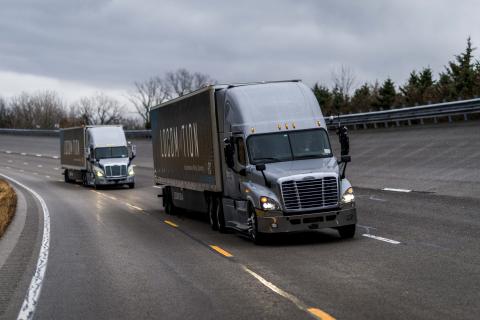
Locomation to test its autonomous truck platforms at Ohio's Transportation Research Center
Locomation, the provider of what it calls the world’s first trucking technology platform to offer human-guided autonomous convoying, has announced a research project with the Transportation Research Center Inc. (TRC) in East Liberty, Ohio.
Alongside TRC’s extensive research and development team, Locomation will actively test at the research center to advance its autonomous truck platforms, in an effort to facilitate more innovation on the testing and validation of the company's autonomy technology.