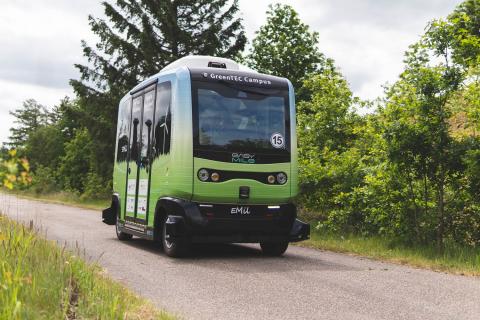
EasyMile and GreenTEC Campus have launched the first Society of Automotive Engineers (SAE) level 4 autonomous driving operation in Germany, on a closed site.
Known as “EMil,” the autonomous shuttle has been operating on the GreenTEC campus in northern Germany for two years. EasyMile and GreenTEC Campus worked with project partners such as EurA AG over the last six months to prepare for the move to level 4 operations.
“We strive to be highly innovative, but also sustainable and green in our ‘Green Valley’. We are therefore proud that we were able to bring this milestone to the north,” says Marten Jensen, managing director of the GreenTEC Campus.
Autonomous Vehicles
Autonomous Vehicles
MDOT-led coalition conducts multi-state automated truck platooning demonstration
On Thursday, Oct. 22, the Smart Belt Coalition (SBC) conducted an automated truck platooning demonstration that began in Pittsburgh and ended in Michigan.
A collaboration between the Michigan Department of Transportation (MDOT), transportation agencies in Ohio and Pennsylvania, and academic institutions in all three states, the SBC partnered with Locomation, the provider of the world’s first trucking technology platform to offer human-guided autonomous convoying, to complete the demonstration. The SBC and Locomation demonstrated the agency coordination and administrative and procedural requirements necessary for a truck platooning system to operate continuously through the three states.

Weekend Roundup: October 16, 2020
This Week in the Unmanned Systems and Robotics World
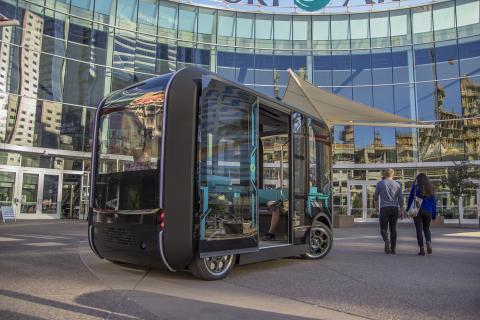
As part of an automated transportation trial in spring 2021, the latest version of Local Motors’ Olli driverless shuttles will begin operating in the city of Toronto next year. Expected to last six to 12 months, the test run will measure how well the autonomous vehicles will bolster Toronto’s mass transit system. (Engadget)
Velodyne Lidar's World Safety Summit on Autonomous Technology to focus on enabling safer mobility via autonomous technologies
Velodyne Lidar’s third annual World Safety Summit on Autonomous Technology (WSS) will take place as a virtual event on Oct. 22 from 9:00 a.m. to 1:00 p.m. PDT.
Featuring a diverse group of experts and thought leaders from industry, government, journalism and academia, the summit will seek to advance understanding about how autonomous technologies can enable safer mobility by addressing safety and autonomy issues in vehicle transportation.

Dr. Cara LaPointe provides an overview of Assured Autonomy, the theme of Xponential 2021
As autonomy and artificial intelligence continue to be integrated into systems across society, making sure these systems work properly continues to be of the utmost importance.
“It’s really important to make sure these systems work like they’re supposed to, but it can be really hard,” says Dr. Cara LaPointe, co-director, Institute for Assured Autonomy, Johns Hopkins University Applied Physics Laboratory.
The goal is to reach a point of assured autonomy, where people can be confident that the autonomous systems around them are, and will, operate the way they are designed to. Reaching this point requires making sure that these systems are safe, secure, resilient and capable of operating within an ecosystem alongside humans and other technologies.

Industry, Navy collaborating to develop highly capable unmanned and autonomous surface ships
When it comes to unmanned and autonomous surface ships, the U.S. Navy will have “a lot” of them “very soon,” says Craig Perciavalle, president of global ship builder and defense prime contractor Austal USA.
“As we talk about autonomy, one thing’s for sure: it’s certainly not a question now if the Navy will have unmanned or autonomous surface ships in the fleet,” Perciavalle says during a session titled “Designing & Constructing Autonomous Naval Ships.” “It’s more a question of when and how many.”
As the Secretary of Defense and the Navy have made it clear that unmanned and autonomous vessels are the future of the Navy, the efforts to bring that vision to reality sooner than later have become a priority.

The winners of the 2020 XCELLENCE Awards
Xponential 2020 host DanRam announced the winners of the 2020 XCELLENCE Awards on Tuesday, Oct. 6.
There were five categories under the Technology & Innovation umbrella. In the category of services, InNovo Partners LLC took first place for its iPaaS - InNovo Platform as a Service, while SqwaQ took second place for its SqwaQbox.
In the category of software, Verity took first place for its Failsafe by Verity, Airbus took second place for its project Wayfinder, and Perceptive Automata took third place for its Bringing Human Intuition to Autonomous Trucks.

Weekend Roundup: October 2, 2020
This Week in the Unmanned Systems and Robotics World
Einride has raised an additional $10 million in venture capital funding. The company believes the funding will be enough to get it to next year, when it can hopefully seek out a bigger round. (VentureBeat)
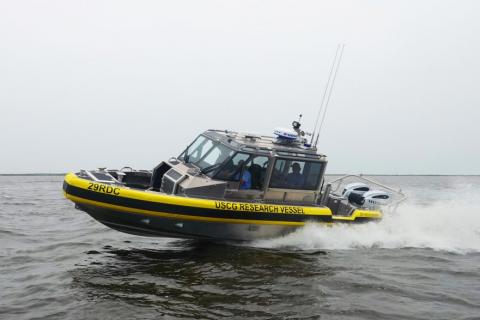
Sea Machines Robotics, Metal Shark Boats to supply USCG's RDC with autonomous vessel for testing
Sea Machines Robotics has partnered with shipbuilder Metal Shark Boats to supply the U.S. Coast Guard (USCG)’s Research and Development Center (RDC) with a new Sharktech 29 Defiant vessel.
Responsible for helping transition innovative technologies and providing premier analysis and decision support to enhance operational performance across all Coast Guard missions, the RDC will use the vessel to test and evaluate the capabilities of available autonomous vessel technology.
Sea Machines SM300 autonomous-command and remote-helm control technology is integrated onto the vessel, providing the USCG with a full range of advanced capabilities, including transit autonomy, collaborative autonomy, collision avoidance and remote vessel monitoring.
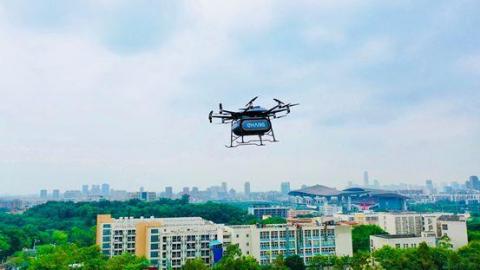
EHang unveils EHang 216L AAV for short-to-medium-haul air logistics
EHang has unveiled the EHang 216L, which is the logistics version of the company's EHang 216 designed for short-to-medium-haul air logistics in both urban and rural areas.
Boasting a payload of more than 440 pounds, which to EHang’s knowledge is the largest for multi-rotor autonomous aerial vehicles (AAVs) for aerial logistics, the EHang 216L opens up more commercial opportunities for the company in various urban and rural short-to-medium-haul aerial logistics use cases that require frequent and point-to-point flight tasks. One example that EHang highlights is in mountainous areas with poor road conditions, the EHang 216L can help boost the local economy by more quickly and efficiently transporting agricultural products.