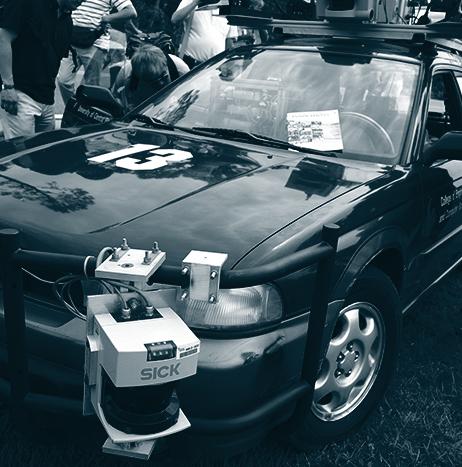
Real-Time Innovations (RTI) has announced that its RTI Connext DDS has been selected as the connectivity framework for NextDroid's self-driving vehicles.
NextDroid, which is an autonomous vehicle and robotics company, is developing a variety of autonomous systems across both the automotive and maritime space, and the company is utilizing RTI's technology as part of a “modular software architecture” that enables real-time processing of different sensor data across a distributed computing platform.
Autonomous Vehicles
Autonomous Vehicles
Weekend Roundup
This Week in the Unmanned Systems and Robotics World
On March 30, China’s unmanned submersible, “Hailong 11000,” completed its first sea test in the western Pacific Ocean. Capable of diving to a depth of 11,000 meters, the vehicle is expected to complete an 11,000-meter-deep sea test in three years, according to the China Ocean Mineral Resources R&D Association. (The State Council of the People's Republic of China)

Microsoft announced as exclusive data and cloud provider for American Center for Mobility during ACM's grand opening
During the grand opening of the American Center for Mobility (ACM) on April 4, it was announced that Microsoft will be the exclusive data and cloud provider for ACM.
In an effort to advance the testing and development of connected and automated vehicles (CAV), as well as mobility technologies, Microsoft will provide ACM with cloud resources and data infrastructure, according to John Maddox, ACM president and CEO.
“We are excited to collaborate with Microsoft in our efforts to lead the world in the safe development of CAV technologies and to enable the safe deployment of these vehicles onto the nation's roads,” Maddox says.

Wilhelmsen and Kongsberg establish Massterly, the 'world's first autonomous shipping company'
Wilhelmsen, which is a global maritime industry group, and Kongsberg have announced the establishment of the “world's first autonomous shipping company,” Massterly.
Wilhelmsen and Kongsberg say that by joining forces to establish Massterly, they are taking the next step in autonomous shipping by offering a “complete value chain for autonomous ships, from design and development, to control systems, logistics services and vessel operations.”
The companies say that Massterly will benefit from the combined 360 years of experience between them, as Kongsberg brings its “unique technological expertise and solutions” to the table, while Wilhelmsen brings its “world-leading experience in logistics and ship management operations” to the table.
G7, GLP and NIO Capital form joint venture to develop autonomous driving electric trucks
Internet of Things (IoT) technology company G7, modern logistics technologies provider GLP, and private equity fund NIO Capital have announced a joint venture that will focus on developing next generation smart heavy-duty trucks powered by “autonomous driving, new energy technologies, logistics big data and exploring innovative models of 'vehicle-as-a-service.'”
The joint venture, which is controlled by G7, is built on “G7's massive real-time data and fleet management capabilities, GLP's open logistics ecosystem and NIO Capital's extensive automotive industry partnership.” The aim of the joint venture is to create the “next generation of smart vehicles for logistics and transportation through cross-industry collaboration.”
Weekend Roundup
This Week in the Unmanned Systems and Robotics World
UAVOS has introduced its new Borey-10 fixed-wing UAS. Among its many capabilities and features, the UAS has a heated battery compartment that allows it to fly in temperatures as low as -22F, and it can fly for four hours, nonstop, with a payload of two pounds. The UAS is also equipped with an EW countermeasure system, which makes it possible to conduct research operations in the absence of GNSS signals. (UAVOS)

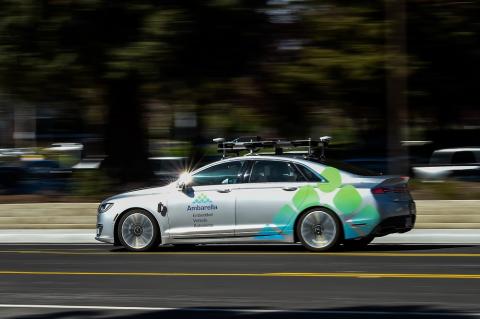
Ambarella testing its fully autonomous EVA vehicle on the roads of Silicon Valley
Ambarella, Inc., which develops low-power, HD and Ultra HD video processing semiconductors, is demonstrating its fully autonomous Embedded Vehicle Autonomy (EVA) vehicle on the roads of Silicon Valley to industry analysts and customers.
Ambarella says that EVA has been trained to handle different traffic scenarios presented by Silicon Valley’s challenging urban environment.
EVA combines software and algorithms based on more than 20 years of autonomous vehicle research with Ambarella’s “low-power CV1 embedded computer vision processors” based on its CVflow architecture.
Weekend Roundup
This Week in the Unmanned Systems and Robotics World
Walmart has reportedly filed a patent for autonomous robotic bees that could potentially pollinate crops like real bees. Technically known as pollination drones, the autonomous robotic bees would carry pollen from one plant to another, using sensors and cameras to detect the crops’ locations. (ScienceAlert)
University of Waterloo partners with Chinese institutions to advance research related to connected and autonomous vehicle technology
In an effort to “advance research in the areas of connected and autonomous vehicle technology,” the University of Waterloo is partnering with the Qingdao Academy of Intelligent Industries (QAII), and the State Key Laboratory for Management and Control of Complex Systems (SKL-MCCS), both of which are institutes in China.
The entities recently signed an agreement to solidify the partnership.
The agreement outlines several initiatives, including faculty and graduate student exchanges, a Waterloo PhD program focused on autonomous vehicles, and the establishment of a shared research center for automated driving.
Magna and Lyft partner to develop and manufacture self-driving systems
Magna, which is a mobility technology company and automotive supplier, and Lyft have announced a multi-year collaboration in which the companies will “jointly fund, develop, and manufacture self-driving systems.” Magna will also invest $200 million in Lyft equity.
As a result of the collaboration, Lyft will lead the co-development of the self-driving system at its Palo Alto-based self-driving engineering center; Magna will lead manufacturing and join Lyft's development team onsite, where it will contribute its vehicle systems knowledge, safety and ADAS expertise, and manufacturing capabilities; and Magna and Lyft will share jointly created IP and utilize Lyft data to improve systems.