
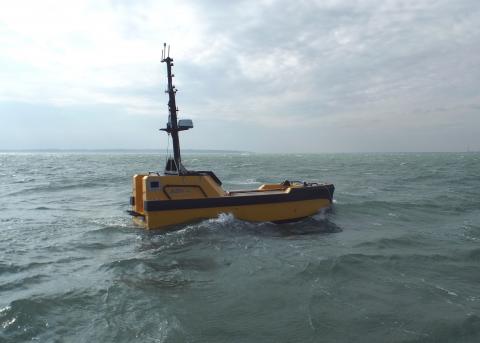
ASV Global has announced that one of its C-Worker 7 class of autonomous surface vessels was successfully deployed for Subsea 7, which is a subsea engineering, construction and services company. The C-Worker 7 was used to support a pipelay operation off the coast of Egypt.
The C-Worker 7, which was equipped with a survey suite made up of a multibeam echosounder and side scan sonar, conducted touchdown monitoring in support of the Seven Antares pipelay vessel.
“The C-Worker 7 has proven to be a very capable vessel providing an excellent stable survey platform controlled by the Pipelay Vessel,” says a spokesperson from Subsea 7.
Autonomous Vehicles
Autonomous Vehicles
Weekend Roundup
This Week in the Unmanned Systems and Robotics World
On Jan. 24, Purdue officials and leaders celebrated the launch of the new Center for Brain-inspired Computing Enabling Autonomous Intelligence (C-BRIC). According to C-BRIC director Kaushik Roy, researchers at the center will work to develop “autonomous intelligent systems capable of reasoning and decision-making to complete mission-critical tasks without human intervention.” (Purdue)

Connecting Cars, Connecting Users: Challenges and Opportunities Offered by Automated Vehicles
Recently a range of diverse companies have launched high-profile automated vehicle programs and have begun describing their implementation plans. As automated vehicles gain traction and garner headlines, complex questions have arisen in the automated vehicles community, some of which were expected and others more surprising.
Innovators are exploring seemingly next-gen possibilities today. Ideas such as driverless delivery, smart roads, and AI are becoming actualities. This webinar will explore these topics and more, as industry leaders discuss their visions for future mobility and what it holds for road users.
Who Should Attend
'DriveOhio' launches, will focus on autonomous and connected vehicle initiatives in Ohio
On Jan. 18, Ohio Governor John Kasich made DriveOhio official with an executive order. DriveOhio is essentially a “one-stop shop for researchers, developers and manufacturers to collaborate on autonomous and connected vehicle initiatives in Ohio.”
The executive order brings together two entities; those that are responsible for building transportation infrastructure, and those that are developing advanced mobility technologies. It provides a “statewide, single point of entry” for companies and innovators to test and build smart mobility technologies together, and, it establishes an “infrastructure for developing and establishing statewide standards and strategic recommendations” in regard to the types and use of technology for deployment, as well as their financing.
Optimus Ride receives approval to carry passengers in autonomous vehicles in Boston
After receiving approval from city officials, Optimus Ride, a developer of self‑driving technologies, will begin using its autonomous vehicles to carry passengers in Boston, according to the Boston Herald.
To start, the vehicles will only carry passengers in the Raymond L. Flynn Marine Park in South Boston, where Optimus is based. Optimus has been talking to other Marine Park-based companies about giving rides and getting feedback from their employees.
Ryan Chin, chief executive officer of Optimus Ride, says that a software company called Autodesk has agreed to take part in the rides.

Weekend Roundup
This Week in the Unmanned Systems and Robotics World
New Jersey state legislators have approved a ban on operating UAS while inebriated. Under the approved legislation, drunk or high pilots would be punished with up to six months in prison or a $1,000 fine. (Gizmodo)
BlackBerry unveils software cybersecurity product that can be used in connected and autonomous vehicles
During a keynote address at the North American International Automotive Show (NAIAS), BlackBerry Limited Executive Chairman and CEO, John Chen, unveiled a “transformational software cybersecurity product” called BlackBerry Jarvis, which is built on BlackBerry’s decades of cybersecurity expertise and proprietary technology.
BlackBerry Jarvis has many potential uses; chief among them, in connected and autonomous vehicles.
Described as a “one-of-its-kind cloud-based static binary code scanning solution that identifies vulnerabilities in software used in automobiles,” Jarvis, in just minutes, scans and delivers deep actionable insights. If done manually, the scanning process would take large numbers of experts and an “impractical amount of time,” according to BlackBerry.
Weekend Roundup
This Week in the Unmanned Systems and Robotics World
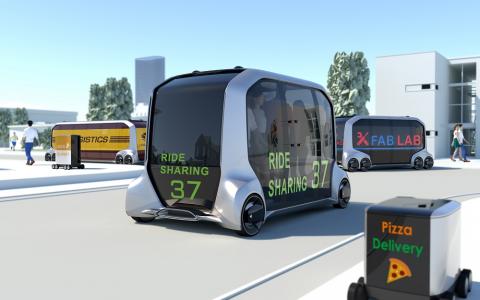
In an effort to “meet the demands of future multi-mode transportation and business applications,” Toyota Motor Corporation President Akio Toyoda announced a new mobility service business alliance and e-Palette Concept Vehicle during CES 2018. The new e-Palette Alliance will utilize Toyota’s proprietary Mobility Services Platform (MSPF) to create a suite of connected mobility technologies and a flexible, purpose-built vehicle. (Toyota)
Robomart unveils its 'self-driving bodega on wheels'
In an effort to bring online produce shopping to people’s front door, a Santa Clara, California-based startup company called Robomart has developed a “self-driving bodega on wheels,” according to Engadget. The vehicle made its debut this week during CES 2018 in Las Vegas.
As part of NVIDIA's deep learning/AI “Inception Program,” Robomart developed this concept, which relies on a Sprinter Van-sized delivery vehicle equipped with a variety of technologies, including a CAN motion control system, and enough route planning and obstacle avoidance software—including LiDAR, radar, and cameras—for it to reach the highest level of autonomy, Level 5.
Samsung introduces DRVLINE platform for autonomous driving market
During CES 2018 in Las Vegas, Samsung Electronics Co., Ltd. introduced its new Samsung DRVLINE platform, which is an “open, modular, and scalable hardware and software-based platform” for the autonomous driving market.
Samsung says that the DRVLINE platform is a valuable technology for automakers because it can “integrate best-in-class technology into new vehicles, while also building a foundation for fleets of the future.”