
This Week in the Unmanned Systems and Robotics World
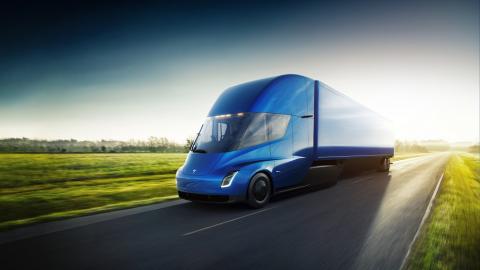
Tesla has unveiled its fully electric semitruck, which is expected to go into production in 2019. The semitruck is equipped with Enhanced Autopilot, the second generation of Tesla's semiautonomous technology, giving it several autonomous capabilities, including automatic braking, lane keeping, and lane departure warnings. (Wired)
Autonomous Vehicles
Autonomous Vehicles
Groundbreaking ceremony launches construction of SunTrax test facility
A groundbreaking ceremony officially launched the construction of SunTrax test facility, which is a long-term partnership between the Florida Department of Transportation (FDOT), Florida’s Turnpike Enterprise and Florida Polytechnic University (Florida Poly) that is centrally located between Tampa and Orlando.
SunTrax includes a 2.25 mile oval track on a 400-acre site in the city of Auburndale, Florida that will be used for, among many things, testing connected and automated technology such as lane departure, and vehicle platooning. The oval track’s construction is scheduled to be complete in spring 2019.
In addition to the oval track, SunTrax will also feature an infield facility, which is being designed as a hub for connected and automated vehicle testing.

Ontario launches Autonomous Vehicle Innovation Network
Ontario, Canada has launched its Autonomous Vehicle Innovation Network (AVIN), which is located in Stratford, Ontario.
Among its many features, which include a Research and Development Partnership Fund, a Talent Development Program and a Central Hub, AVIN has a demonstration zone that is described as “among the first of its kind in Canada.” The demonstration zone will serve as a space for researchers to hone connected and autonomous vehicle (C/AV) technology, and test these vehicles in various every day, real-life traffic scenarios.
Premier Kathleen Wynne officially opened the AVIN Demonstration Zone on Nov. 8, and she thinks very highly about the future of this technology not only in Ontario, but across the globe.
Weekend Roundup
This Week in the Unmanned Systems and Robotics World
Uber and NASA will work together to develop software that Uber hopes to use to manage “flying taxi” routes, which could work in a similar fashion as the company’s current ground-based ride-hailing service that is used across the world. Uber says that it was the first formal services contract by NASA covering low-altitude airspace instead of outer space. (Reuters)

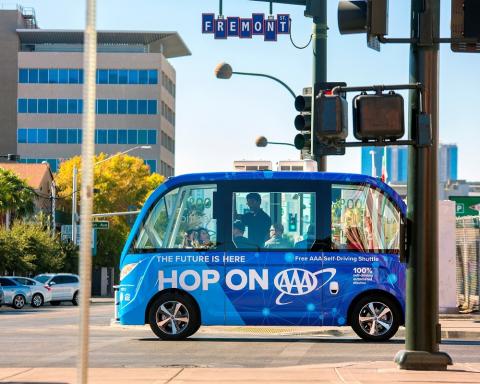
Las Vegas launches first self-driving shuttle pilot project in the United States
On Wednesday, Nov. 8, the nation’s first self-driving shuttle pilot project designed specifically for the public was launched in Las Vegas, Nevada. The pilot project will utilize an autonomous shuttle from Navya.
The goal of the one-year pilot project, which is a result of a partnership between AAA Northern California, Nevada & Utah (AAA), the city of Las Vegas, the Regional Transportation Commission of Southern Nevada (RTC) and Keolis North America (Keolis), is to provide Las Vegas residents and visitors with a first-hand experience of autonomous vehicle (AV) technology, providing many people with their first hands-on experience with the technology.
NAVYA unveils AUTONOM CAB, the company's fully autonomous taxi
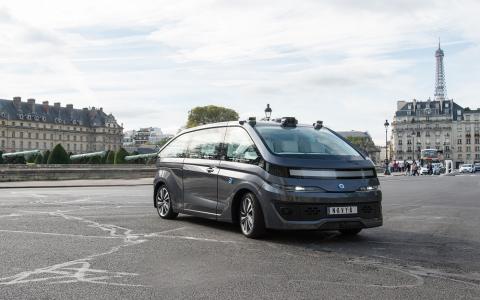
Navya has unveiled its AUTONOM CAB, which is an autonomous, personalized and shared vehicle designed to address the “major challenges urban populations face traveling in and around cities.”
The AUTONOM CAB is equipped with extremely sophisticated multi-sensor technology, with no fewer than 10 Lidar sensors, six cameras, four radars, two GNSS antennae and one inertial measurement unit (IMU). Navya says that these sensors provide “at least a triple redundancy across all functions,” which guarantees exceptional reliability.
Florida's HART and others set to introduce self-driving shuttles to Hillsborough County
The entity responsible for providing public transportation service within Hillsborough County, Florida—the Hillsborough Area Regional Transit Authority (HART)—has selected engineering services company Stantec to provide autonomous mobility services for the Marion Street Transitway, which will result in the “first continuously operated shared autonomous project in the United States that will function in an open environment on public roads with mixed traffic.”
The goal of the project is to document the safety benefits of this kind of service, while seeking to bring Automated Vehicles (AVs) forward within a Connected Vehicle (CV) environment.
From Unmanned Systems Magazine: Robots and Drones: Farm Workers of the Future?
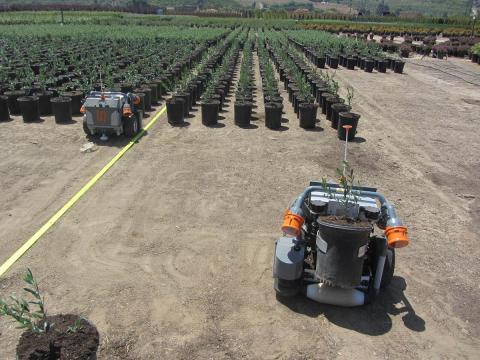
The agricultural industry is experiencing labor shortages in various parts of the United States today, and some growers and producers are turning to robots and drones to help keep their farms and greenhouses viable.
Weekend Roundup
This Week in the Unmanned Systems and Robotics World
Using the company's KnifeFish UUV, which is a mine countermeasure (MCM) UUV, the General Dynamics Mission Systems' Knifefish team has successfully completed contractor trials for the U.S. Navy's Knifefish program. Using buried, bottom and volume type mine-test targets, the UUV operated in multiple mine test target fields at-sea. At various depths, the UUV showcased its ability to detect, classify and identify potential mines that would serve as unique threats to naval vessels operating in a mission area. (PR Newswire)
EasyMile's EZ10 shuttle bus becomes first autonomous vehicle operating in Germany
A German railway company called Deutsche Bahn has welcomed the first autonomous vehicle to the roads of Germany, in the form of EasyMile’s EZ10 shuttle bus.
The EZ10 shuttle bus is currently operating in Bad Birnbach, which is a municipality in the district of Rottal-Inn in Bavaria, Germany.
The vehicle, which has one staff member onboard to take over operation of the vehicle if necessary, will be used on a route that is approximately 700 meters long, from the town center to the thermal baths. Next year, the route will be extended to connect the town center and rail station.