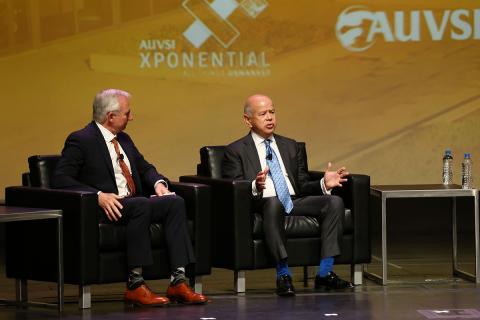
AUVSI has published a 27-page set of comments on the Federal Aviation Administration's Notice of Proposed Rulemaking for remote identification, which would require drones to be able to report their positions, allowing police or other officials to determine who is flying a particular unmanned aircraft.
The issue is seen as enabling the wider use of drones for a variety of services such as package delivery, but the proposed rule has received significant complaints from the hobbyist drone flyers, who say it is too restrictive and would end their hobby. As of the afternoon of March 2, the last day to submit responses, the proposed rule had racked up more than 34,000 comments.
Commercial
Commercial
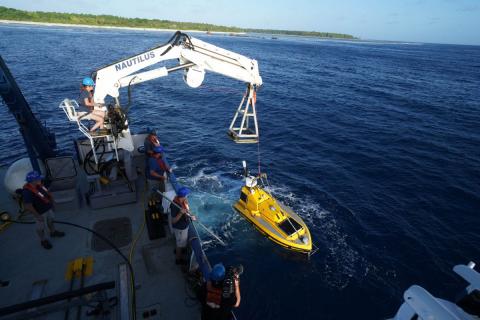
Ballard prepares to head up 'Lois and Clark' expedition to map underwater America
Legendary underwater explorer Robert Ballard is about to embark on perhaps his most ambitious voyage yet — a modern-day version of the Lewis and Clark expedition to map a newly enlarged United States of America.
America doubled in size when Napoleon, forced to pay war debts after losing to England, sold the Louisiana Purchase to Thomas Jefferson for $15 million. He enlisted Meriwether Lewis and William Clark to find out what he had bought.
Advanced aerial mobility holds promise, challenges for US aviation leadership, report says
Advanced aerial mobility — including flying taxis and aerial package delivery — gives the United States a unique opportunity to continue its historic leadership in aerospace, says a new report from the National Academy of Sciences, Engineering and Medicine.
In 2018, NASA, which has been a pioneer of urban air mobility, asked the national academy to review the topic. The academy says while the study was underway, NASA and the aviation community began using the term "advanced aerial mobility," of which urban air mobility was the most challenging part.
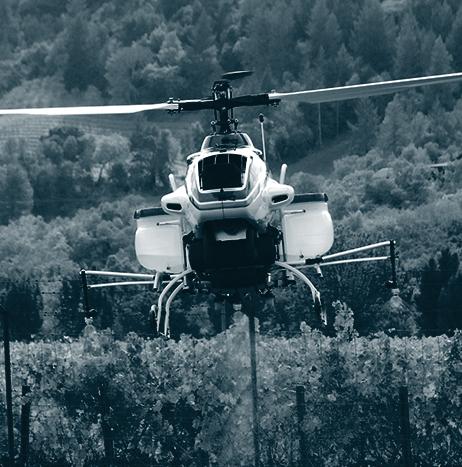
Implementing drones to inspect electric utility wires
It’s plotting a new course to the destination utilities are already sailing to (a proactive condition based asset management) and that this new course or technology is often seen as a disruption first before realizing it as an opportunity.
Q&A with Ilkka Hiidenheimo, CEO, Sharper Shape
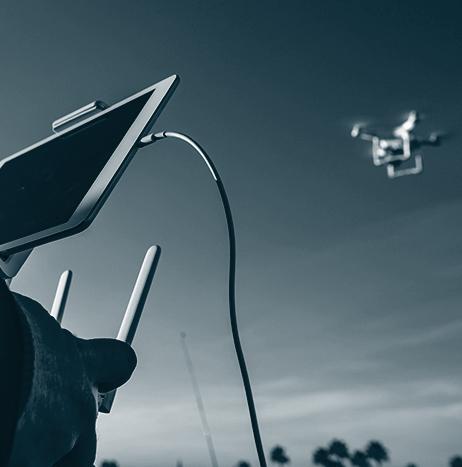
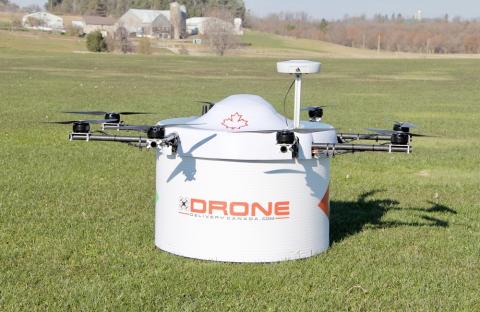
Drone Delivery Canada to establish drone delivery hub at Edmonton International Airport
Drone Delivery Canada (DDC) will establish the
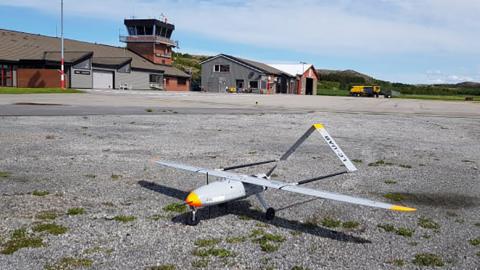
Drone makes long-distance Norwegian coastal flight through civilian airspaces
Norway's Maritime Robotics announced that a Penguin B drone owned by the Norwegian Defence Research Establishment concluded a 200 kilometer flight in June, passing through several different types of controlled civil airspace.
The flight demonstrated a new wireless data link technology using phased array antennas from Radionor Communications, as well as a lightweight transponder on the aircraft, all of which was integrated by Maritime Robotics.
The Penguin B took off from Frøya, on Norway's midwestern coast, and flew north to Rørvik, where its landing was assisted by a crew from the Norwegian University of Technology and Science. The flight took two hours and 12 minutes.
From Unmanned Systems Magazine: The present and future of Commercial unmanned maritime systems
Autonomous and unmanned maritime systems are being used for a plethora of operations commercially.
Unmanned Systems takes a look at some of the companies creating these platforms and the technologies that power them and gets perspectives from industry leaders on how to inspire the next generation of robotic maritime innovators.
Conveying action
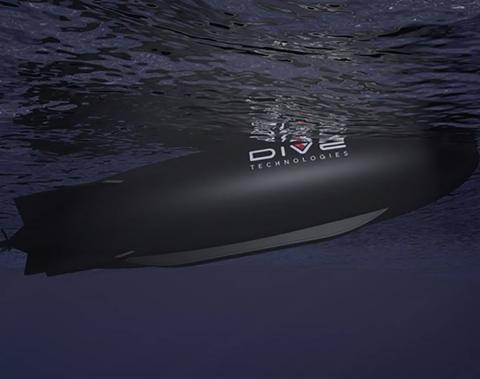
Formed in 2018 by a group of engineers working in the AUV industry, Dive Technologies was launched with the intent of developing a low-cost, large-displacement AUV that could support the emerging needs of commercial and defense customers by being rapidly configured with different payloads and sensors.

From Unmanned Systems Magazine: FAA developing a menu of new rules to oversee the booming unmanned aviation sector
The FAA’s efforts to oversee commercial and recreational unmanned aircraft systems seem to be growing almost as quickly as the industry itself.
With more than 1.4 million UAS now registered with the FAA, a statistic that did not even exist until a few years ago, the agency is pursuing several regulatory and other initiatives to manage the increasing traffic to ensure safe and efficient operations.
“This is a fast-moving industry, and we’re doing our level best to keep up,” then-acting FAA Administrator Daniel Elwell said in a June speech. “The trick is to mitigate safety risks without putting the cuffs on technological and operational advances.”