
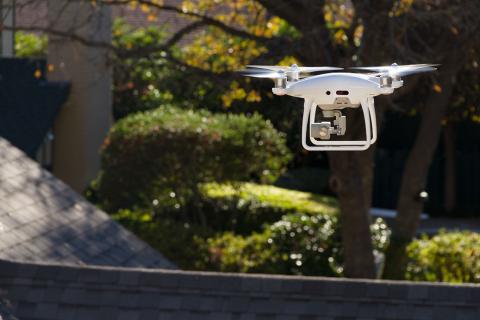
Over the years, drones have proven to be extremely beneficial for the insurance sector, offering safe and efficient tools for companies to use during various tasks.
In 2014, State Farm — a pioneer in the insurance sector for using this technology — began looking at how to use drones for claims. Just a few short years later in Aug. 2017, the company began using drones for real-life claims and hasn’t looked back.
“They’ve definitely provided a tool that we did not necessarily have in the past,” drone pilot Jared Brose tells Unmanned Systems. “They allow us to get out there and get in the air as quickly as possible and handle a claim as quickly as possible.”
Commercial
Commercial


ESAero to support Planck Aerosystems' defense and commercial UAS business through new partnership
Aerospace manufacturer Empirical Systems Aerospace Inc. (ESAero) will support the defense and commercial UAS business of Planck Aerosystems (Planck Aero) through a new partnership between the two companies.
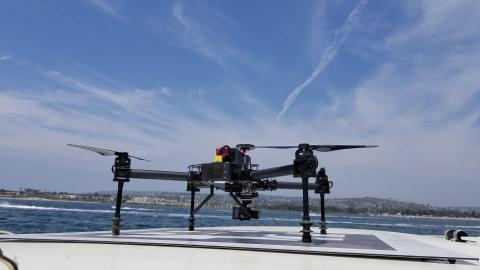
In support of increasing demand across Planck’s customer base, both domestically and internationally, ESAero will manufacture Planck Aero’s Group 1 UAS, Shearwater, in its manufacturing plant in San Luis Obispo, California, which will support Planck’s strategy to scale the company.
The companies note that the Shearwater UAS is the preferred small multi-rotor platform to host the Planck Autonomous Control Engine – ACETM navigation system, which enables the UAS to operate autonomously from moving vehicles and vessels, including vision-based precision landing.
Intelligent Energy launching fuel cell power product for commercial UAS market during Xponential 2019
During Xponential 2019, Intelligent Energy is launching its 2.4-kilowatt fuel cell power product for the commercial UAS market.
Over the last year and a half, Intelligent Energy has launched four products designed specifically for commercial UAS. The company says that these products provide technology to the constraints of battery power, offering minimum downtime and fast refuel, which makes them an attractive option for the commercial UAS market.

Wing launches UAS delivery service in North Canberra, Australia
Wing, a subsidiary of Google’s parent corporation Alphabet, has launched a drone delivery service in North Canberra, Australia.
Through Wing’s service, customers can order a variety of items on Wing’s mobile app, and have them delivered directly to their homes via UAS in minutes.
Boston Dynamics acquires robotics company Kinema Systems
Boston Dynamics recently acquired Kinema Systems, a company that uses deep learning technology to enable industrial robotic arms to locate and move boxes on complex pallets.
Kinema Systems’ initial product, Kinema Pick, uses a combination of vision sensors and deep learning software to work with commercial robotic arms to move boxes off pallets to conveyors or build stacks of boxes on pallets.
With Kinema Systems’ Pick technology, logistics, retail, and manufacturing companies “achieve high rates of box moving with minimal set up or training for both multi-SKU and single-SKU pallets,” Boston Dynamics says.
NUAIR and Measure partner on efforts to safely integrate UAS into national airspace system
The Northeast UAS Airspace Integration Research Alliance (NUAIR) has signed a collaboration agreement with aerial intelligence company Measure.
In support of NUAIR’s mission to safely integrate UAS into the national airspace system, Measure will work with NUAIR to bring its commercial operations to the region.
NUAIR and Measure say that their partnership will enhance commercial support inspections, public operations and consulting capabilities at the New York UAS Test Site at Griffiss International Airport.
From Unmanned Systems Magazine: VR training offers cost savings, safety benefits
When Amir Rubin was first exposed to virtual reality in 1994, the graphics were primitive at best. The device, if one could call it that, was large, cumbersome, and involved an unruly nest of cables and wires.
Still, the engineer and former soldier could not help but react enthusiastically to the potential of the technology he witnessed.
“It was very complex, and lower quality than anything [most people today] have seen,” says Rubin.
Nevertheless, he describes himself as “hooked” as soon as he put the headset on.