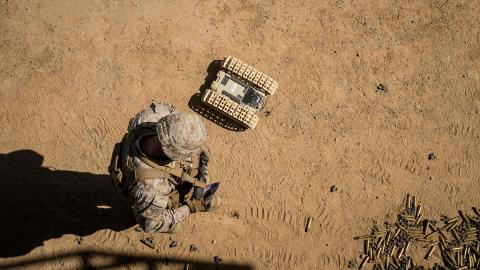
Ground
Ground


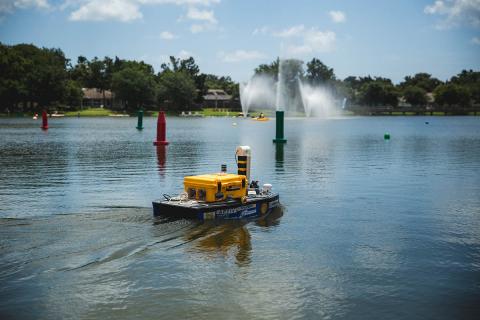
Hundreds of teams from around the globe go robot to robot in 2018 RoboNation competitions
Three hundred and fifty teams. Forty-four countries. Seven competitions. One community.
After spending an entire year or more working tirelessly to create robotic vehicles, teams from all over the world attempted one or more of the seven competitions sponsored by RoboNation, the new name of the former AUVSI Foundation. Not only were these students in school while they worked on their projects, many had jobs and internships, on top of finding the time and resources to build a successful system.
AeroVironment and GD partner to integrate UAS and tactical missile systems with armored ground combat vehicles
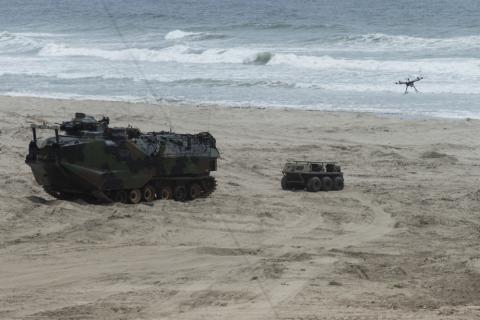
AeroVironment Inc. has announced a new strategic relationship with General Dynamics Land Systems (GD) to produce “highly integrated and effective” tactical UAS and tactical missile systems (TMS) for armored ground combat vehicles.
“By integrating the leading small tactical UAS and loitering missile systems with the leading armored combat vehicles, our team will deliver a new level of battlefield lethality, survivability and combat effectiveness to protect and enable the warfighter,” explains Kirk Flittie, vice president and general manager of AeroVironment’s UAS business.


From Unmanned Systems Magazine: Interoperability efforts are changing the way robots are used in the field
During the more than 17 years of continuous warfare in Iraq and Afghanistan, improvised explosive devices (IEDs) have proven to pose the most serious threat to service members stationed in combat theaters. Mitigating this threat, as such, has emerged as a primary mission for engineering and design teams in both industry and the U.S. Department of Defense.
Additionally, research teams are well aware of the utility UAS can provide in the intelligence, surveillance and reconnaissance (ISR) realm. Perimeters of harbors and land-based installations can be monitored and kept clear of obstacles and potential threats — without placing human lives in harm’s way.
Endeavor Robotics to supply U.S. Marine Corps with its Firstlook 'throwable' robots
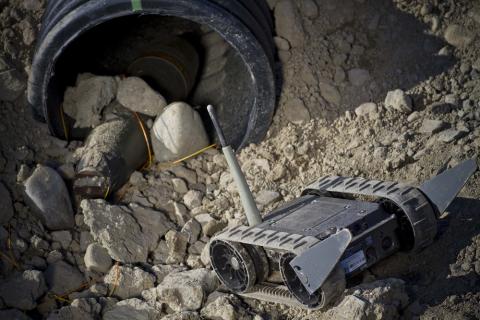
The U.S. Marine Corps has awarded Endeavor Robotics a $10 million contract for its “lightweight, battle-proven” FirstLook robots.
Weighing in at five pounds, the ‘throwable’ FirstLook robot can be dropped roughly 20 feet onto concrete without sustaining damage. The robots are typically used to clear buildings, detect IEDs, and are also a top choice for confined spaces like caves, tunnels and crawl spaces.
More than 1,000 FirstLook robots have been fielded across the world to military, law enforcement and industrial customers.
Colorado’s energy, attributes attract unmanned systems industry
When Canada’s Aeryon Labs decided to set up a separate defense-focused company so it could work with the U.S. military on unmanned systems programs, it quickly settled on Colorado — and specifically Denver — as home for the new Aeryon Defense, which just launched on Feb. 1.
Tom Jackson, a retired U.S. Marine Corps officer and AH-1W Super Cobra pilot who is the company’s vice president and general manager, was already in the area, as were other employees who formed the nucleus of the new venture.
Beyond that, however, the state and city offered some unique attributes. Colorado is very centrally located, so it’s easier for the company to support multiple time zones and for company officials to travel to defense facilities around the country.

From Unmanned Systems Magazine: Third Offset: How can the military take advantage of industry work on plug-and-play systems?
In a perfect world, the U.S. military would have a fleet of plug-and-play unmanned ground vehicles that would be simpler to operate and support than the current fleet of thousands of small and medium-size UGVs, which has a variety of logistics trains and electronic architectures. The current fleet works well, but it was fielded quickly without a long-term plan to meet urgent needs, like countering roadside bombs.