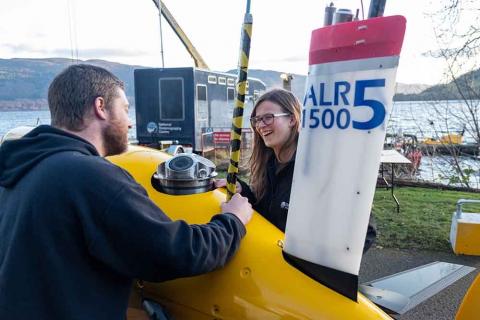
A joint project led by Sonardyne International Ltd., with partners the National Oceanography Centre (NOC) and L3Harris, has set “new standards in long-endurance underwater navigation and automated subsea positioning,” according to the entities.
One of the main goals of the two-year, £1.4 million Precise Positioning for Persistent Autonomous Underwater Vehicles (P3AUV) project was to integrate existing and emerging technologies to deliver a “step-change” in unmanned platform endurance and navigational precision.
The project also sought to use USVs to increase the use of autonomy in offshore survey positioning operations, which ultimately reduces risk to personnel, environmental impact and operating costs.
Maritime
Maritime
Fugro completes first deepwater AUV site survey for Brunei Shell Petroleum Company Sdn Bhd
Geo-data specialist Fugro has announced that in August, it successfully completed the first deepwater AUV site survey for Brunei Shell Petroleum Company Sdn Bhd (BSP).
The survey was completed using a dedicated geophysical survey vessel called the Fugro Equator and the Fugro ES-V AUV in water depths of 600 meters. There were no HSSE incidents during the operations.
According to Fugro, the survey results will be crucial for planning a safe drilling program, as they provide engineering and design studies with key inputs for pipeline routing and subsea structures in future deepwater field developments.

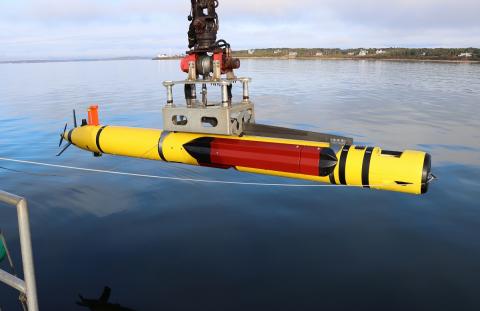
Hydroid equips REMUS 600 UUV with HISAS 2040 module for customer
Hydroid Inc. has announced that it equipped a REMUS 600 UUV with the Kongsberg High-Resolution Interferometric Synthetic Aperture Sonar (HISAS) 2040 for a customer.
According to Hydroid, the integration of the in-mission processing allows for the quick download of high-resolution images from the HISAS module once the vehicle returns from its mission.
“The integration is the first of its kind at Hydroid, allowing faster processing of data to shorten post-mission analysis timelines,” says Duane Fotheringham, president of Hydroid.
“We’re excited to offer this as an option to customers who have time-sensitive missions but also need the high-resolution data of the HISAS module.”
Mikros Systems awarded SBIR Phase I contract to develop software for USVs and UUVs
The Naval Sea Systems Command has awarded advanced technology company Mikros Systems Corporation a $150,000 Small Business Innovation Research (SBIR) Phase I contract for topic number N193‑A02: “Unmanned Surface Vehicle (USV) and Unmanned Underwater Vehicle (UUV) Autonomous Behavior Development.”
Through this contract, Mikros Systems will develop a Sensor In-stride Diagnostic, Correction, and Confidence Component (SID3C) that can be installed on current and future USV and UUV vehicle platforms. SID3C will monitor shipboard sensors and sensor data to detect degradation or failures and correct recoverable sensors. The component will also help autonomy systems appropriately filter unreliable sensor data.

Ocean Infinity tests battery technology for AUVs
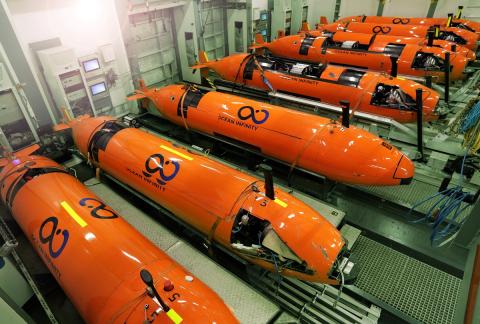
Following 18 months of research, development and trials, Ocean Infinity has tested new, advanced battery technology for AUVs.
Ocean Infinity says that its new 6000 meter pressure tolerant batteries provide the company’s HUGIN AUVs with greater endurance and efficiency, allowing missions to be conducted across a period of more than four days without having to change the battery.
In combination with Ocean Infinity’s multi-AUV operation, the technology also increases the possible survey range to nearly 700 kilometers per AUV, providing the industry with a “revolutionary survey platform offering,” according to the company.
European Maritime Safety Agency extends contract for Schiebel's Camcopter S-100 UAS
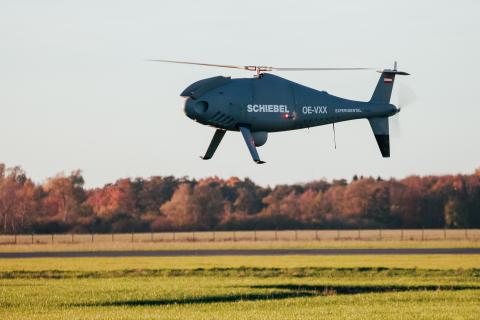
The European Maritime Safety Agency (EMSA) has extended the contract for Schiebel’s Camcopter S-100 UAS to the end of the year after two months of successful maritime surveillance services for the Ministry of the Sea, Transport and Infrastructure of the Republic of Croatia.
Based on the Croatian island of Brač, EMSA’s Camcopter S-100 performs regular day and night patrolling flights, on-demand incident monitoring missions and specific inspection operations.
Thus far, the UAS, which is equipped with Harris L3 Wescam Electro-Optical / Infra-Red (EO/IR) camera, an Overwatch Imaging PT-8 Oceanwatch payload and an Automatic Identification System (AIS) receiver, has completed 67 missions and 210 flight hours during two months of maritime operations.
Hydroid integrating Seaglider AUV Division into its organization
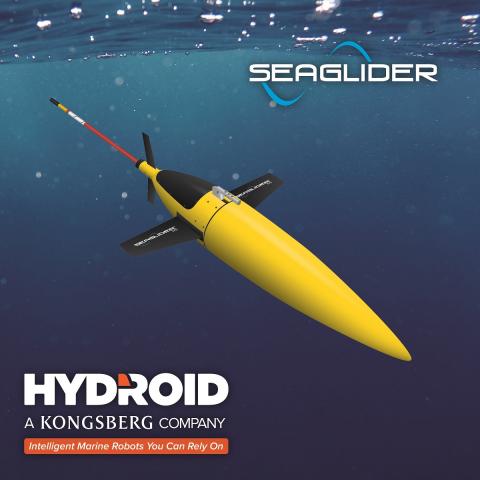
Kongsberg Maritime subsidiary Hydroid Inc. has announced the integration of the Seaglider AUV Division into its organization.
Seaglider is being transferred from Kongsberg Underwater Technology Inc. (KUTI), which will allow Hydroid to utilize complementary technologies and markets across the REMUS and Seaglider product lines.
With the integration of Seaglider into Hydroid, the range of technical solutions and program management support that can be offered to customers also increases.
Sofar Ocean Technologies unveils Strider ASV
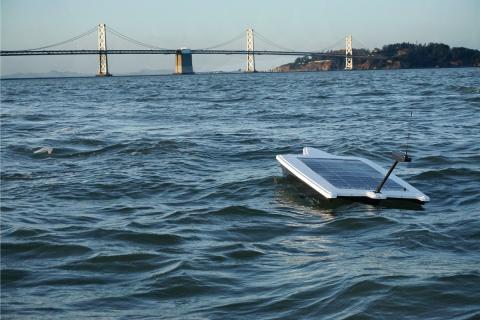
Ocean drone and sensor manufacturer Sofar Ocean Technologies has unveiled its new autonomous surface vehicle (ASV), Strider, which is designed to make ocean data collection more accessible.
Built to operate in coastal, near-shore and inland waters, the Sofar Strider can operate autonomously or remote-controlled through the internet—while integrating with a variety of sensors—thanks to the combination of autonomous navigation, solar power, and a modular design.
The ASV supports customizable payloads, and it is capable of collecting real-time video from above and below the waterline.
From Unmanned Systems Magazine: The present and future of Commercial unmanned maritime systems
Autonomous and unmanned maritime systems are being used for a plethora of operations commercially.
Unmanned Systems takes a look at some of the companies creating these platforms and the technologies that power them and gets perspectives from industry leaders on how to inspire the next generation of robotic maritime innovators.
Conveying action
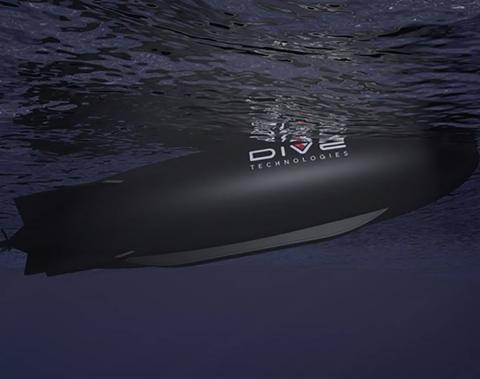
Formed in 2018 by a group of engineers working in the AUV industry, Dive Technologies was launched with the intent of developing a low-cost, large-displacement AUV that could support the emerging needs of commercial and defense customers by being rapidly configured with different payloads and sensors.
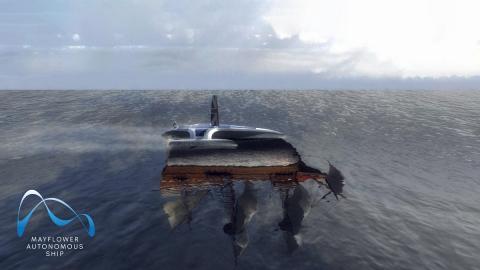
Mayflower Autonomous Ship to utilize IBM AI and other tech to autonomously cross Atlantic
Led by marine research organization ProMare, a global consortium of partners is building an unmanned, fully-autonomous ship that will cross the Atlantic on the fourth centenary of the original Mayflower voyage in September 2020.
IBM has joined that consortium, and the Mayflower Autonomous Ship (MAS) will utilize IBM’s artificial intelligence (AI), most powerful servers, cloud and edge computing technologies to autonomously navigate and avoid ocean hazards as it travels from Plymouth, England to Plymouth, Massachusetts.
If the voyage proves successful, MAS will be one of the first self-navigating, full-sized vessels to cross the Atlantic Ocean.