Sea Machines Robotics and the U.S. Department of Transportation’s Maritime Administration (MARAD) have entered into a cooperative agreement to showcase how Sea Machines’ autonomous technology can be used to increase the safety, response time and productivity of marine oil-spill response operations.
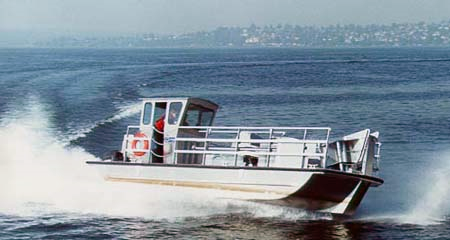
On-water exercises will be conducted once Sea Machines equips a Marine Spill Response Corp. (MSRC)-owned MARCO skimming vessel—manufactured by Kvichak Marine Industries—with its SM300 autonomous-command system. Sea Machines will train MSRC personnel on how to operate the system.
Maritime
Maritime
EMILY USV saves four swimmers at Oregon beach
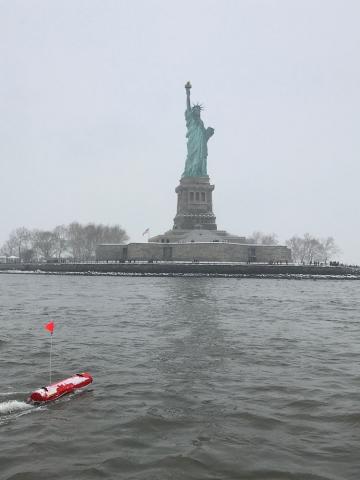
The Emergency Integrated Lifesaving Lanyard (EMILY) USV was recently used to rescue four swimmers from the ocean at Rockaway Beach in Oregon, according to KGW.com.
After training with the USV for about a year, the Rockaway Fire Department deployed EMILY for the first time on Monday, July 8, to save two young boys and their family members that tried to rescue them.
From Unmanned Systems Magazine: U.S. Navy wants to boost unmanned systems on the surface, underwater to meet challenges
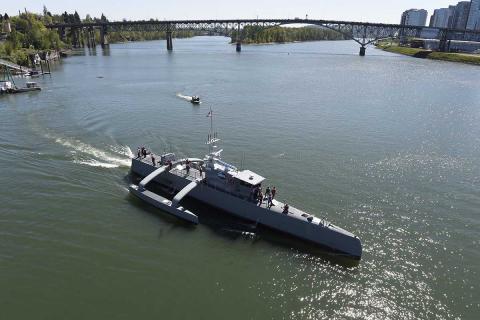
U.S. Navy leaders want to move promptly to the widespread use of unmanned surface and undersea vehicles to bolster its manned fleet, citing the growing threat of a new and complex international environment in which China, Russia and other countries are increasingly using commercial technology to gain military advantage.
The Navy sees its projected new vehicles, and a network that would link them, as helping to allow appropriate responses to nearly any maritime challenge, and thus ensure American naval superiority — but the major investment and fast pace it recommends have prompted questions from Congress and other parties.
From Unmanned Systems magazine: Fiscal 2020 defense budget request includes billions for unmanned systems
In March, the White House released a fiscal 2020 defense budget request totaling $718.3 billion, which it said would invest in space and cyber warfighting domains, modernize air, maritime and land domains, innovate more rapidly to strengthen the nation's competitive advantage, and sustain the forces and readiness.
As part of the request, the services release budget estimates that detail unclassified procurement and research, development, test & evaluation (RDT&E) efforts.
UAV Navigation announces autopilot for USVs and ASVs
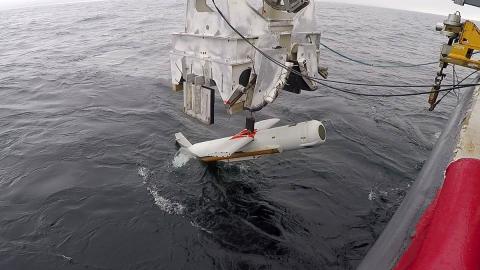
UAV Navigation has announced that it has developed an autopilot for USVs and ASVs.
Designed to comply with IP66—which means that it can work in humid conditions, including salt spray and saline environments—UAV Navigation’s autopilot is capable of completely autonomously controlling a USV mission from beginning to end.
According to UAV Navigation, all of the advanced features available for UAS can be used by USV operators, including multiple waypoints, multiple onboard mission plans, and no-go zones.
One of the most useful features of the autopilot, according to UAV Navigation, is ‘relative routes,’ which is the ability to install the Ground Control Station (GCS) on a moving ship, and then to fix a mission plan relative to the moving vessel.
BAE Systems purchases key assets of Riptide Autonomous Solutions
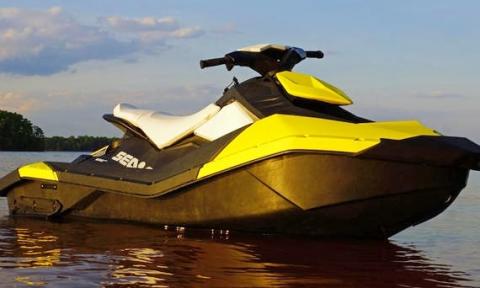
BAE Systems Inc. has purchased the key assets of Riptide Autonomous Solutions, which develops affordable UUV technology and platforms.
With a specialty in small UUVs, Riptide’s UUVs are described as “sophisticated yet simple, efficient, and highly flexible,” and offer “performance discriminators within this domain” that include greater depth, range, endurance, and speed.
“Adding Riptide's technological capabilities will position us to provide customers unmatched flexibility by offering a family of UUVs and integrated payload solutions capable of supporting a variety of critical missions,” says Terry Crimmins, president of BAE Systems Electronic Systems.

Sonardyne acquires maritime software and equipment specialist EIVA
Sonardyne International Ltd. has announced that it has acquired maritime software and equipment specialist EIVA A/S, marking the latest step in the company’s long-term growth strategy.
“We are committed to a sustainable future for Sonardyne, which includes investing in complementary technologies and enterprises that supplement our core expertise in underwater communications, navigation, monitoring and imaging systems,” says Simon Partridge, Sonardyne’s strategy director.
Sea Machines Robotics bringing autonomous capabilities to commercial vessels
Sea Machines Robotics has partnered with workboats manufacturer Hike Metal to integrate its SM300 autonomous vessel control system aboard commercial vessels used for search-and-rescue (SAR) missions.
According to Sea Machines, the collaboration will “help develop and demonstrate the capabilities of autonomous marine technology for the purposes of increasing the productivity and safety of SAR operations.”

Cellula Robotics equipping its new UUV with technology from Sonardyne
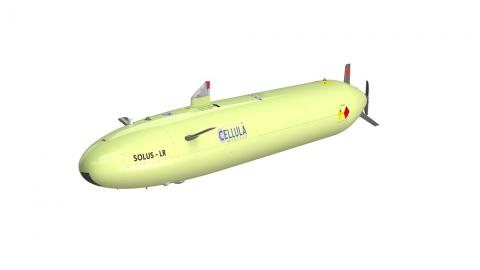
Sonardyne Inc. has announced that its integrated navigation, positioning and communications technology will support Cellula Robotics’ new, fuel cell-powered long-range UUV, which is being designed for the Canadian defense department.
Known as Solus-LR, the UUV is being designed to be able to travel up to 2,000 kilometers, and stay submerged for missions stretching months at a time with support from an onboard fuel cell power pack.