
Over a three-week period this summer, FlightWave Aerospace participated in the “Exploring Fronts with Multiple Robotics expedition,” as part of a high-tech research mission in the Pacific Ocean, approximately 1,000 miles west of Southern California in an area called the Subtropical Front.
UAS
UAS

Braille Battery completes test trials for its customized lithium batteries for commercial UAS applications
Braille Energy Systems Inc. has announced the completion of Braille Battery’s test trials for its customized lithium batteries for commercial UAS applications such as Aerial LiDAR surveys, Aerial Photogrammetry and other Aerial Inspections.
According to Braille, the trials showed that Braille Battery batteries provide longer discharge cycles—with a lot less weight—than the incumbent battery.
Braille Battery is “extremely pleased with the results of its trials and the achievement of meeting another key milestone,” especially with the commercial UAS market projected to grow steadily in the upcoming years.

NSWC PHD and Aerial Alchemy looking into using UAS to enhance maintenance and fleet readiness for U.S. Navy
Naval Surface Warfare Center, Port Hueneme Division (NSWC PHD) and industry partner Aerial Alchemy are working together to research and investigate the use of UAS to enhance the U.S. Navy’s maintenance and fleet readiness.
The UAS are capable of visually capturing the exterior surface of naval ships, and this data could then be used to develop 3D digital models, to ultimately identify damage, corrosion, and alignment issues.
“Collaboration is key to rapidly increasing the lethality of our Navy,” says NSWC PHD Commanding Officer, Capt. Ray Acevedo, via the Defense Visual Information Distribution Service.
Weekend Roundup
This Week in the Unmanned Systems and Robotics World
Kespry has released the pulp and paper industry’s first UAS-based aerial intelligence platform. According to Kespry, the platform delivers more accurate and timely supply chain material inventory data, while improving site operations and safety. (Kespry)
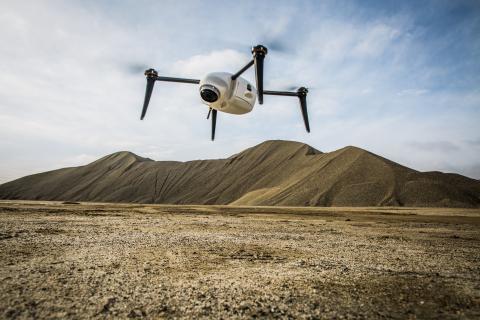
3DR and Yuneec establish 3DR Government Services based on Dronecode platform
Two founding members of the Dronecode software consortium, 3D Robotics (3DR) and Yuneec, have established a US-based joint venture known as 3DR Government Services to bring new products based on the Dronecode platform to market.
With a focus on serving the security and open platform needs of US government customers and their vendors in construction, engineering, and public safety, 3DR Government Services will combine Yuneec’s UAS expertise and manufacturing scale with the capabilities offered by 3DR’s software.
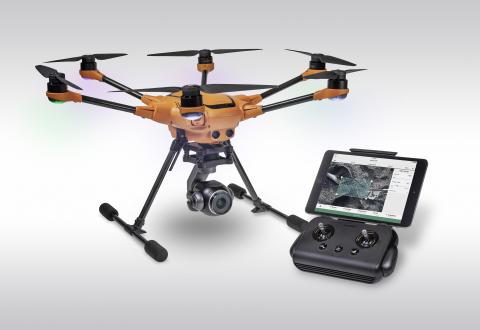
Persistent Systems' Embedded Module receives new security validation from NIST
Persistent Systems’ Embedded Module, which is a low-size, -weight and -power mobile ad hoc networking (MANET) unit for sensors and unmanned vehicles, has received a Federal Information Processing Standards (FIPS) 140-2 Level 2 security validation from the National Institute of Standards and Technology.
Persistent says that the achievement confirms that all of its main products have achieved this level of validation, which in turn increases usability for users with nonnegotiable requirements for FIPS 140-2 Level 2.
With this new FIPS 140-2 Level 2 validation, the Embedded Module meets its Level 1 cryptographic data security requirement. It also has in place physical security mechanisms—such as tamper-evidence—that allow it to handle sensitive data transmission.
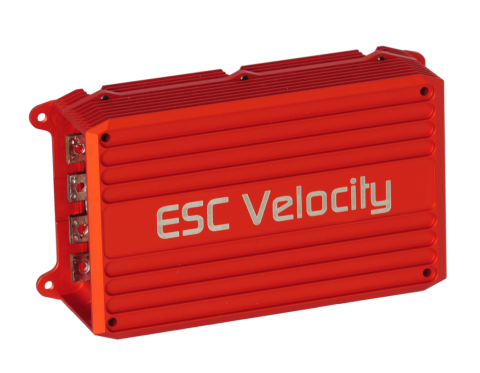
Currawong Engineering's 18S ESC Velocity for UAS applications receives updates
Currawong Engineering has released its updated 18S ESC (electronic speed controller) Velocity, which features the addition of “true hardware interlock and fully isolated PWM input” to its existing design.
Featuring high power and aerospace grade reliability, the ESC Velocity is designed for UAS applications.
According to Currawong Engineering, true hardware interlock is the “ultimate in operator safety,” as it provides guaranteed motor shutdown without the need for bulky inline power switches. CAN communications operate independently of the interlock, which allows for preflight checks with absolute confidence in the safe status of the controller.
Altiscope releases 'Blueprint for the Sky: The Roadmap for the Safe Integration of Autonomous Aircraft'
Altiscope, which is the Unmanned Traffic Management (UTM) group from A³ by Airbus, has released “Blueprint for the Sky: The Roadmap for the Safe Integration of Autonomous Aircraft.”
The Blueprint represents months of careful analysis by Airbus of the future needs for the airspace, the widespread impact of the upcoming changes to the airspace, and the development of the required tools for its enablement.

Weekend Roundup
This Week in the Unmanned Systems and Robotics World
According to China’s National Enterprise Credit Information Publicity System, Waymo has established a subsidiary in China. Known as Huimo Business Consulting, the subsidiary, based in Shanghai, has a business scope that includes autonomous driving parts and product design, testing and other related services, to name a few. (China Money Network)
Boeing to build U.S. Navy's first operational carrier-based unmanned aircraft
On Aug. 30, the U.S. Navy awarded Boeing an $805 million contract to build the Navy’s first operational carrier-based unmanned aircraft, the MQ-25 aerial refueler, selecting the company over bids from Lockheed Martin and General Atomics.
Boeing was awarded the engineering and manufacturing development contract to provide an initial four aircraft.
“As a company, we made an investment in both our team and in an unmanned aircraft system that meets the U.S. Navy’s refueling requirements,” says Leanne Caret, president and CEO, Boeing Defense, Space & Security.