Echodyne has received FCC certification for its EchoFlight radar, which is an airborne detect and avoid radar designed to be integrated into a wide-variety of UAS platforms, and also provides “unprecedented combination of C-SWaP, range, and accuracy.”
According to Echodyne, the EchoFlight radar is a “significant step forward for UAS mission safety,” especially for organizations seeking authorization to operate beyond visual line of sight (BVLOS) or autonomously.
“Echodyne is excited to receive authorization from the FCC and to make EchoFlight available to the many interested UAS partners in the US,” says Eben Frankenberg, CEO of Echodyne.
UAS
UAS
Pollen Systems unveils 'drone-aided managed service and self-service portal'
Pollen Systems Corporation has unveiled a “drone-aided managed service and self-service portal” called Pollen Scout, which helps farms and vineyards monitor crop growth, discover irrigation issues, and investigate pests and diseases.
Every week, commercially certified UAS technologists go to subscribing farms and vineyard sites and capture detailed pictures and spectral images using UAS. These pictures and images can help farmers quickly uncover and address common issues, ultimately helping improve crop yield and quality.
Pollen Systems unveiled Pollen Scout during the Woodinville, Washington annual Auction of Washington Wines, which provided a perfect venue to launch the company, and communicate with potential customers.

Boeing completes synchronized UAS flight tests using new technology
Boeing has successfully completed the first suite of synchronized UAS flight tests using new on-board autonomous command and control technology developed by Boeing Australia.
During the test flights, which were conducted at a regional Queensland airfield, five UAS test beds equipped with Boeing’s new on-board system safely completed “in-air programmed missions” as a team without input from a human pilot.
The milestone comes six months after the establishment of Boeing's largest international autonomous systems development program in Queensland.
Army Research Laboratory and Bell Helicopter seek to advance development of micro UAS
In June, researchers from the U.S. Army Research Laboratory (ARL) and Bell Helicopter met to further advance the development of a micro UAS.
Described as a “miniature, lightweight reconnaissance vehicle,” the UAS is designed to be carried onto the battlefield by soldiers, and deployed in a confined space.
The relationship between Bell and ARL has roots dating back to November 2016, when Bell representatives attended ARL's open campus event. The two entities spent a year and a half building their relationship and sharing information before signing a five-year cooperative research and development agreement (CRADA) in March 2018.
Colorado Springs Police Department prepares to launch UAS fleet
The Colorado Springs Police Department (CSPD) in Colorado Springs, Colorado is preparing to launch its fleet of UAS.
The department has purchased eight UAS—DJI Mavics, Phantom 4s, and a larger and more expensive Inspire 2—which will be used for everything from documenting accident scenes to finding a fugitive on the run.
One of the Phantom UAS will include an infrared camera for nighttime operations, when officers are most at risk.
Danville Community College launches UAS program
Danville Community College (DCC) in Danville, Virginia recently launched a new UAS class.
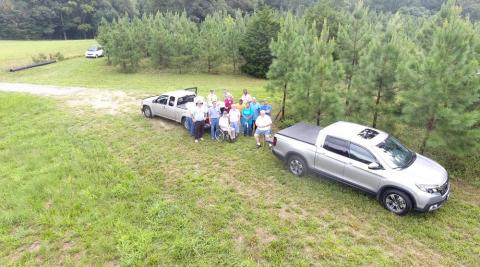
On Friday, August 10, DCC Instructor Steven Carrigan conducted a three-hour introductory training session at the college with 12 students. On Saturday, August 11, the students participated in the hands-on portion of the course at a remote site in Pittsylvania County, Virginia.
While instructing the students, Carrigan was joined by several Certified 107 Pilots volunteering their time, who helped teach students the dos and don’ts of operating UAS.
Weekend Roundup
This Week in the Unmanned Systems and Robotics World
Last week, the City of San Diego, along with Cape, a company that builds software that unlocks the “true potential of drones,” completed a public UAS deployment, marking the city’s first UAS Integration Pilot Program (IPP) demonstration by the San Diego Fire Department. The event began with a live public safety demonstration in which Cape and the San Diego Fire Department used Cape's Aerial Telepresence platform during a simulated fire call. (The Drive)
Swift Engineering uses Swift020 UAS for forestry mission in Japan
Swift Engineering, which provides products, technologies and “fully integrated product development solutions from ideation to market,” recently flew its Swift020 UAS over densely forested areas within the Ishikawa prefecture in Japan.
Swift Engineering worked with a number of entities to complete the flights from July 23 to 25, including the local forest cooperative association, key forestry industry leaders and members of the Ishikawa Prefecture Research Center for Agriculture and Forestry.
Kentucky's Georgetown Police Department finds unique ways to utilize UAS
After purchasing a UAS from Atlanta-based Sky Fire Consulting in April 2017, the Georgetown Police Department (GPD) in Georgetown, Kentucky has found a number of unique use cases for its UAS.
Among those use cases, the UAS has been especially helpful in tracking lost citizens and locating fleeing suspects and stolen vehicles.
The UAS, which shows streets using satellite maps, and is equipped with a camera, was purchased after a large number of vehicle break-ins were being reported. Thus far, it has helped the department detect suspects involved in the crimes.
Winnipeg Fire Paramedic Service deploys new UAS for first time
The Winnipeg Fire Paramedic Service (WFPS) in the city of Winnipeg, Manitoba, Canada recently deployed its new UAS for the first time to assist with the assessment of a fire and later, the detection of hot spots.
“With the drone’s help, the commander of the scene was better able to critically assess the dangers of this fire and direct the crews to target the fire in a more efficient manner,” explains Assistant Chief Jay Shaw.
“This is a great example of how our department is using technology to increase safety for our crews and also create better outcomes for citizens.”