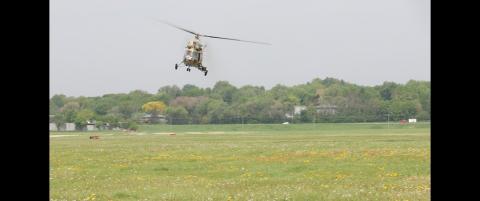
Engineers at the California Institute of Technology (Caltech) have developed a new control algorithm that allows a single UAS to herd an entire flock of birds away from the airspace of an airport.
The project was inspired by the 2009 "Miracle on the Hudson," when US Airways Flight 1549 struck a flock of geese shortly after takeoff and forced pilots to land the plane in the Hudson River off Manhattan.
“The passengers on Flight 1549 were only saved because the pilots were so skilled,” says Soon-Jo Chung, an associate professor of aerospace, and the principal investigator on the drone herding project.
UAS
UAS
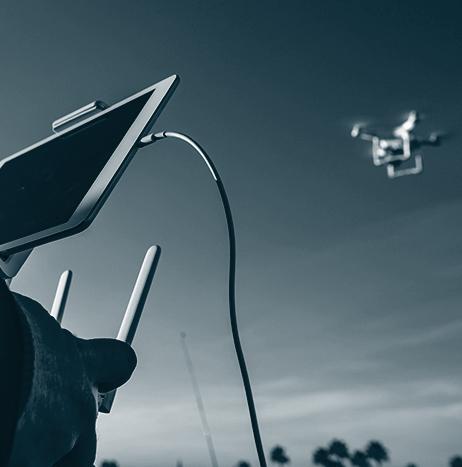
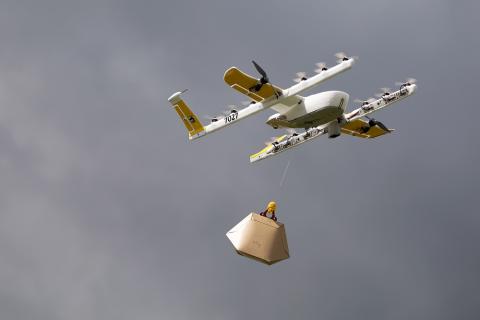
Wing completes landmark UAS package delivery in Montgomery County, Virginia
On Tuesday, August 7, Wing, a subsidiary of Google’s parent corporation Alphabet, completed a landmark UAS package delivery in Montgomery County, Virginia.
After a woman hit order on a mobile app, Wing’s UAS traveled 1.4 miles and delivered a package of ice cream and other frozen treats to a Montgomery County residence in less than 10 minutes.
A two-year-old child retrieved the cardboard box, completing the “most advanced drone package delivery to ever occur in the United States,” according to those who conducted the operation.
Pierce Aerospace receives USAF SBIR award for its remote identification system for UAS
Pierce Aerospace has received a U.S. Air Force Small Business Innovation Research Grant award for its work on Flight Portal ID, a remote identification system for UAS.
According to Pierce Aerospace, Flight Portal ID has received international attention for its “sensible approach” to solving the industry challenges of identifying UAS, including its recognition by the International Civil Aviation Organization last fall.

RADA receives $4 million in radar orders; company's radars can be used for counter UAS tech
RADA Electronic Industries Ltd. has announced that during the second quarter, it received $4 million in radar orders.
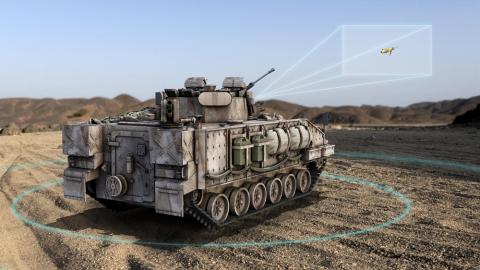
The orders were for the company’s software-defined radars, and will be used in “today’s most advanced defense applications,” RADA says, including active protection systems (APS) for armored vehicles, counter rocket artillery and mortar (C-RAM), counter UAS and short range air defense (SHORAD).
According to RADA, a third of the orders were follow-on-sales from existing customers, while the remaining orders were from “new and highly strategic customers,” such as leading defense organizations. Additionally, these orders represent initial sales from which RADA expects further follow-on orders in the future.
Cyberhawk completes oil tanker hull survey using UAS
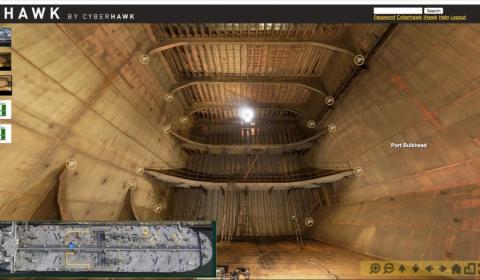
Cyberhawk has announced that it has successfully completed the first full American Bureau for Shipping (ABS) Intermediate Hull Survey 4 on an oil tanker using UAS.
While at a shipyard in Singapore, Cyberhawk performed full class inspection across 19 tanks onboard an oil tanker, which included 12 Cargo Oil Tanks, two slop tanks and five ballast tanks.
“UAVs and robotics in general have taken inspection to a new level thanks to the time, cost and safety benefits being proven every day,” explains Chris Fleming, CEO at Cyberhawk. “However, digitizing the data captured is a transformational step for the asset management industry.”
U.S. Navy awards CACI contract to support deployment of counter UAS platforms
The U.S. Navy has awarded CACI International Inc. a $48.5 million single-award, “indefinite delivery/indefinite quantity contract” to provide integration, installation, sustainment, and engineering services to the Naval Air Systems Command Naval Air Warfare Center Aircraft Division (NAWCAD) AIRWorks Rapid Development Capabilities Integrated Product team.
CACI develops, deploys, and integrates counter-UAS technologies with its SkyTracker product suite, providing “fixed site, on-the-move, and man-packable and small form factor technologies.”
Oceans Unmanned expands its freeFLY UAS program to Dutch Harbor, Alaska
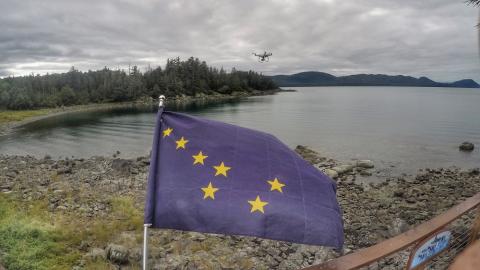
In partnership with Alaska Sea Grant and Aleutian Aerial LLC, and with additional support from DJI, Oceans Unmanned Inc. has announced the expansion of its freeFLY initiative into Dutch Harbor, Alaska, to provide UAS aerial support for marine mammal entanglement response efforts in the region.
The freeFLY program, which was launched earlier this year in Hawaii, provides training, equipment, and management oversight to networks of local volunteer UAS operators that are available to support response groups.
Weekend Roundup
This Week in the Unmanned Systems and Robotics World
China’s Xiangying-200 unmanned helicopter recently completed test flights. The unmanned helicopter was jointly developed by Shenyang Institute of Automation and several units of the Chinese Academy of Sciences (CAS), according to Gu Feng, an associate researcher at the institute. (China Daily)
Terabee's new TeraRanger Tower Evo ideal for collision avoidance on UAS and robots
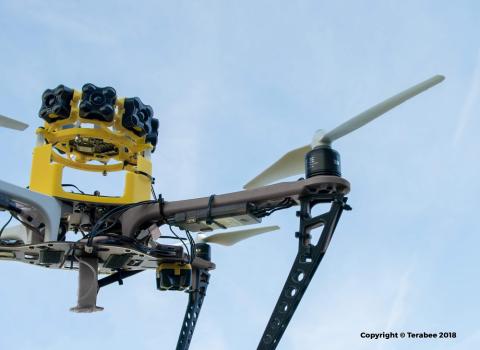
Terabee has announced TeraRanger Tower Evo, its new generation 360 degree solid-state LiDAR.
Lightweight, compact and ideal for collision avoidance on UAS and robots, TeraRanger Tower Evo has up to eight detection zones monitored simultaneously and at high-speeds.
After using the TeraRanger One sensors to launch its first-generation Tower in 2016, Terabee is now using the latest TeraRanger Evo sensors for this new version. As a result, the maximum range indoors has increased from 14 meters up to 60 meters, while outdoors in strong sunlight, 20 to 30 meters in range is possible.
Xwing developing software stack that enables pilotless flight of small passenger aircraft
An autonomous-aviation startup called Xwing recently secured $4 million in funding.
The company is reportedly focused on the software stack that will enable pilotless flight of small passenger aircraft.
In an interview with TechCrunch, Xwing’s CEO Marc Piette says that while he was pursuing his pilot’s license, he saw restraint when it comes to smaller aircraft, but he also saw potential.
“It became pretty apparent that there were major issues with the general aviation industry with smaller aircraft,” Piette said.
“And yet it had enormous potential to change the way people moved around.”