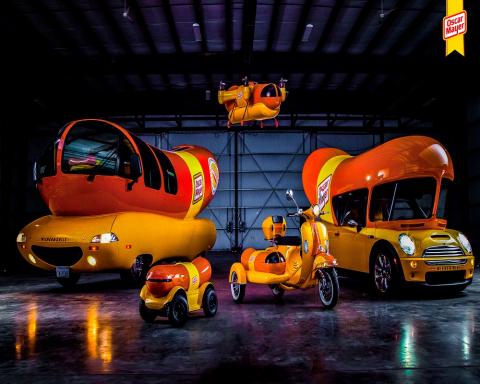
American meat and cold cut production company Oscar Mayer has announced that it is expanding its WienerFleet to include a brand new WienerDrone, which will be the first hot dog-carrying UAS designed to make deliveries in remote locations.
The announcement of the new WienerDrone, as well as a new WienerCycle, comes after Oscar Mayer recently announced a major recipe overhaul across its entire portfolio, in which the company has removed all “added nitrates and nitrites1, by-products and artificial preservatives from the meat in its entire line of hot dogs.”
UAS
UAS
Canada’s UAS Centre of Excellence granted permission to begin operations at its UAS test range
Canada’s UAS Centre of Excellence can now begin operations at its test range in Alma, Quebec, after receiving approval from Transport Canada.
Besides facilitating research and development, the test range will provide the UAS industry with “dedicated, restricted airspace,” where beyond visual line of sight (BVLOS) flights can be carried out.
“Transport Canada is proud of the progress we are making to support innovation and research in Canada’s drone sector,” says Marc Garneau, Minister of Transport.

New York’s Orange County set to begin using UAS
Orange County, New York’s Emergency Services Department will begin using UAS for a variety of tasks around the county.
The UAS program will be overseen by Deputy Commissioner of Emergency Services Alan Mack.
Mack, who is a licensed UAS operator and recent retiree from the U.S. Army, is looking forward to getting this new technology into the sky.
“The drones will be a valuable tool in many emergency situations and we are eager to put this program into practice,” Mack says via the Hudson Valley News Network.
RE2 Robotics chosen to develop technology that will convert manned aircraft to robotically piloted, autonomous aircraft
The United States Air Force has selected Pittsburg-based RE2 Robotics to develop the Common Aircraft Retrofit for Novel Autonomous Control (CARNAC) robotic system, which will serve as “a drop-in robotic system to rapidly convert a variety of traditionally manned aircraft to robotically piloted, autonomous aircraft under the Small Business Innovation Research (SBIR) program.”
The CARNAC robotic system, which will utilize existing aviation assets and advances in vehicle automation technologies during its development, will be used to operate the aircraft in a similar fashion to how a human pilot does, and there will not be any modifications required to the aircraft.
Kansas State University Polytechnic Campus receives approval to fly UAS at night
The FAA has granted Kansas State Polytechnic's Applied Aviation Research Center permission to fly UAS at night.
The campus's research sector will benefit from this waiver, and the waiver will also be used in commercial flight training courses, as well as in upcoming curriculum in the UAS degree option.
UC Santa Barbara researchers use UAS and WiFi for 3D through-wall imaging
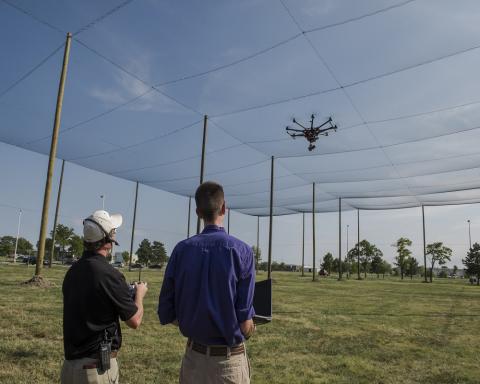
Researchers at the University of California, Santa Barbara (UCSB) working out of professor Yasamin Mostofi’s lab have conducted a demonstration in which they used two UAS working in tandem, and WiFi, to capture the three-dimensional imaging of objects through walls.
In their experiment, which the results of that and the proposed methodology appeared in the Association for Computing Machinery/Institute of Electrical and Electronics Engineers International Conference on Information Processing in Sensor Networks (IPSN), researchers use two autonomous octocopters to fly outside of an enclosed, four-sided brick house whose interior is foreign to the UAS.
Intel partners with International Olympic Committee to bring its Drone Light Show to future Olympics
Intel has announced a long-term technology partnership with the International Olympic Committee (IOC), which will, among many things, bring Intel’s drone light show technology to future Olympic games, in an effort to create “never-seen-before images in the sky.”
Through the partnership, which is expected to “transform the Olympic Games and the Olympic experience," Intel will join “The Olympic Partner” (TOP) worldwide sponsorship program, and thus, become a Worldwide TOP Partner through 2024.

3D Robotics to offer Site Scan to AEC professionals in Japan after partnering with SoftBank C&S
3D Robotics (3DR) has announced a new partnership with one of Japan’s largest distributors of information and communications technology, SoftBank C&S, which will result in 3DR providing its Site Scan UAS data platform to AEC professionals in Japan.
Site Scan will be the only commercial UAS software offered by SoftBank, which will open up the power of UAS data to Softbank’s customers across Japan.
“Aerial data software like Site Scan is already driving productivity for our customers in Japan,” says Matt Harrison, Head of Sales at 3DR.
“The partnership with SoftBank will allow 3DR to meet the demand for drone data across the country.”
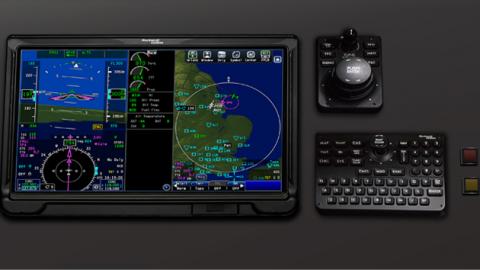
Rockwell Collins avionics chosen by General Atomics Aeronautical Systems to support UAS ground control station
General Atomics Aeronautical Systems Inc. (GA-ASI) has selected the Rockwell Collins Pro Line Fusion integrated avionics system to support the company’s MQ-9B SkyGuardian UAS.
In an effort to simply civil airspace access, Rockwell Collins will offer support to GA-ASI to “efficiently upgrade the proven Predator B Remotely Piloted Aircraft (RPA) system.”
The UAS ground control station will utilize the capabilities of the Rockwell Collins Pro Line Fusion integrated avionics system, to support customers and missions that require operations in civil airspace.