Delair-Tech and RTE recently flew a civilian UAS 30 miles beyond visual line of sight (BVLOS), setting a new distance record.
The flight, which used a 3G communication network to guide the UAS, was flown in France.
“In collaboration with RTE, we used for the first time in France a 3G network to guide the drone, allowing real-time communication from any distance,” says Michael Lagarde, President & Co-Founder of Delair-Tech.
“This removes an important technological barrier. It is a first step toward making drones the most common method for inspections of infrastructure that stretches over large distances, such as power lines and pipelines.”
UAS
UAS
Traffic jam in the skies: NASA updates UTM effort
By Clark Perry
There could be 7 million UAS vehicles flying in U.S. airspace by the year 2020, according to the FAA. It’s a staggering number, especially when it comes to safely managing all that air traffic.
To get a sense of what the skies may be like in just a few years, imagine the following scenario: firefighting aircraft are racing to the scene of a wildfire, only to find their air path strewn with municipal UAS vehicles inspecting power lines, hobbyists capturing vacation footage with the latest off-the-shelf drone from Best Buy, and Amazon Prime’s local drone fleet launching to make their daily deliveries.
Insitu’s Integrator UAS to replace ScanEagle systems being used by Netherlands Ministry of Defence
After awarding the Short Range Tactical UAV (SRTUAV) contract to Insitu, the Netherlands Ministry of Defence (NMOD) will replace the ScanEagle systems currently being used by the NMOD defence forces with three of Insitu’s Integrator UAS.
Designed to be a “modular, flexible and multi-mission capable solution for land and maritime operations,” the Integrator is a multi-mission, long-endurance UAS that can conduct a variety of missions, including target acquisition, force protection, and battle damage assessment.

Virginia Tech takes part in testing of NASA's unmanned traffic management research platform
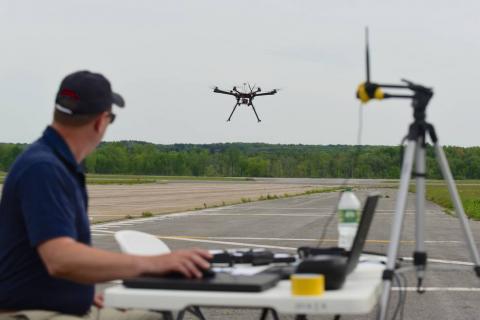
As a part of a national campaign to test NASA's unmanned traffic management research platform, UAS operations were conducted at Virginia Tech in Blacksburg, Virginia during the week of June 5, to test technology that is designed to allow multiple aircraft to safely share the same airspace.
The test flights were designed to “mimic what operators might encounter if widespread commercial UAS flights beyond line of sight become commonplace.” During the test flights, multiple aircraft carried out several different simulated missions simultaneously.
The aircraft communicated with NASA’s central cloud-based platform using different software interfaces, which allowed them to respond to changes in the airspace.
AUVSI XPONENTIAL 2019
This premier event unites the largest global community of drone, intelligent robotics and unmanned systems leaders to shape the future of the industry. Featuring the largest and most comprehensive trade show, this event is the spot to learn from daily keynotes with tech visionaries and 200+ world-class sessions as well as connect with 8,500+ industry pros and business experts from 20+ industries.
www.xponential.org
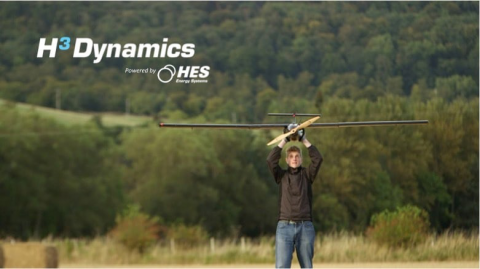
NEW ATLAS: FUEL-CELL DRONE IS GOOD TO GO FOR 10 HOURS
HES Energy Sys!ernsraised a lew eyebrows last May, when it announced development 01 a luel ceil-powered quadcopter !hat could potentially stay arrborne lor four hours at
AUVSI XPONENTIAL 2018
This premier event unites the largest global community of drone, intelligent robotics and unmanned systems leaders to shape the future of the industry. Featuring the largest and most comprehensive trade show, this event is the spot to learn from daily keynotes with tech visionaries and 200+ world-class sessions as well as connect with 8,500+ industry pros and business experts from 20+ industries.
www.xponential.org
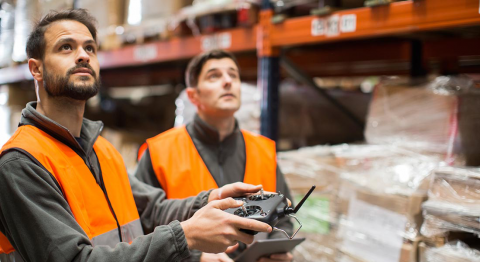
IFM creating uas for warehouse inventory upkeep
Intelligent Flying Machines has developed a UASthat warehouses can use for inventory upkeep and management. The UAS are currently in their testing phase, with plans to go commercial next year.
The plan of IFM is for companies to deploy several of their UASinside of a warehouse, and those UASwould be tasked with scanning isles and collecting various pieces of information. The UASare designed to operate autonomously, and once they complete their missions, they can land without any human supervision or oversight to recharge. The information that the UAScollect will be sent to a cornpany's inventory software and cross-referenced with company data, and errors and alerts will be sent to tablets for workers to check at the beginning of their shifts.
WEEKEND ROUNDUP
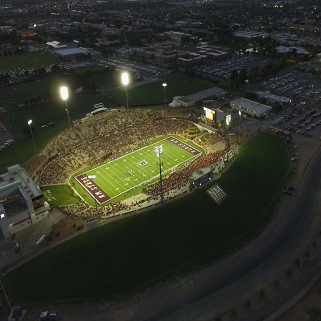
This Week in the Unmanned Systems and Robotics World, New Mexico State University used a UAS last week end to record the pregame festivities before their football game. The UAS captured video and took pictures of the event, ineluding the main photo aecompanying this post.