UAS
UAS
Texas' Brownsville Police and Fire departments use UAS to locate elderly man
The Brownsville Police and Fire departments in Brownsville, Texas recently collaborated to locate a missing 88-year-old man using a UAS.
Approximately three hours after the man was reported missing, he was located in a grassy area by the fire department thanks to the UAS. The man was then transported to a local hospital, and as of Tuesday, Jan. 8, was in stable condition.
“This rescue was a team effort with a great response from the Brownsville Fire and Police Departments,” says Brownsville Fire Chief Jarrett V. Sheldon.

Sky Power GmbH unveils newly developed 2-stroke engine
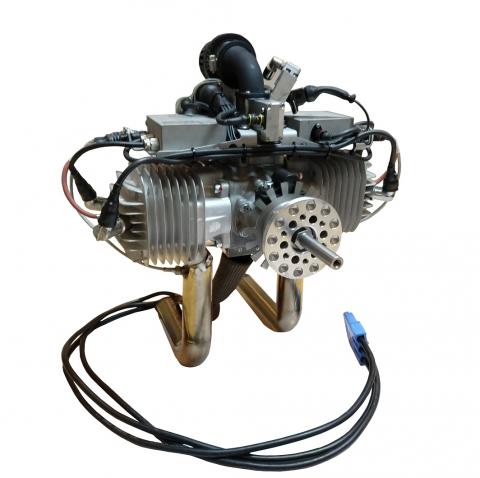
Sky Power GmbH, which manufactures 2-stroke combustion- and Wankel engines for UAS and hybrid applications, has unveiled its newly developed 2-stroke engine, the SP-210 FI TS.
Based on the same engine concept as the company’s SP-110 FI TS, the SP-210 FI TS has a “max. 8,2 kW at 5000 rpm,” Sky Power says.
The SP-210 FI TS has a system carrier just like the SP-110 FI TS—although it is optionally offered without a system carrier as well—which is mounted above the cylinders with the two electronic systems of the HKZ215 ignition, as well as the engine injection system.
The injection system and the system carrier are screwed firmly together with the engine.
Canada's new UAS rules set to go into effect on June 1
On Jan. 9, Canada’s Minister of Transport, Marc Garneau, announced Canada’s new rules for UAS, which will go into effect on June 1, 2019.
The rules will apply to all UAS pilots flying UAS between 250 grams and 25 kilograms (.55 pounds to 55 pounds) that are operated within the pilot’s visual-line-of-sight, regardless of whether the UAS is flown for fun, work or research.
Transport Canada says that the new simplified rules reflect a great amount of consultation with Canadians and the industry, with the final regulations introducing two main categories of UAS operation—basic and advanced—that are based on distance from bystanders and airspace rules.
State Farm granted first national FAA waiver to conduct UAS flights over people and BVLOS
State Farm has become the first company in the U.S. to receive a national waiver from the FAA that allows it to conduct UAS operations over people (OOP) and flights beyond the pilot’s visual line of sight (BVLOS) through November 2022. Previously, State Farm received waivers that were limited to a short time frame and to specific geographic areas impacted by hurricanes.
A member of Virginia’s UAS Integration Pilot Program (IPP) team, State Farm says that the waiver will also open up new innovation opportunities for the company by allowing longer-distance flights.
“It’s been a team effort to make drone technology a reality,” says Senior Vice President for P&C Claims Robert Yi.
Project RACHEL's fuel cell powered UAS completes 70-minute flight
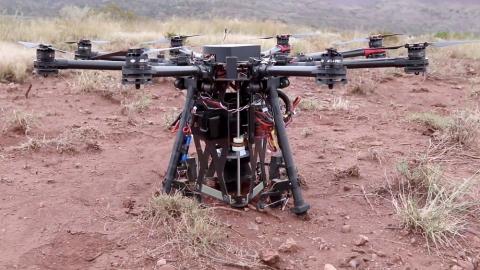
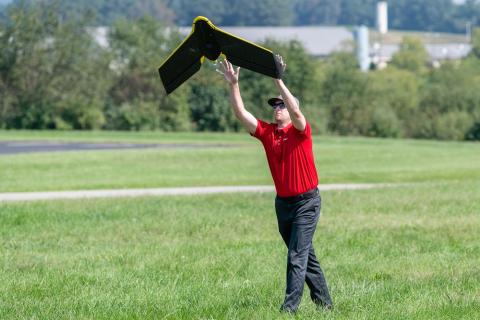
With a goal of developing a hydrogen fuel cell powered multi-rotor UAS, Project RACHEL recently eclipsed its original test flight target of 60 minutes with a five-kilogram payload, as the purpose-built fuel cell powered UAS flew for an uninterrupted 70 minutes carrying a five-kilogram payload.
The flight was completed using a UAS that had less than a 20-kilogram maximum take-off mass, using a six-liter cylinder containing hydrogen gas compressed to 300 bar.
Supported by Innovate UK, Project RACHEL is led by Productiv, a venture engineering company, on behalf of BATCAM, a UAS filming specialist based in the United Kingdom.
Apollo Robotics announces early access to its Apollo Development Partner Program
Apollo Robotics has announced the immediate availability of early access to its Apollo Development Partner Program, which is designed to deliver a fully automated, autonomous surveying UAS for professionals.
Apollo Robotics says that it can quickly digitize and reconstruct any worksite into a “highly accurate and instantly actionable” 3D model from a single scan by combining multi-sensoring LiDAR, HD and thermal cameras with artificial intelligence.
Mid Michigan College to offer UAS classes for professionals and hobbyists
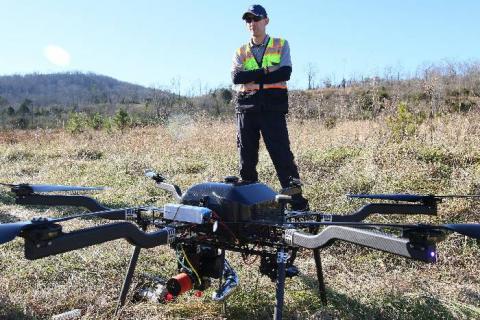
According to the Midland Daily News, Mid Michigan College will soon begin offering professional UAS users, as well as hobbyists, the opportunity to learn more about UAS and their impact on businesses.
Mid Michigan College has a Drone Training program, which is designed to address a number of areas, including teaching UAS-piloting skills, identifying potential uses and industry applications for the technology, and ultimately preparing students to pass the remote pilot knowledge test needed to obtain a Remote Pilot Certificate from the FAA to legally operate the systems under the FAA's small UAS Rule.
Mid Michigan College adjunct faculty member Robert Giuliani will teach the courses.