
Simlat has announced that it has developed a simulation capability for counter-UAS (C-UAS) operations that allows different sensors and effectors to be emulated with diverse capabilities and technologies.
High volume threats, which can include any kind of hostile platform(s) in any configuration, are simulated in complex environments such as airports, critical infrastructure settings, urban terrain and sensitive sites.
UAS
UAS
Cape and Chula Vista Police Department tout benefits of UAS
Cape and the Chula Vista Police Department (CVPD) have announced the early results from their Drone as a First Response (DFR) program, which is part of the San Diego UAS Integration Pilot Program (IPP).
Since the launch of the program in Oct. 2018, UAS equipped with the Cape Aerial Telepresence platform have conducted more than 282 flights, contributing to 20 arrests in the process.
“The Chula Vista Police Department is at the forefront of utilizing drones to enhance the science of policing,” says Chris Rittler, CEO of Cape.

Insitu Commercial Solutions conducts UAS operations in Papua New Guinea
After obtaining its first approval to undertake commercial UAS operations in Papua New Guinea (PNG), Insitu Commercial Solutions—operating through Insitu Pacific Pty. Ltd.—recently conducted a series of aerial data collection operations in the country.
Through this activity, which was a first for both Insitu Commercial Solutions and PNG, Insitu showcased its proficiency and competence in becoming the primary contracted UAS operator in PNG.
University of South Florida's Brain-Drone Race welcomes diversity and inclusivity
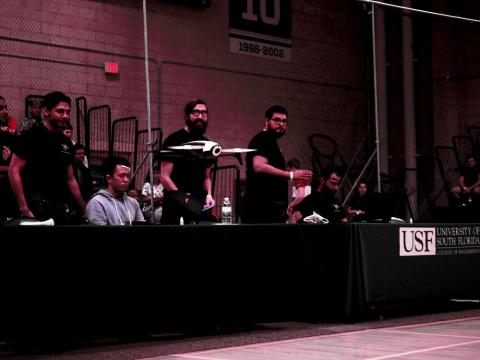
Inside the Yuengling Center on the campus of the University of South Florida (USF), competitors focused intently as they raced to their respective finish lines in front of an enthusiastic crowd of onlookers.
But the field of 16 competitors weren’t using their legs to compete in a series of drag races taking place over the course of four rounds. Instead, they were using their brains to race drones during USF’s first brain-drone race on Saturday, Feb. 9.
California's Corona Police Department launches UAS team to assist with community operations
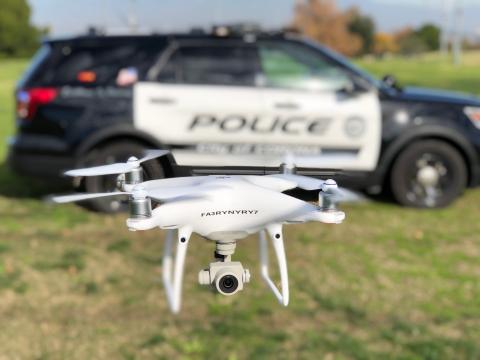
On Thursday, Feb. 7., the UAS team of Corona, California's police department officially went into service. According to the Corona Police Department, the UAS team will be used to enhance the safety and service the department provides the community.
Made up of seven FAA certified UAS pilots, the UAS team will support various traditional and non-traditional police activities, including but not limited to, search and rescue, supporting fire operations, and helping locate and apprehend fleeing criminals.
Hughes Network Systems begins shipment of HM400 SATCOM modems for GA-ASI's MQ-9B SkyGuardian
Broadband satellite networks and services provider Hughes Network Systems LLC has begun shipping its specialized, multiband HM400 SATCOM modems to General Atomics Aeronautical Systems Inc. (GA-ASI).
The HM400 SATCOM modems will be used to power beyond-line-of-sight (BLOS) communications for GA-ASI’s MQ-9B SkyGuardian Remotely Piloted Aircraft (RPA).
According to Hughes, its specialized Hughes HM400 delivers enhanced satellite-based communications for RPA’s, as it leverages an open system architecture and software-definable modem and waveform technology.
The Hughes HM400 modems support both military and commercial satellite frequencies, opening up applications such as search and rescue or disaster response for Predator-variant aircraft.
Planck Aero's Shearwater small UAS autonomously takes off and lands onto moving ground vehicle
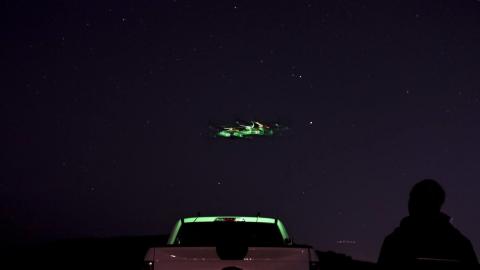
Marine Corps Air Station (MCAS) Miramar, Air Traffic Control (ATC) recently gave Planck Aerosystems (Planck Aero) permission to test its Shearwater small UAS in controlled airspace and at night.
During testing, the Shearwater small UAS routinely conducted successful autonomous takeoffs and precision landings onto a moving, off-road ground vehicle with centimeter-level accuracy in complete darkness. The UAS performed these tasks without GPS or a pilot in the loop.
According to Planck Aero, the ability to perform nighttime operations from moving vehicles represents a “major step” forward in demonstrating the maturity of the company's vision-based navigation technology.
Cranfield University and Blue Bear conduct first UAS test flights to establish principles for NBEC project
Cranfield, England's Cranfield University has announced that the first test flights to establish the principles for the National Beyond visual line of sight Experimentation Corridor (NBEC) were successfully conducted at Cranfield Airport.
A collaboration between Cranfield University and Blue Bear Systems Research Ltd, NBEC seeks to create an experimentation corridor that will enable UAS to fly in the same airspace as manned aircraft.
Using its Blackstart UAS towards its facility in Oakley, Bedfordshire, Blue Bear executed three-kilometer Extended Visual Line of Sight (EVLOS) race track flights within the Cranfield Air Traffic Zone.
Grossmont College to offer free UAS training starting in March
Grossmont College in El Cajon, California has announced that it will offer a comprehensive UAS training program starting in March.
Funded by a $6 million federal America’s Promise grant through the U.S. Department of Labor, the UAS program will be free to anyone who is at least 18 years old and a U.S. citizen, as required by the grant.
The noncredit program will be geared towards a variety of groups, including but not limited to, veterans, Native Americans, military spouses, ex-offenders, women, high school students and the unemployed and underemployed.
Logos Technologies becomes preferred provider of WAMI sensors for Insitu's UAS
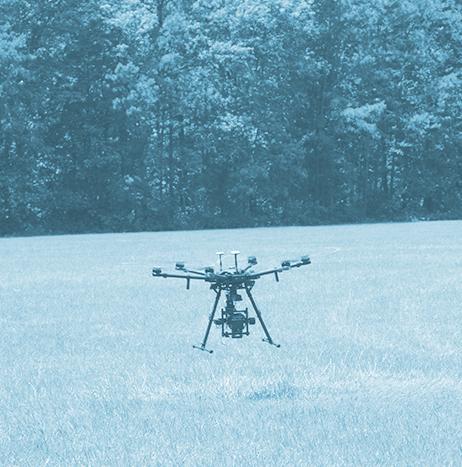
Logos Technologies will become the preferred provider of wide-area motion imagery (WAMI) sensors for Insitu’s line of UAS, thanks to a recently finalized memorandum of understanding (MOU) between the two companies.
Developed for the payload bay of the Insitu Integrator tactical UAS, Logos Technologies’ RedKite-I WAMI sensor is an official Insitu product offering for U.S. and international customers.
“By adding the RedKite-I WAMI system as a payload on their platform, Insitu now gives their users the unprecedented capability to detect and track multiple targets across a city-sized area,” says John Marion, president of Logos Technologies.