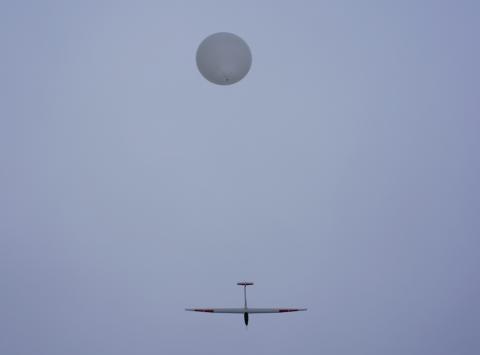
UAVOS Inc. and Stratodynamics Aviation Inc. have successfully completed the next stage of flights tests for their HiDRON stratospheric aircraft.
Reaching an altitude of 82,000 feet, the HiDRON carried an atmospheric measurement system onboard, as a result of a collaboration with researchers from the University of Kentucky.
The night-time flight, which was conducted in collaboration with the regional Air Traffic Control Agency, lasted four hours. There was a one-hour weather balloon launch period that had an average climb rate of 22 feet per second. At release altitude, the HiDRON was 22 miles away from the launch site where it headed home and was above launch area at an altitude of 59,000 feet.
UAS
UAS
Drone Delivery Canada begins testing its newest cargo delivery drone
After receiving approvals from Transport Canada to begin testing its newest cargo delivery drone, Drone Delivery Canada (DDC) has begun testing the Falcon UAS within Southern Ontario.
DDC notes that the Falcon, which has been in development for almost a year, is the big brother of the company’s Sparrow UAS, which is also designed for cargo delivery.

Intel's Shooting Star UAS return to the Super Bowl
During the Halftime Show of Super Bowl 53 on Sunday, Feb. 3 in Atlanta, Intel teamed up with the NFL to create the first live drone light show during a Super Bowl Halftime Show.
During a performance by pop band Maroon 5, 150 enhanced Intel Shooting Star UAS floated up and over the field in a choreographed performance to the music to form the words “ONE” and “LOVE.” With this performance, Intel broke its own world record for UAS flown indoors, which the company previously set with 110 during CES 2018.

MetaVista complete nearly 11-hour UAS flight using Intelligent Energy fuel cell power module
Intelligent Energy has announced that a South Korean liquid hydrogen specialist called MetaVista conducted a 10 hour and 50-minute multi-copter test flight using an Intelligent Energy Fuel Cell Power Module.
The flight, which utilized Intelligent Engineering’s lightweight 650-watt Fuel Cell Power Module (FCPM), is believed to be the longest flight time of its kind.
Sinclair College's National UAS Training and Certification Center partners with senseFly
Through a recently announced partnership, Sinclair Community College’s National UAS Training and Certification Center will become the primary North American partner of senseFly, providing standardized OEM training platforms for senseFly’s clients, in an effort to complement direct training and training through authorized senseFly distribution partners.
Sinclair and senseFly say that their partnership will broaden the reach of senseFly’s expertise in UAS technology, while also expanding its offering of high-quality training through Sinclair’s National UAS Training and Certification Center.
NUAIR Alliance and others test impact of wind on air worthiness and performance of UAS
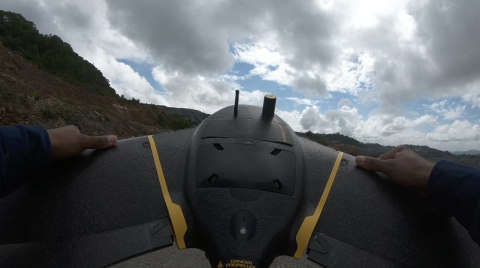
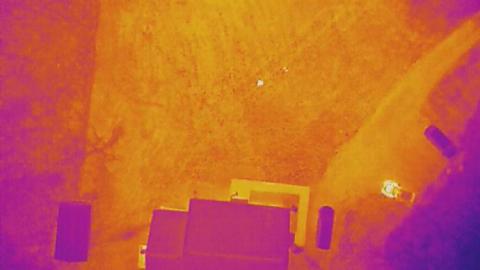
The New York State UAS Test Site, TruWeather Solutions, the NUAIR Alliance and a company called Windshape have announced that using “industry-leading” micro-weather stimulations, they tested the impact of wind on the air worthiness and performance of various types of UAS.
Testing took place at the New York State UAS Test Site at Rome, New York's Griffiss International Airport.
“We know that weather impacts small drones in a variety of ways and these tests enabled us to evaluate that impact and each platform’s capacity to reject atmospheric disturbances and maintain safe flight,” explains Major General Marke F. “Hoot” Gibson (ret), chief executive officer, NUAIR Alliance.
Airborne Response conducts UAS training exercise with National Guard and others
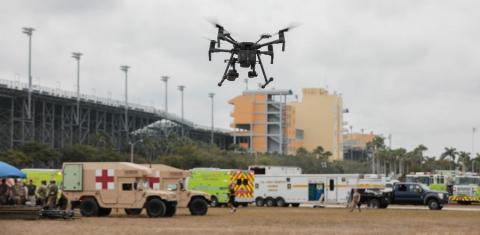
On Jan. 24, Airborne Response completed a full-scale training exercise called Exercise Lightning Shield, during which it provided aerial support for the U.S. Army National Guard, as well as specialized elements of the Miami-Dade Fire Rescue Department, at the Homestead-Miami Speedway in Homestead, Florida.
A Miami-based provider of “Mission Critical Unmanned Solutions” for industry and government, Airborne Response says that by deploying a force made up of UAS and Tethered Aerostat Systems (TAS) flight teams, it was able to provide “comprehensive low-altitude umbrella” capable of delivering aerial intelligence throughout the simulated disaster response exercise.