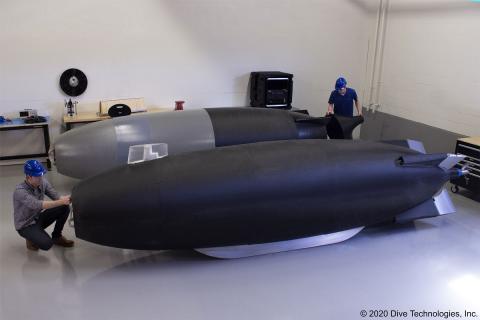
Boston-based subsea robotics designer and manufacturer Dive Technologies Inc. has announced the completion of the integration and build of DIVE-LD, the company’s first full-scale commercial large displacement (LD) UUV platform.
At-sea testing of the UUV will begin this summer, and will be followed by commercial and defense demonstrations, which will include deep ocean testing.
“We’re thrilled to see the DIVE-LD come together after nearly two years of iterating on the design, prototyping, and lab testing,” says Jerry Sgobbo, CEO at Dive Technologies.
UUV
UUV
Australia's Defence Science and Technology Group acquires BlueComm undersea communications system
As part of its ongoing program in maritime autonomous systems (MAS), Australia’s Defence Science and Technology Group (DST) has acquired a BlueComm undersea communications system from Sonardyne International Ltd.
According to Sonardyne, BlueComm is the only commercial-off-the-shelf (COTS) technology that enables wireless transmission of high bandwidth tactical data—including video—over ranges of a few tens or even hundreds of meters, at rates of up to 10 megabits per second.

SeeByte to provide a variety of services for MK18 UUV Family of Systems
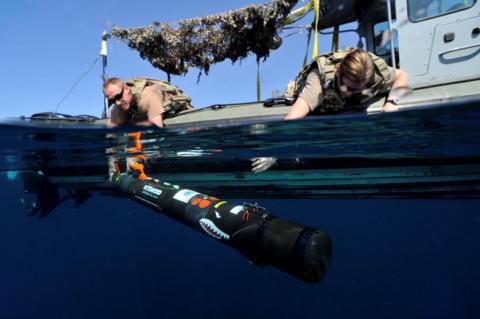
The US Naval Surface Warfare Center (NSWC) Indian Head EOD Technology Division has awarded SeeByte the first delivery order in the second option year of a five-year contract, which will result in SeeByte providing engineering, technical support, and training services for the MK18 UUV Family of Systems (FoS).
“We are delighted to continue our support in response to MK18 training needs. We will provide a tailored training solution which will encompass the mission planning, mission monitoring and post-mission analysis features of our multi-vehicle co-operative autonomy product, Neptune,” says Rob Carsley, operations manager at SeeByte.
Weekend Roundup: May 29, 2020
This Week in the Unmanned Systems and Robotics World
In an effort to help families in need, Optimus Ride will use its self-driving shuttles to deliver meals to a waterfront development in Washington, D.C. called the Yards. Optimus Ride’s fleet will distribute the meal kits to the families on a weekly basis, serving a total of 5,000 meals. (VentureBeat)

Sonardyne demonstrates tech that will help autonomous vehicle ops in challenging environments
Under a project funded by the UK’s national Defence and Security Accelerator (DASA), Sonardyne International Ltd. demonstrated technologies that it says will help autonomous vehicle operations in challenging environments.
Sonardyne worked with a 12-meter-long SEA-KIT X class USV, and tested and validated sensors already used by UUVs for use on USVs in support of missions in coastal waters.
The SEA-KIT X was equipped with Sonardyne’s SPRINT-Nav hybrid inertial navigation instrument, which was tested against local real-time kinematic (RTK) GPS positioning as part of the DASA program to fast-track autonomous vehicle capability in challenging or harsh conditions.
Huntington Ingalls Industries closes acquisition of Hydroid Inc.
On Thursday, March 26, Huntington Ingalls Industries (HII) announced that it had closed its acquisition of Hydroid Inc. HII says that the acquisition expands its capabilities in the “strategically important and rapidly growing” autonomous and unmanned maritime systems market.
Hydroid will become part of HII’s Technical Solutions Unmanned Systems business unit, which now includes UUVs such as the Orca extra-large UUV. The addition of Hydroid expands HII’s capabilities in the medium and small UUV space, with the inclusion of vehicles such as the REMUS and Seaglider AUVs, as well as marine robots.
DARPA awards contracts to four companies for Manta Ray Program focused on UUVs
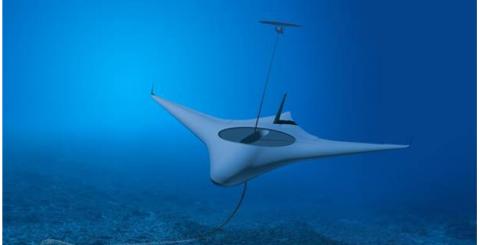
DARPA has awarded contracts to four companies to work on its Manta Ray Program, which seeks to demonstrate critical technologies for a new class of long duration, long range, payload-capable UUVs.
Lockheed Martin Advanced Technology Laboratories, Northrop Grumman Systems Corporation and Navatek LLC have been selected to focus on the development of an integrated platform for Manta Ray technology and operational areas. The fourth company, Metron Inc., will work on developing critical technology and platforms specific to the field of undersea energy harvesting techniques at the necessary depths for successful operations.
COLREGs update, testing and public acceptance key to boosting unmanned maritime systems
For unmanned maritime systems (UMS) to reach their full potential, COLREGs, the set of regulations that provide the “rules of the road” for vessels to prevent collisions, need to be updated to include the innovative waterborne technologies.
“COLREGs for us is really the biggest issue. We need to have UMS put into COLREGs,” said Mike Smitsky, AUVSI’s senior manager of advocacy and government relations who manages and staffs the AUVSI UMS Advocacy Committee.
Speakers highlight importance of collaboration for developing, integrating unmanned maritime systems
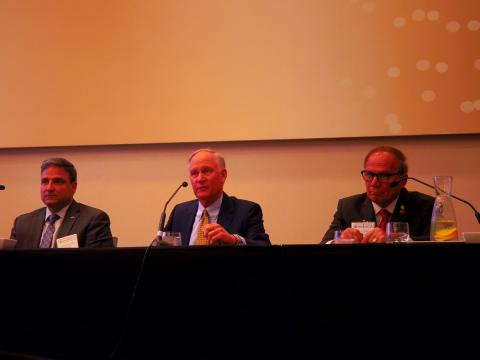
As the U.S. Navy continues to develop and integrate unmanned maritime systems into its repertoire, members of the government and the unmanned systems industry agree they will need to continue relying on each other to make these systems a regular part of the armed forces.
“What I really appreciate is industry’s willingness to get on board with the Navy’s vision for the family of systems that can be upgraded throughout their life,” said Capt. Pete Small, USN, program manager, PMS 406, on a government panel during the Unmanned Systems Integration Seminar, presented by the Naval Submarine League and AUVSI.