
This Week in the Unmanned Systems and Robotics World
China’s Xiangying-200 unmanned helicopter recently completed test flights. The unmanned helicopter was jointly developed by Shenyang Institute of Automation and several units of the Chinese Academy of Sciences (CAS), according to Gu Feng, an associate researcher at the institute. (China Daily)
Technology
Technology
Sacramento and Phantom Auto partner to test autonomous vehicles in the city
The City of Sacramento, California has signed a deal with Phantom Auto to test autonomous vehicles in the city.
The vehicles will be monitored by remote “drivers” sitting at computers in Silicon Valley, where Phantom Auto is based. The people monitoring the vehicles will be able to take control of the vehicle if its on-board computer system can’t figure out how to navigate the road.
“I view this as another signature moment for our city,” says Sacramento Mayor Darrell Steinberg, via the Sacramento Bee. “It is a clear sign we are willing to step up and show the state and the country that we want to be on the forefront of new technologies.”

Terabee's new TeraRanger Tower Evo ideal for collision avoidance on UAS and robots
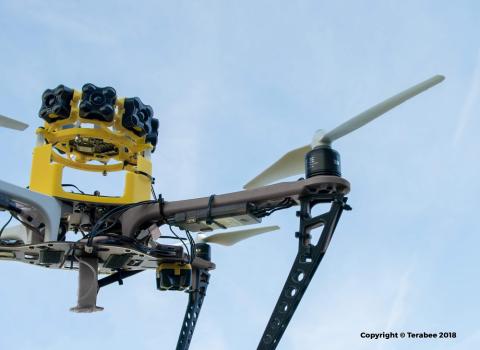
Terabee has announced TeraRanger Tower Evo, its new generation 360 degree solid-state LiDAR.
Lightweight, compact and ideal for collision avoidance on UAS and robots, TeraRanger Tower Evo has up to eight detection zones monitored simultaneously and at high-speeds.
After using the TeraRanger One sensors to launch its first-generation Tower in 2016, Terabee is now using the latest TeraRanger Evo sensors for this new version. As a result, the maximum range indoors has increased from 14 meters up to 60 meters, while outdoors in strong sunlight, 20 to 30 meters in range is possible.
Louisiana Department of Environmental Quality finds no shortage of uses for its UAS
The Louisiana Department of Environmental Quality (LDEQ) is utilizing its UAS for a variety of tasks.
Recently, one of the department’s UAS was used to fly over a section of the Mississippi River to document an oil spill that occurred near the French Quarter, while in another instance, a UAS allowed responders to view a flooded field in St. Landry Parish.
When the department deploys its UAS, the UAS records the event in both still images and video, which can then be used for environmental protection and emergency response tasks.

NIAS launches Nevada Drone Center of Excellence for Public Safety
The Nevada Institute for Autonomous Systems (NIAS) has launched the Nevada Drone Center of Excellence for Public Safety (NDCOE) to help save lives and reduce air hazards from UAS incursions.
Located in Las Vegas, Nevada, NDCOE will seek to do this by “empowering a shared safety vision with the FAA’s integration of drones into the commercial air traffic system.”
Textron businesses integrate, demonstrate manned-unmanned teaming capability
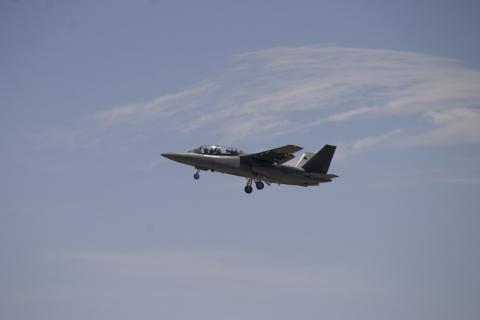
Textron Systems and Textron Aviation have announced the successful integration and demonstration of Textron’s manned-unmanned teaming capability via the Textron Systems' Synturian control and collaboration technology and Textron Aviation Defense Scorpion jet.
Synturian control and collaboration technologies empower situational awareness and informed action, while the Textron Aviation Defense Scorpion jet provides the warfighter with a technological advantage, while also delivering “exceptional mission readiness at unparalleled low acquisition, operating and training costs.”
Lockheed Martin selected as Integrated Systems Developer for US Army's TARDEC ExLF program
The U.S. Army's Tank Automotive Research, Development and Engineering Center (TARDEC) has selected Lockheed Martin as the Integrated Systems Developer for its Expedient Leader Follower (ExLF) program.
Under this role, Lockheed Martin will lead a three-year effort to develop, integrate and test “unmanned prototype systems” that support leader/follower convoy activities within an asymmetric threat environment.
Using the prototypes developed in the ExLF program, soldiers will conduct operational technology demonstrations to not only establish operating procedures, but also shape future programs of record.
Rowan County agencies see benefits of using UAS
In Rowan County, North Carolina, the Rowan County Rescue Squad and the North Carolina Highway Patrol are increasingly relying on UAS to respond to various incidents.
Each N.C. Highway Patrol troop has a single UAS to map traffic collisions, while the Rescue Squad is part of a pilot program using its UAS at fires, as well as for search and rescue operations.
The Rowan Rescue Squad received its UAS as part of the pilot program in April 2017, according to Chief Eddie Cress. The squad currently has one certified pilot, a pilot-in-training, and two others who are working on obtaining certification.
Great Lakes Drone Company's UAS light up 2018 EAA AirVenture Oshkosh
On the night of Thursday, July 26, during 2018 EAA AirVenture Oshkosh, a UAS light show lit up the sky in Oshkosh, Wisconsin.
As Lee Greenwood's “God Bless the U.S.A.” played over loudspeakers, the UAS formed a double heart and eagle before flying around to spell out EAA and finish with an American flag.
The light show was performed by Great Lakes Drone Company, which is one of just three companies in the U.S. approved by the FAA to perform lighted drone shows.
The company has four stock shows ranging from 25 to 100 UAS, as well as shows it customizes for customers.
From Unmanned Systems Magazine: What a self-driving world could look like
That our future includes self-driving cars is a given. Certainly, every auto manufacturer and urban planner is preparing, or thinking about preparing, for the day. But what form that future will take, and what our daily lives will look like as a result, remains ripe for prognostication.
In an interview with The New York Times, Chris Anderson, the former editor of Wired magazine, cofounder of 3D Robotics and founder of DIY Robotics — in other words, someone who knows and thinks a lot about the world of autonomous vehicles — said he continues to be confounded by the fact that people so often ask him a question that, to his mind, hardly needs asking: What will people do inside driverless cars?