As part of a five-year trial of autonomous vehicle technology, a driverless public electric shuttle called the Flinders Express (FLEX) has begun operating on public roads in South Australia for the first time.
The vehicle, which is funded by the State Government and industry partners, will initially provide ‘first mile–last mile’ shuttle services, then connections to bus stops on the main South Road and businesses within the Tonsley precinct.
Within a year, the shuttle is expected to run to the Flinders Medical Centre and the University’s Bedford Park campus before using main arterial roads around the entire Bedford Park precinct. During the first stage of the trials, commuters can book free rides on the shuttle on week days from Monday to Friday between 10am and 2pm.
Technology
Technology
Kansas State Polytechnic becomes first university to receive waiver to fly UAS BLOS
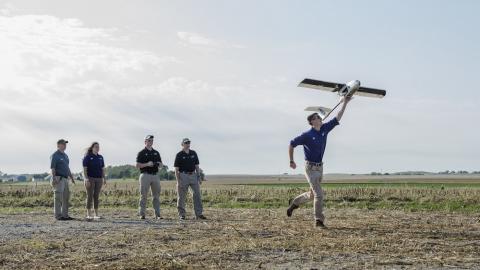
Kansas State University Polytechnic Campus has become the first university to receive a waiver from the FAA to fly UAS beyond the line of sight (BLOS).
The FAA certificate to Kansas State Polytechnic's Applied Aviation Research Center waives the rules regarding visual sight of aircraft operations by the pilot and visual observers, which will allow K-State Polytechnic to conduct research and operations where pilots and observers can no longer see their UAS.
“These operations and research will provide valuable insight into regulation and safety measures for UAS in the national airspace,” says Travis Balthazor, Kansas State Polytechnic's UAS flight operations manager.
Kratos' Unmanned Systems Division's Autonomous Impact Protection Vehicle approved to deploy on public roadways
Kratos Defense & Security Solutions’ Unmanned Systems Division (USD) has received confirmation that its Autonomous Impact Protection Vehicle (AIPV) has officially been approved for “autonomous operation on public roadways in the first of many planned states in the USA for roadway line painting operations.”
This approval transitions the AIPV, also known as the Autonomous Truck Mounted Attenuator (ATMA), from the validation phase of deployment to “standard safety critical equipment ready for operational use with trained roadside construction crews.”

Weekend Roundup
This Week in the Unmanned Systems and Robotics World
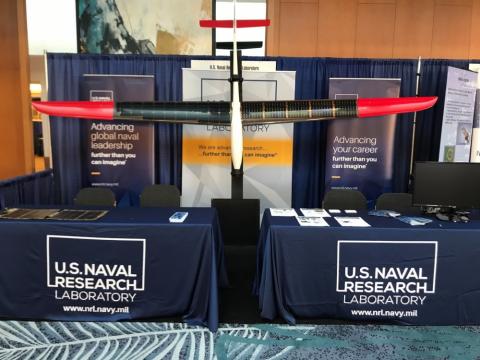
Researchers at the U.S. Naval Research Laboratory (NRL) have developed Solar Soaring technology that gives UAS the ability to fly for more than 12 hours. Solar-Soaring, which is a “pair of endurance-enhancing technologies,” enables a UAS to fly longer without carrying extra weight in batteries, ultimately helping the warfighter. (United States Navy)
CNC Technologies selected to deploy state-of-the-art mobile video network to support advanced UAS program
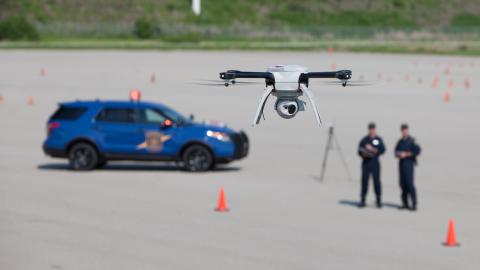
The Michigan State Police (MSP) has selected CNC Technologies—an aviation technology and wireless communications company that serves the law enforcement, military and government markets—to deploy a state-of-the-art mobile video network to support the department’s advanced UAS program.
The new technology is meant to speed and improve the ability of MSP to share actionable aerial intelligence. It is also meant to “secure transmission of real-time video and data from the department’s airborne assets to officers and partner agencies across the region.”
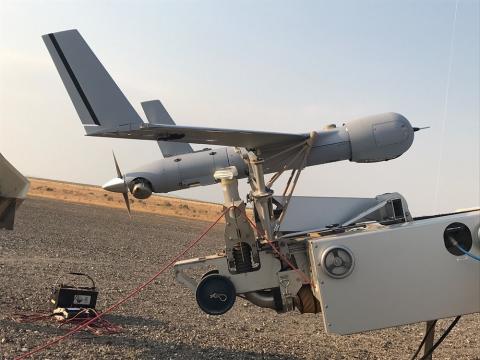
Insitu's ScanEagle UAS selected to provide fire suppression services across U.S.
The U.S. Department of the Interior (DOI) has awarded a “first-of-its kind” contract to Insitu, so that the company can provide fire suppression services within the contiguous 48 states and Alaska using its ScanEagle UAS.
The UAS will help battle wildfires using geospatial mapping and full motion video.
Through the contract, Insitu will support manned aerial operations for a variety of scenarios, including fire suppression, search and rescue, and emergency management, as needed on a “call when needed” basis.
ST Engineering and SafeRide Technologies partner to provide cybersecurity protection for autonomous vehicles
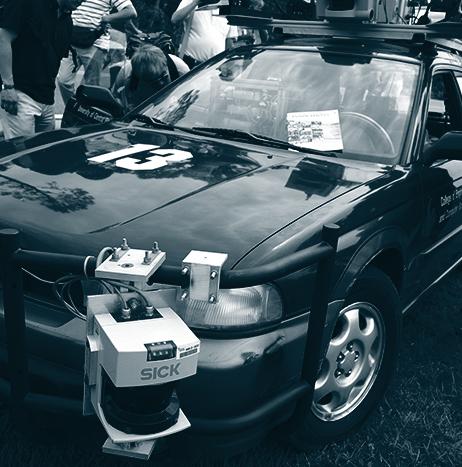
Global technology, defense and engineering group ST Engineering has announced a strategic partnership with SafeRide Technologies to integrate SafeRide’s “vSentry” software cybersecurity suite with ST Engineering’s Connected Electric Vehicles and Autonomous Vehicles (AV) platforms.
A “specialist” in automotive cybersecurity, SafeRide Technologies offers “anomaly uncovering” and cyber threat prevention for connected and autonomous vehicles.
Ohio's Franklin County Sheriff's Office uses UAS to locate stolen ATV
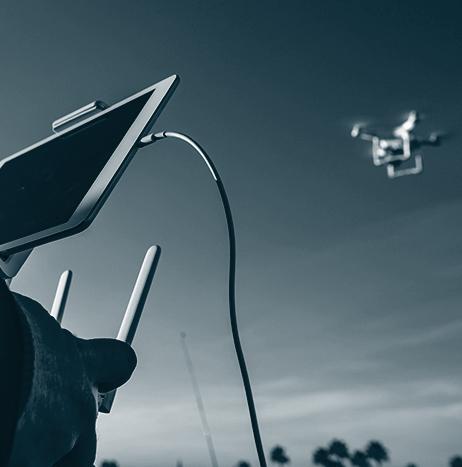
According to NBC4 Columbus, a UAS was recently used to locate a stolen ATV in Franklin County, Ohio.
After receiving a call from someone reporting that their ATV was stolen, deputies from the Franklin County Sheriff's Office deployed their UAS and followed tire tracks that led from the area to an abandoned house, where deputies found the ATV.
The ATV was reportedly a recent gift for a young boy.
“End result, one happy kid!” read a Facebook post from the sheriff's office.
Syracuse Fire Department launches UAS program
In an effort to help members of its department fight fires, the Syracuse Fire Department has launched a new UAS program.
According to Fire Capt. Timothy Gleeson, the department expects to use the technology for stubborn fires or on fires in large commercial buildings.
Thanks to the drones' thermal imaging capabilities, firefighters will be able to see hotspots in stubborn fires and identify spots where roofs or parts of buildings could collapse, notes Syracuse Fire Chief Michael Monds.
“We're aggressive. ... This is a really different type of concept,” Monds says via Syracuse.com. “To step back and get a good picture.”
University of Colorado Boulder and others collect data on monster storm using UAS
A team of aerospace engineers from the University of Colorado Boulder (CU) recently spent the first half of June traveling across the Midwest in search of monster storms.
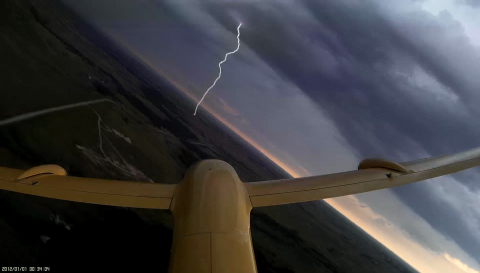
During this time period, the CU team, which was made up of 16 CU employees and students, encountered a storm on June 8 outside Norris, South Dakota, and used one of its three “TTwistor” UAS to fly through the dark skies to collect data from the storm.
“It is amazing to me how you're driving along for several hours and it's nice, clear, sunny skies, and all of sudden you're under these clouds and it gets dark pretty fast,” says Eric Frew, CU associate professor, via the Daily Camera.