
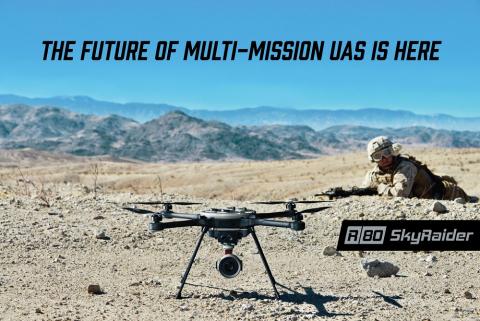
Aeryon Defense USA has released details on the R80D SkyRaider, which is the company's new multi-mission Defense and Federal Government Group 1 vertical takeoff and landing (VTOL) small UAS.
Aeryon Defense calls the SkyRaider its “most advanced military-grade sUAS,” as it delivers “a range of versatile Group 2-3 payload capabilities with the agility and single-operator deployment footprint of a proven Group 1 VTOL aircraft.” Some of the SkyRaider's core capabilities include Tactical Intelligence Surveillance and Reconnaissance (ISR), Persistent Overwatch and payload delivery.
Technology
Technology
Virginia Tech offers insight into its role in NASA's UTM research program
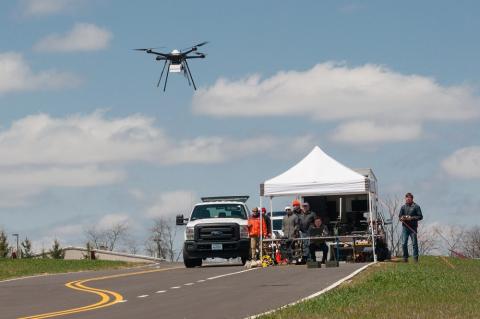
The Virginia Tech Mid-Atlantic Aviation Partnership and the Virginia Tech Transportation Institute recently participated in the latest iteration of NASA’s Unmanned Aircraft System (UAS) Traffic Management (UTM) research program.
A series of research flights conducted during the research program focused on how to enable unmanned vehicles to detect and avoid each other, which is one of the most complex issues in unmanned traffic management, and in the UAS industry in general.
Schiebel and Airbus Helicopters demonstrate Manned UnManned Teaming
On April 17, Schiebel’s Camcopter S-100 UAS and Airbus Helicopters’ manned H145 successfully completed a series of manned-unmanned teaming (MUM-T) flights.
The user onboard the manned aircraft was provided full command and control over the UAS and its payload — including launch and recovery — allowing Level 5 interoperability to be achieved.
The demonstration took place as part of a technology partnership between the Austrian Armaments and Defense Technology Agency and Schiebel. The purpose of the demonstration was to look into the benefits and challenges of delivering MUM-T flight operations, especially those with “highly valuable, mission-enhancing advantages for army aviation.”

uAvionix successfully tests and demonstrates DroneAware uAvionix UAS Remote Identification software for NASA's TCL3 UTM system
uAvionix has announced that it successfully completed testing and demonstration of the DroneAware uAvionix UAS Remote Identification software for NASA’s Technical Capability Level 3 (TCL3) UAS Traffic Management (UTM) system.
The tests were conducted in coordination with several entities, including North Dakota’s Northern Plains UAS Test Site (NP UAS TS), Simulyze, Rockwell Collins, and the University of Iowa Operator Performance Laboratory.

Textron Systems' CUSV demonstrated on Potomac River Test Range
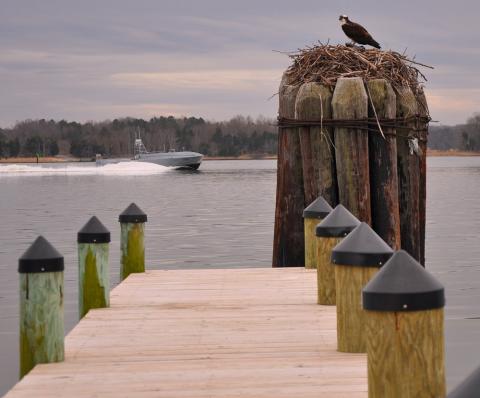
On March 28, Textron Systems' Common Unmanned Surface Vehicle (CUSV) autonomously conducted maneuvers on the Potomac River Test Range during a demonstration before an audience made up of government, defense contractors, and military personnel.
During the event, Navy and corporate leaders discussed their collaboration to weaponize a CUSV capable of multiple missions.
“The reason we collaborate is because we as a nation find ourselves in a situation where we can no longer take time to deliver capability to our warfighters,” says John Fiore, Naval Surface Warfare Center Dahlgren Division (NSWCDD) technical director, during the March 28 event.
Liberty County Sheriff's Office establishing aviation unit to utilize UAS
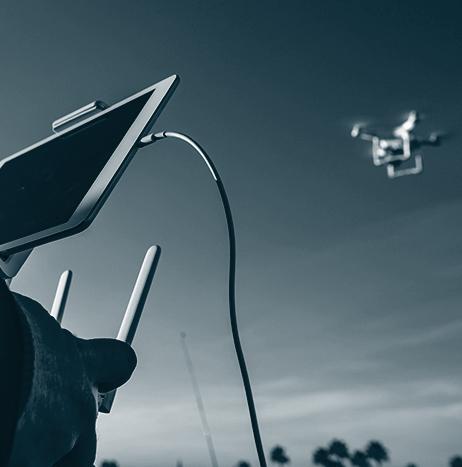
In Liberty, Texas, the Liberty County Sheriff’s Office has announced that it is establishing an aviation unit and utilizing small UAS for a variety of operations.
Using funds secured through court-awarded confiscated drug money, the agency purchased a Phantom 4 Pro Plus small UAS. The UAS was put into full operation the week of April 16, and has been placed under the command of the Special Operation Division of the Sheriff’s Office.
In a press release published on KFDM.com, Sheriff Bobby Rader explains the process that went into launching this program.
Weekend Roundup
This Week in the Unmanned Systems and Robotics World
According to the San Francisco Chronicle, Waymo recently applied to test cars without drivers on California roads. Waymo's application was submitted to the California Department of Motor Vehicles. Thus far, only two companies have applied for such permits, but the identity of the other company has yet to be publicly revealed. (San Francisco Chronicle)
Exyn Technologies and Velodyne LiDAR partner to develop fully autonomous indoor UAS
Exyn Technologies has announced that Velodyne LiDAR’s VLP-16 Puck LITE LiDAR sensors are now integrated into Exyn Technologies’ Advanced Autonomous Aerial Robots (A3R).
The primary sensor for simultaneous localization and mapping, the Velodyne VLP-16 is also part of the sense-and-avoid capabilities and state estimation.
“Using Velodyne’s VLP-16, Exyn’s A3Rs do not need GPS, beacons or markers,” explains Nader Elm, chief executive officer of Exyn Technologies.
Fully Autonomous Vehicle Testing Pilot Program launches in Connecticut
On April 17, Connecticut Governor Dannel P. Malloy announced the launch of Connecticut’s Fully Autonomous Vehicle Testing Pilot Program (FAVTPP).
Created by legislation that Malloy signed into law in 2017, FAVTPP is an initiative that will “help bring Connecticut to the forefront of the innovative and burgeoning autonomous vehicle industry.”
Under the terms of the program, interested towns and cities that would like to participate in FAVTPP and allow the testing of fully autonomous vehicles on their roadways must submit an application to the state. After a review is conducted, up to four municipalities will be selected for participation.

Bow Valley College to offer UAS certification courses starting in May
Through its School of Continuing Learning, Bow Valley College helps UAS enthusiasts and professional UAS operators alike prepare for new and updated aviation laws that will limit where and how UAS can be flown. So with this in mind, two comprehensive certification courses will be offered at Bow Valley College’s Okotoks and High River campuses in Alberta, Canada starting May 4.
The courses will provide theory and practical knowledge through a variety of measurers including in-class instruction, labs, seminars, two tests, and a certificate that requires renewal every five years.