
During the opening keynote of the GPU Technology Conference, NVIDIA founder and CEO Jensen Huang announced NVIDIA DRIVE Constellation, which is a computing platform based on two different servers.
The first server runs NVIDIA DRIVE Sim software to simulate a self-driving vehicle’s sensors, such as cameras, lidar and radar, while the second server contains an NVIDIA DRIVE Pegasus AI car computer that runs the “complete autonomous vehicle software stack and processes the simulated data as if it were coming from the sensors of a car driving on the road.”
NVIDIA says that the cloud-based system for testing autonomous vehicles using “photorealistic simulation” is a “safer, more scalable method” for bringing self-driving cars to the roads.
Technology
Technology
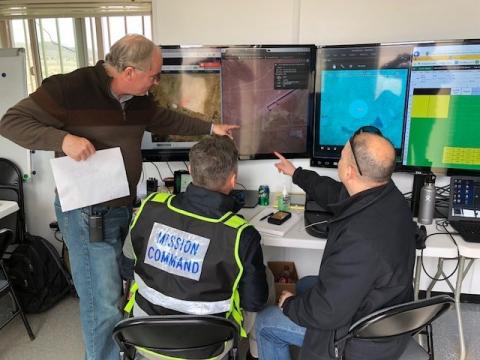
NIAS and its NASA UTM partners successfully test UAS at Nevada UAS Test Site at the Reno-Stead Airport
Along with its NASA Unmanned Traffic Management (UTM) partners, the Nevada Institute for Autonomous Systems (NIAS) recently flew multiple UAS over a week-long testing period at the Nevada UAS Test Site at the Reno-Stead Airport. NIAS manages the Nevada UAS Test Sites.
Testing focused on airspace management technologies that will enable the safe integration of UAS into the National Airspace System (NAS).
During testing, NASA provided a Flight Information Management System (FIMS) research platform. The platform will serve as a future prototype system for the FAA to use to coordinate with Unmanned Service Supplier's (USS) operating throughout the U.S.
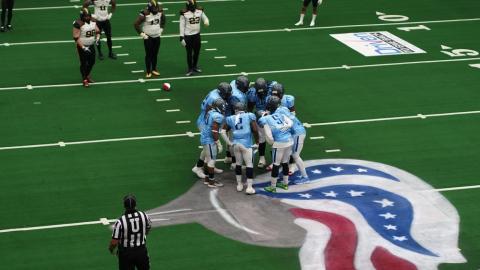
Kansas State Polytechnic's adds drone to professional indoor football team
Kansas State Polytechnic's Applied Aviation Research Center is collaborating with the Salina Liberty, a professional indoor football team in Salina, Kansas, to bring drone technology to the team’s home games this season.
Through the collaboration, the research center is using a UAS to perform a 35-foot ball drop to the head referee before opening kickoff. The research center is also using UAS to capture aerial footage of the games to livestream on the team's Facebook page.
The idea behind using a drone to release the game ball to the referee was sparked by one of the challenges in the NFL's Pro Bowl Skills Showdown called drone drop.
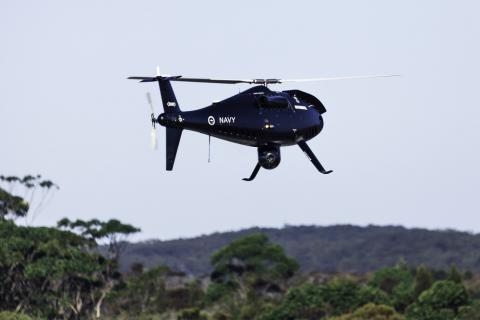
Schiebel successfully demonstrates heavy fuel variant of CAMCOPTER S-100 UAS to Royal Australian Navy customer
As part of its customer acceptance program with the Royal Australian Navy (RAN), Schiebel successfully demonstrated the heavy fuel variant of its CAMCOPTER S-100 UAS.
The UAS successfully completed its flying program for the RAN validation and verification customer acceptance program at the Jervis Bay Airfield facilities in New South Wales, Australia.
Schiebel says that in a comprehensive series of tests, the JP-5 (NATO F-44) heavy fuel powered CAMCOPTER S-100, equipped with a “Wescam MX-10S payload,” and at operational ranges of up to 60 nautical miles as well as altitudes above 10,000 feet, showcased its ability to deliver world-class imagery to commanders.
Weekend Roundup
This Week in the Unmanned Systems and Robotics World
Walmart has reportedly filed a patent for autonomous robotic bees that could potentially pollinate crops like real bees. Technically known as pollination drones, the autonomous robotic bees would carry pollen from one plant to another, using sensors and cameras to detect the crops’ locations. (ScienceAlert)

Southwest Research Institute-led team developing UAS to use in Japan's Fukushima Daiichi Nuclear Power Plant
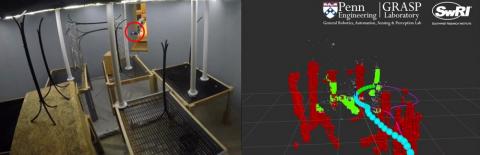
Southwest Research Institute (SwRI) is leading a team that is developing UAS technology to fly into the containment vessels of the damaged units at Japan’s Fukushima Daiichi nuclear power station and assess conditions.
SwRI was contracted by Tokyo Electric Power Company Holdings, Incorporated (TEPCO Holdings) to explore the use of UAS within the containment.
SwRI engineers are working with the General Robotics, Automation, Sensing and Perception (GRASP) Lab at the University of Pennsylvania (Penn) School of Engineering and Applied Science, to help “adapt small drones to autonomously operate within the containment.”
Persistent Systems' new upper C-band module can be used for UAS operations
Persistent Systems has announced the release of its Upper C-Band module for the MPU5 mobile ad hoc networking (MANET) radio, which transmits and relays voice, video, text, and sensor data in a “robust, peer-to-peer fashion.”
Certified for unlicensed use in the Industrial, Scientific, and Medical (ISM) Band, the new 5.1 to 5.9 GHz radio module will allow MPU5 users around the world to utilize the MANET for various commercial applications, including UAS operations, Industrial Internet of Things (IoT) networking, and live event video streaming.
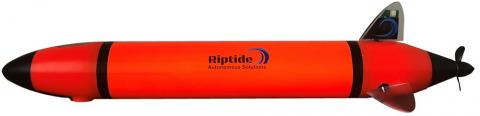
Riptide releases second generation micro UUV
Riptide Autonomous Solutions launched its second generation “micro” UUV product during Oceanology International 2018 in London.
Riptide says that the MK II product offers “significant improvements” over the MK I µUUV.
With a focus on performance and manufacturability improvements, the new MKII µUUV has undergone a “near-total redesign of internal electronics.” As a result, it offers a “nearly 70% reduction” in hotel load power to 3.5 Watts, which extends vehicle endurance across the vehicle speed regime.
New manufacturing approaches—including increased use of molded parts instead of 3-D printed parts—allows for “expanded depth ratings, faster production times and improved quality assurance.”
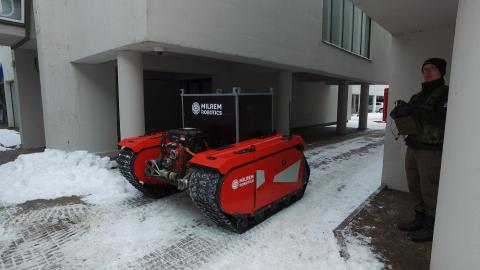
Milrem Robotics developing firefighting and search and rescue UGV
Milrem Robotics is developing a firefighting and search and rescue UGV called Multiscope Rescue.
The UGV, which is being developed together with rescue services, is built to reach areas that are unreachable by human personnel or too dangerous for firefighters to go into, such as tunnels or other structures that may collapse at any time.
The UGV can be equipped with firefighting equipment such as a water tank and a remotely controlled water cannon. It can also be equipped with thermal cameras and powerful lights to locate missing people in harsh environments or remote forested areas.
Kansas State Polytechnic introduces UAS to the world of professional indoor football
Kansas State Polytechnic's Applied Aviation Research Center is collaborating with the Salina Liberty, a professional indoor football team in Salina, Kansas, to bring UAS technology to the team’s home games this season.
Through the collaboration, the research center is using a UAS to perform a 35-foot ball drop to the head referee before opening kickoff. The research center is also using UAS to capture aerial footage of the games to livestream on the team's Facebook page.
“We see drones as a way to enhance the in-game experience for the fans, giving them a unique view of the action on the field, so we're excited that Kansas State Polytechnic was so receptive to the idea,” says Ricky Bertz, Salina Liberty CEO and co-owner.