During the week of March 5, Drone Delivery Canada (DDC) successfully completed its first UAS test flights in the United States at the Griffiss International Airport in Rome, New York.
Testing was conducted using DDC's Sparrow cargo delivery UAS, which has a lifting capacity of five kilograms. DDC also tested its mission control operations, its proprietary FLYTE management system, and its proprietary DroneSpot Technology, which provides “secure and controlled take off and landing area for users to interact with.”
Technology
Technology
Oceans Unmanned's freeFLY program uses UAS for large whale entanglement response efforts
In partnership with NOAA Hawaiian Islands Humpback Whale National Marine Sanctuary (HIHWNMS), Oceans Unmanned, Inc. has launched the freeFLY Program, which is a new initiative that uses small UAS to provide aerial support for large whale entanglement response efforts off of Maui, Hawaii.
The freeFLY Program provides training, equipment, and management oversight to a network of local, Maui-based volunteer UAS operators that are available to support the Hawaiian Islands Entanglement Response Network, led by HIHWNMS.
The goals of the Network are to safely free endangered humpback whales and other marine animals from life threatening entanglements, while also collecting crucial information that will lower entanglement threats in the future.

Weekend Roundup
This Week in the Unmanned Systems and Robotics World
From April 19 to 20, the UAS/Drones for Disaster Response conference will help key stakeholders that are responsible for responding to disasters better understand how UAS and other unmanned systems can enhance their efforts during missions. The conference will be held at the Biscayne Bay Campus of Florida International University. (PR Web)
WPI students building autonomous security robot for U.S. Air Force
A team of undergraduate students at Worcester Polytechnic Institute (WPI) in Worcester, Massachusetts is attempting to turn a wheelchair into an autonomous security robot that could help protect unmanned installations for the U.S. Air Force.
The students are building this proof-of-concept robot using a tracked all-terrain wheelchair (trackchair)— provided by a company called Action Trackchair Inc.—and about $8,000 for supplies.
According to WPI, the military wants to have robots at unmanned bases that can respond to and investigate intrusion alarms and other warnings within two minutes. The robots would be used to safeguard thousands of unmanned bases, such as missile silos, around the world.
Boaty McBoatface AUV successfully completes first under-ice Antarctic mission
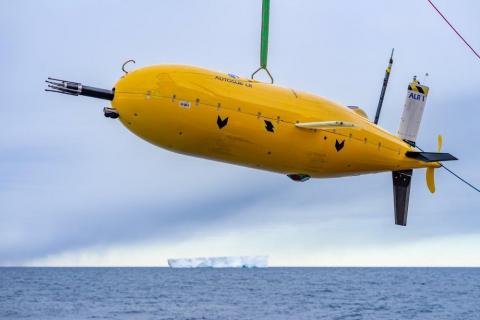
Last week, the National Oceanography Centre’s (NOC) Autosub Long Range (ALR) AUV —popularly known around the world as ‘Boaty McBoatface’—was successfully recovered following its first under-ice mission beneath the Filchner Ice Shelf in West Antarctica.
The AUV was deployed in the southern Weddell Sea from January to February 2018 during RV Polarstern cruise PS111, as part of the Filchner Ice Shelf System (FISS) Project, which is a collaboration that involves several leading UK research institutions, including the NOC.
The AUV plays an important role in the project that aims to investigate and describe the “current state of the complex atmosphere-ice-ocean system.”
U.S. Department of the Interior adding up to 50 VTOL fixed wing UAS to its fleet
The U.S. Department of the Interior (DOI) has announced that it will soon have the use of up to 50 Vertical Take Off and Landing (VTOL) fixed wing UAS.
The new UAS are a result of an extended process to develop mission performance requirements and select the most useful type of aircraft to meet the needs. Andover, New Hampshire-based startup company Birdseyeview Aerobotics was awarded a contract to produce and train on the new UAS.
The new UAS weigh less than 10 pounds and are capable of carrying a variety of modular sensors. They have a service ceiling of 12,000 feet, and are operable in winds up to 25 knots.
Oakland University professor uses UAS to combat ill effects of climate change on crops in Africa
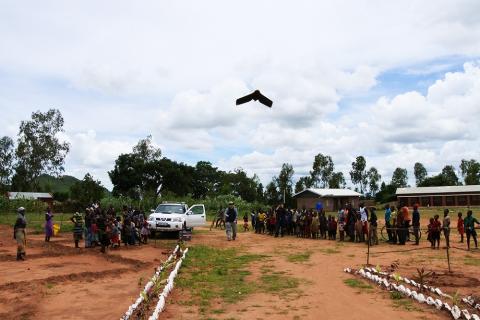
Oakland University professor Jon Carroll, Ph.D., is part of a team of scholars that is using UAS technology to “promote sustainable agriculture in Africa.”
Recently, Carroll, who is also an FAA-licensed UAS pilot and a Registered Professional Archaeologist, traveled to Liwonde, Malawi to work on a research project called “Precision Agriculture for Smallholder Systems in Africa,” which is helping farmers boost crop production in the face of emerging threats posed by climate change.
Kansas State Polytechnic offering Part 107 prep course in Denver area just ahead of XPONENTIAL 2018
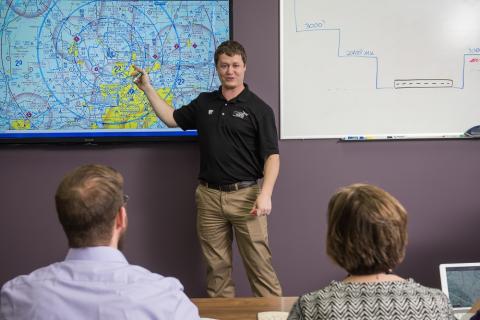
Right before the start of AUVSI’s XPONENTIAL conference, which will be held in Denver, Colorado from April 30 to May 3, Kansas State University's Polytechnic Campus will offer its Part 107 preparation course in the Denver area from April 27 to 29.
Designed to prepare professionals for the FAA’s written exam—which is required for anyone who wants to operate a commercial small UAS, who does not already hold a manned pilot certificate—the course will focus on areas covered in the FAA written exam, including “adherence to FAA rules and regulations pertinent to small unmanned aircraft operations, how to set up sUAS within FAA regulations and the application of safety practices in flight.”
Weekend Roundup
This Week in the Unmanned Systems and Robotics World
Elistair has announced the launch of its ORION UAS, which is the “next generation of persistent tethered drone systems,” according to the company. Elistair says that the UAS is designed for semi-persistent aerial surveillance and telecommunications needs, allowing it to handle the most difficult missions across a variety of sectors, including law enforcement, private and public safety, and national security, just to name a few. (Elistair)

EasyMile autonomous shuttle bus makes history in California
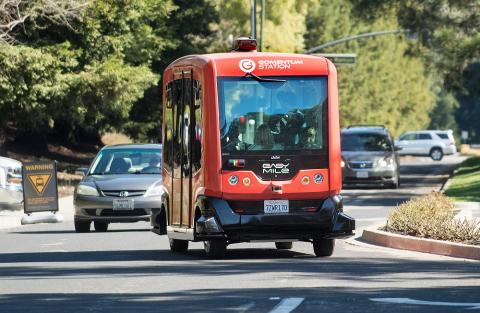
An EasyMile autonomous shuttle bus became the first vehicle to operate on California's roads without a driver behind the wheel on Tuesday, March 6. The vehicle operated on the roads of San Ramon, California.
With its historic journey, EasyMile’s autonomous shuttle bus became the first vehicle to take advantage of recently approved regulations governing the driverless testing and public use of autonomous vehicles on California roads.