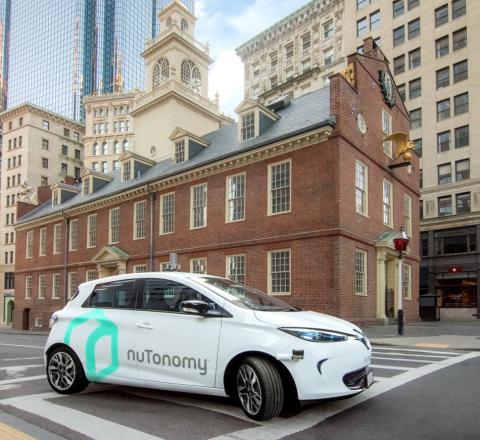
Ford and on-demand delivery company Postmates have announced that they will work together to “explore the sustainable application of self-driving technologies within local economies.”
Through this partnership, Postmates becomes the first on-demand delivery partner for Ford’s self-driving program.
During the first phase of their pilot, Ford and Postmates will evaluate and measure several things, including “what the merchant experience needs to be at the point of delivery, what the customer experience needs at the point of drop-off, and how the hardware of self-driving technology may need to be outfitted when integrated with an on-demand network.”
Commercial
Commercial

AeroVironment announces joint venture to develop solar-powered HALE UAS
AeroVironment, Inc. has announced the formation of a joint venture to develop solar-powered high-altitude long-endurance (HALE) UAS for commercial operations.
The joint venture, known as HAPSMobile, Inc., will fund the development program up to a net maximum value of $65,011,481.
HAPSMobile, Inc. is a Japanese corporation that is 95 percent funded and owned by SoftBank Corp., which is a telecommunications operator based in Japan. The remaining five percent of the joint venture is funded and owned by AeroVironment, which is committed to contribute $5 million in capital for its five percent ownership of HAPSMobile.
AeroVironment has an option to increase its ownership stake in HAPSMobile “up to 19 percent at the same cost basis as its initial 5 percent purchase.”

Weekend Roundup
A Federal Aviation Administration panel has recommended ways to track and identify flying drones, but hasn’t reached a consensus as to whether hobbyist drones should be included. The Academy of Model Aeronautics says no, but other groups say they should be. (USA Today)
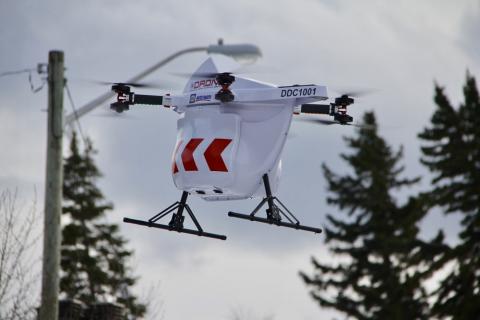
Drone Delivery Canada's cargo delivery UAS now compliant with Transport Canada UAS standard
Drone Delivery Canada (DDC) has announced that Transport Canada has accepted its Declaration of Compliance for the X1000 Sparrow cargo delivery UAS, which makes the UAS compliant with the Transport Canada UAS standard.
The Sparrow UAS, which has demonstrated a “history of safe operation in some of the harshest environmental conditions in Canada’s north” during recent research and development flights according to DDC, is the first cargo delivery UAS of its kind to be accepted under the Transport Canada, Compliant UAS program.
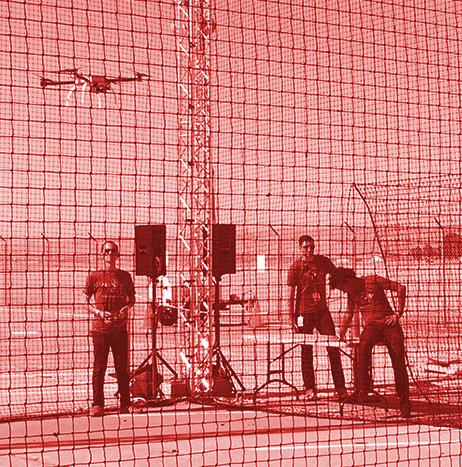
Warm Springs FAA UAS Test Range to offer UAS pilot training course in January
From Jan. 11 to 15, 2018, Warm Springs FAA UAS Test Range will offer a UAS pilot training course to train the next generation of career-oriented UAS enthusiasts to enter the commercial services market.
The training course will consist of four components: Part 107 training to earn FAA certification for safe and legal operations, hands-on flight training to teach the fundamentals of flying a UAS, UAS operational safety training to improve safety and operational performance skills, and a commercial enterprise course to teach UAS enthusiasts how to make money flying UAS.
Minnesota Department of Transportation begins testing autonomous shuttle bus
On Dec. 12, an EasyMile-manufactured autonomous shuttle bus made its debut on the road in Minnesota, as a part of the Minnesota Department of Transportation's (MnDOT) autonomous shuttle bus pilot project.
The vehicle operated in light snow, which is productive for the overall goal of the pilot project, which is to test and analyze how autonomous vehicles operate in cold weather.
“I can't think of a better day in Minnesota to show off and test this autonomous technology,” says MnDOT Commissioner Charles Zelle, via the Star Tribune. “We have just the right amount of snowflakes, a little ice on the road.”
Nissan and DeNA unveil mobility service featuring autonomous driving technology
Nissan Motor Co., Ltd. and DeNA Co., Ltd. have unveiled their Easy Ride mobility service that will utilize autonomous driving technology.
Easy Ride’s concept is “more freedom of mobility,” and it is “envisioned as a service for anyone who wants to travel freely to their destination of choice in a robo-vehicle.”
For Easy Ride customers, the goal is for them to be able to complete the entire process— from setting destinations and summoning vehicles to paying the fare—through a dedicated mobile app.
Customers will also be able to select recommended local destinations and sightseeing routes depending on their objectives.

AUVSI XPONENTIAL 2020
Join more than 8,500 technologists, regulators and users at AUVSI XPONENTIAL 2020 – the world’s largest conference for unmanned and autonomous technology.
Gainesville Autonomous Transit Shuttle to launch in Gainesville, Florida next May
Starting in May, students trying to get to the University of Florida campus will have a new option of transportation in the form of the Gainesville Autonomous Transit Shuttle (GAToRS).
The city of Gainesville will have three of these shuttles, which will be funded by a state grant of $2.6 million.
According to the University of Florida’s Transportation Institute, the shuttle, which will carry 12 people each and run in a loop every 10 to 20 minutes, is expected to provide a number of benefits; chief among them, lowering the number of crashes and pollution, while simultaneously increasing mobility for the public and improving traffic flows.

NuTonomy and Lyft bringing self-driving vehicles to Boston roads before end of 2017
After agreeing to a research and development partnership earlier this year, nuTonomy and Lyft will begin offering driverless Lyft rides to the public in Boston. According to the Boston Globe, those rides are expected to begin before the end of 2017.