
DARPA’s Collaborative Operations in Denied Environment (CODE) program seeks to extend the capability of the U.S. military’s existing UAS to conduct “dynamic, long-distance engagements of highly mobile ground and maritime targets in contested or denied battlespaces.”
With this in mind, DARPA has selected the Raytheon Company to complete the development of the CODE software during Phase 3.
Up to this point, the CODE program has conducted Phase 2 flight test series with teams led by Lockheed Martin and Raytheon, and the software open architecture and test-support framework has been validated. The teams completed several flight tests at Naval Air Weapons Station China Lake in California.
Defense
Defense
Save the Date: AUVSI Unmanned Systems Defense. Protection. Security., Feb. 6 to 8, 2018
FOR IMMEDIATE RELEASE: Jan. 3, 2018
Contact: Tom McMahon, tmcmahon@auvsi.org, (571) 255-7786
Protecting Government Holdings with Unmanned Systems
The Department of Defense and defense contractors have traditionally embraced the use of unmanned technology, but in recent years other government agencies have begun to introduce unmanned systems into their operating procedures. Our panel of speakers will highlight the growing number of public organizations using unmanned systems. Attendees will learn about efforts, within and beyond the Department of Defense, to leverage unmanned technology.
This webinar will provide a preview of AUVSI Unmanned Systems Defense. Protection. Security., the most comprehensive military- and government-focused event in the unmanned systems industry, where experts will address innovation, investment, and sustainability challenges and opportunities.
Who Should Attend?
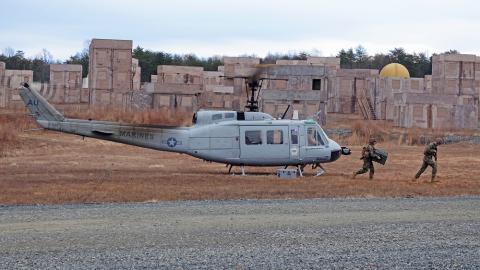
Aurora successfully demonstrates Autonomous UH-1H helicopter at Marine Corps Base Quantico
On Dec. 13, Aurora Flight Sciences conducted a successful demonstration of its autonomous helicopter system, which was developed under the Office of Naval Research’s (ONR) Autonomous Aerial Cargo Utility System (AACUS) program.
Over the course of several flights at Marine Corps Base Quantico’s Urban Training Center in Quantico, Virginia, the AACUS-Enabled UH-1H (AEH-1) demonstrated its ability to “autonomously execute resupply missions in relevant and austere settings.”
AACUS, which is an “aircraft-agnostic hardware and software suite,” allows a Marine on the ground to use a handheld tablet to request a supply delivery via helicopter. No advanced training is required to operate the system.
AUVSI XPONENTIAL 2020
Join more than 8,500 technologists, regulators and users at AUVSI XPONENTIAL 2020 – the world’s largest conference for unmanned and autonomous technology.
Global defense company selects RADA's Multi-mission Hemispheric Radar to support UAS operations
After conducting an in-depth survey of relevant radar technologies, a leading global defense company has selected the extended version of RADA Electronic Industries Ltd.'s (RADA) Multi-mission Hemispheric Radar (ieMHR) to support its industrial UAS operations.
The ieMHR supports UAS operations by creating safe flight zones when the UAS is applied for surveillance and security missions, which could include, for example, the surveillance of critical infrastructure such as energy production facilities.
“We are proud to have been selected once again by a leading global defense company for highly advanced applications of our radar technology,” says Dov Sella, RADA’s CEO.

Innovation Challenge to put startups before exclusive audience
AUVSI’s Innovation Challenge, which will be part of Unmanned Systems — Defense. Protection. Security (USDPS) will allow companies to pitch their technology to the show’s audience and a high-level advisory panel.
It’s an opportunity for small, start-up and early-stage companies operating in the commercial, defense, and non-traditional unmanned systems or autonomous systems spheres to present their technology to government and industry representatives.
Advisory Panel members include Orin Hoffman, autonomy and robotics HQE, DIUx; Bob Sadowski, chief roboticist, U.S. Army; Frank Kelley, deputy assistant secretary of the Navy for Unmanned Systems (DASN (UxS)); and other defense and government industry experts.
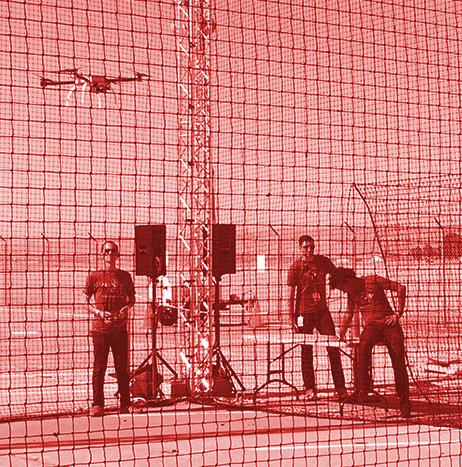
Inside the November-December issue of Unmanned Systems magazine
The November-December issue of Unmanned Systems looks at robots on the farm, which can do everything from pick strawberries to use multispectral imaging from the air; the second part of a market review for UAS sensors and the factors driving new growth; and a story about how utilities are using unmanned systems to quickly recover from damaging storms. That and much more, including our popular Viewfinder aerial photo gallery and a look at a recent meeting of the International Civil Aviation Organization about establishing an air traffic management system for drones.
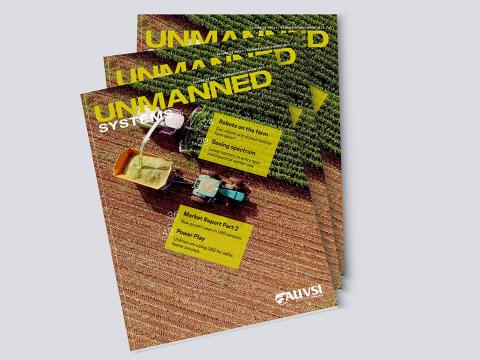
From Unmanned Systems magazine: Market Report Part 2: Legacy geographies point to new growth in radio frequency UAS sensors
Airborne synthetic aperture radars, or SARs, process radar returns as if they were collected by an antenna as much as several hundred meters long.
This “synthetic” antenna aperture is created by the movement of the aircraft itself — which is why airships do not make good SAR platforms — and allows a “parallax view” of the ground similar to a stereoscopic optical image. SARs were developed during the Cold War for their radio frequency ability to provide ground reconnaissance through the clouds and bad weather in Europe, unlike visual, infrared, and even hyperspectral sensors, and for ground moving target indication, which measures the displacement of vehicles and other objects during the radar scan.

Persistent Systems to provide its MPU5 radio to Endeavor Robotics for US Army UGVs
Persistent Systems, LLC, which is a leader in Mobile Ad hoc Network (MANET) technology, has announced that it is a part of Endeavor Robotics’ winning team for the US Army’s MTRS Inc II Award (Man-Transportable Robotic System Increment II), which is a $100 million contract award.
The award has an option for an additional “$58 million worth of deliverables” to provide a fleet of up to 1,200 mid-sized UGVs to the US Army.
As Endeavor’s MANET radio of choice, Persistent Systems’ MPU5 radio will provide “secure and long-range data communication” for C2 (command and control), video, CBRNe, and other vital sensor data.