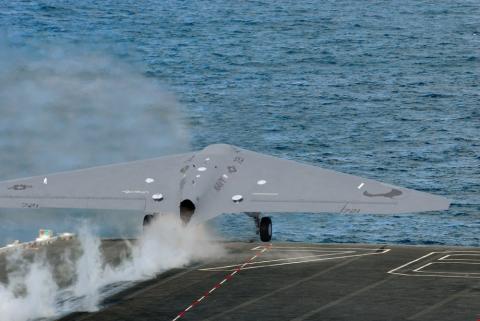
Companies that export unmanned systems or related components to customers abroad; who collaborate with overseas companies in the development or production process; or who share technical data with foreign nationals in the United States need to be aware of the potential impact of export control laws and regulations.
Export controls restrict the cross-border flow of strategic technologies and can even restrict the release of certain technical information within the United States. These restrictions can apply to unmanned systems and their related components and technical data.
This article provides an overview of U.S. commercial and military export controls, assesses how export controls apply to unmanned systems and provides compliance tips.
Defense
Defense
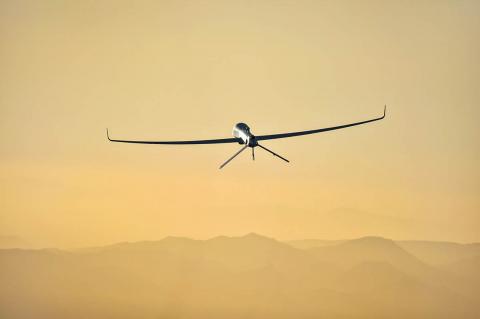
Aurora's Autonomous Aerial Cargo Utility System successfully delivers cargo to US Marines
In early May, Aurora’s Autonomous Aerial Cargo Utility System (AACUS) successfully delivered cargo to U.S. Marines in the Integrated Training Exercise at the Marine Corps Air Ground Combat Center Twentynine Palms in California.
According to Aurora Flight Sciences, AACUS completed its first closed loop mission from takeoff to landing for its intended purpose of actual cargo resupply to Marines, as it successfully completed an autonomous cargo sustainment flight delivering more than 500 pounds of water, gasoline, MREs, and replacement communications gear including a packed cooler to represent urgently required cargo such as blood.
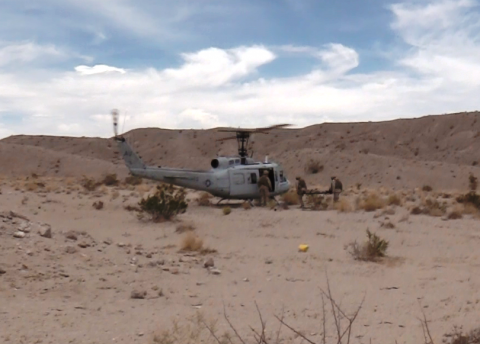
Team Polaris' MRZR X selected by U.S. Army for trials as part of SMET program
The U.S. Army has selected Team Polaris—made up of Polaris Industries Inc., Applied Research Associates Inc. (ARA) and Neya Systems LLC—and its advanced MRZR X multi-mode vehicle platform to be one of the robotic systems used by infantry brigade combat teams for the next year of trials, as part of the Squad Multipurpose Equipment Transport (SMET) program.
Warfighters using the MRZR X are provided with a “modular, multi-mission support platform” that has several modes of operation, from traditional operator driving to multiple levels of autonomy, including the capability for remote control, teleoperation, follow-me, leader-follower and full autonomy.
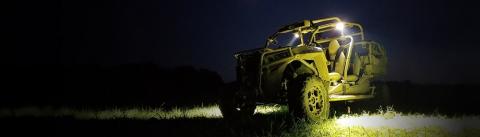
Endeavor Robotics to supply U.S. Marine Corps with its Firstlook 'throwable' robots
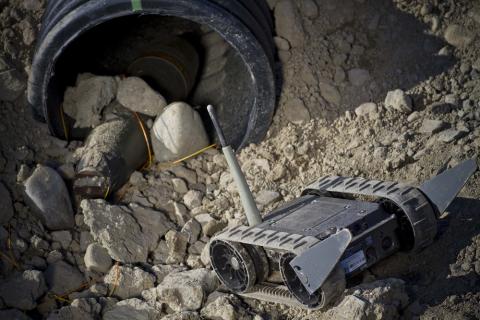
The U.S. Marine Corps has awarded Endeavor Robotics a $10 million contract for its “lightweight, battle-proven” FirstLook robots.
Weighing in at five pounds, the ‘throwable’ FirstLook robot can be dropped roughly 20 feet onto concrete without sustaining damage. The robots are typically used to clear buildings, detect IEDs, and are also a top choice for confined spaces like caves, tunnels and crawl spaces.
More than 1,000 FirstLook robots have been fielded across the world to military, law enforcement and industrial customers.
Aeryon Defense provides details on new R80D SkyRaider UAS
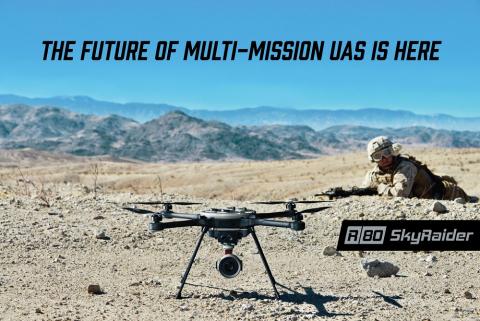
Aeryon Defense USA has released details on the R80D SkyRaider, which is the company's new multi-mission Defense and Federal Government Group 1 vertical takeoff and landing (VTOL) small UAS.
Aeryon Defense calls the SkyRaider its “most advanced military-grade sUAS,” as it delivers “a range of versatile Group 2-3 payload capabilities with the agility and single-operator deployment footprint of a proven Group 1 VTOL aircraft.” Some of the SkyRaider's core capabilities include Tactical Intelligence Surveillance and Reconnaissance (ISR), Persistent Overwatch and payload delivery.
Altavian to support largest small UAS program in the world thanks to new contract with US Army
Altavian, Inc. has been awarded a $250 million Indefinite Delivery, Indefinite Quantity contract with the US Army.
Altavian will support the largest small UAS program in the world, under the Program Executive Office Aviation, Products Office for Tactical Unmanned Aircraft (TUAS).
The US Army Family of Systems, Unmanned Aircraft Systems (FoSUAS) includes the RQ-11 and RQ-20 UAS, as well as supporting control and communications equipment, and other technologies to be fielded over the contract period of performance.
All systems are designed to be carried by a “single dismounted warfighter,” quickly assembled, and deployed to provide “immediate over-the-hill surveillance and reconnaissance.”

Dynetics selected as top performer for Phase 3 of DARPA's Gremlins program
Dynetics, Inc. has been selected as the top performer for Phase 3 of DARPA’s Gremlins program.
The objective of Gremlins is to “accelerate the ability to perform aerial launch and recovery of volley quantities” of low-cost, reusable UAS. Once demonstrated and matured, this capability enables a “significant expansion of distributed architectures for airborne operations.”
The Phase 3 contract is a 21-month, $38.6 million award, and the entire program will last 43 months, totaling $64 million.
Colorado’s energy, attributes attract unmanned systems industry
When Canada’s Aeryon Labs decided to set up a separate defense-focused company so it could work with the U.S. military on unmanned systems programs, it quickly settled on Colorado — and specifically Denver — as home for the new Aeryon Defense, which just launched on Feb. 1.
Tom Jackson, a retired U.S. Marine Corps officer and AH-1W Super Cobra pilot who is the company’s vice president and general manager, was already in the area, as were other employees who formed the nucleus of the new venture.
Beyond that, however, the state and city offered some unique attributes. Colorado is very centrally located, so it’s easier for the company to support multiple time zones and for company officials to travel to defense facilities around the country.

Maritime leadership pushing for unmanned systems, speakers say
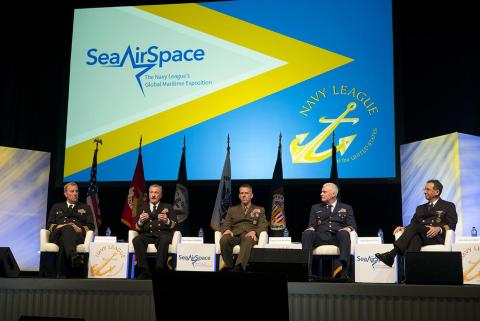
Senior leadership at the U.S. Navy, Marine Corps and Coast Guard are pushing to get unmanned and autonomous technology into the field quickly, panelists said Wednesday at the Navy League’s Sea-Air-Space conference in Maryland.
“We have an imperative from our senior leadership to move quickly,” said Brig. Gen. Christian Wortman, the vice chief of naval research and commander of the Marine Corps Warfighting Lab.
Rear Adm. Mark Darrah, program executive officer for unmanned aviation and strike weapons, agreed, noting the Navy is flying the Fire Scout unmanned helicopter alongside manned aircraft every day at Naval Air Station Patuxent River.
“At the upper levels, we have that covered,” he said.
Lockheed Martin's unmanned MQ-25 tanker designed with the Navy's needs in mind
During a media briefing at Sea-Air-Space 2018 in National Harbor, Maryland, Lockheed Martin Skunk Works’ leaders described the company’s MQ-25 unmanned tanker concept as a “tremendous, high performing tanker/airplane” for the Navy.
The “purpose-built” tanker’s configuration has a “clean sheet design,” the company says. According to Rob Weiss, vice president and general manager for Lockheed Martin Skunk Works, the aircraft’s configuration is a result of the Skunk Works’ team listening to its customer.