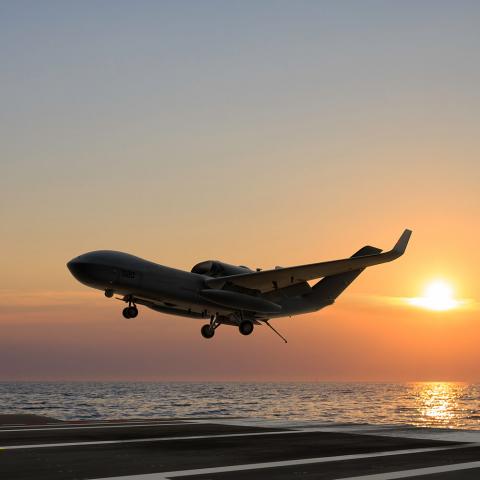
Counter-small unmanned aircraft systems technology has emerged as one of the most prominent growth areas in the defense and security markets in recent years, as governments seek to not only defend critical infrastructure from violent extremist organizations and near-peer adversaries, but also from errant hobbyists.
Threats across the contemporary operating environment stretch from the employment of airborne improvised explosive devices (ABIEDs) by the likes of the self-proclaimed Islamic State in Iraq and Syria, to the breaching of national airspace at major airports by commercially available air frames.
Defense
Defense
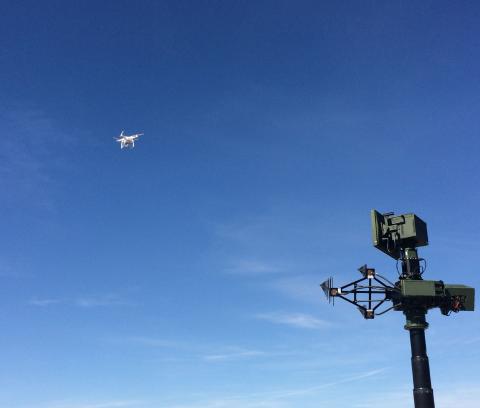
Boeing to build U.S. Navy's first operational carrier-based unmanned aircraft
On Aug. 30, the U.S. Navy awarded Boeing an $805 million contract to build the Navy’s first operational carrier-based unmanned aircraft, the MQ-25 aerial refueler, selecting the company over bids from Lockheed Martin and General Atomics.
Boeing was awarded the engineering and manufacturing development contract to provide an initial four aircraft.
“As a company, we made an investment in both our team and in an unmanned aircraft system that meets the U.S. Navy’s refueling requirements,” says Leanne Caret, president and CEO, Boeing Defense, Space & Security.
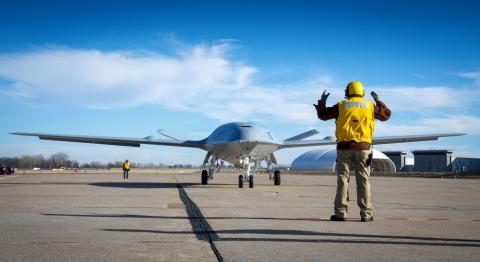
AeroVironment's MacCready Works lab donates Quantix UAS to West Point Military Academy
AeroVironment Inc.’s MacCready Works lab has donated automated Quantix hybrid UAS, spare parts and AeroVironment’s Decision Support System (AV DSS) analytics software to the United States Military Academy, also known as West Point.
The UAS and accompanying parts and software will support West Point’s Center for Innovation and Engineering and Geography and Environmental Engineering Department.

Army Research Laboratory and Bell Helicopter seek to advance development of micro UAS
In June, researchers from the U.S. Army Research Laboratory (ARL) and Bell Helicopter met to further advance the development of a micro UAS.
Described as a “miniature, lightweight reconnaissance vehicle,” the UAS is designed to be carried onto the battlefield by soldiers, and deployed in a confined space.
The relationship between Bell and ARL has roots dating back to November 2016, when Bell representatives attended ARL's open campus event. The two entities spent a year and a half building their relationship and sharing information before signing a five-year cooperative research and development agreement (CRADA) in March 2018.
From Unmanned Systems Magazine: Interoperability efforts are changing the way robots are used in the field
During the more than 17 years of continuous warfare in Iraq and Afghanistan, improvised explosive devices (IEDs) have proven to pose the most serious threat to service members stationed in combat theaters. Mitigating this threat, as such, has emerged as a primary mission for engineering and design teams in both industry and the U.S. Department of Defense.
Additionally, research teams are well aware of the utility UAS can provide in the intelligence, surveillance and reconnaissance (ISR) realm. Perimeters of harbors and land-based installations can be monitored and kept clear of obstacles and potential threats — without placing human lives in harm’s way.
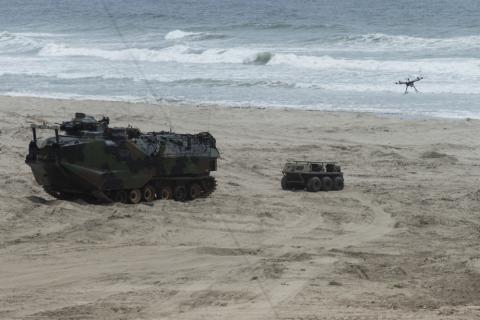
Pierce Aerospace receives USAF SBIR award for its remote identification system for UAS
Pierce Aerospace has received a U.S. Air Force Small Business Innovation Research Grant award for its work on Flight Portal ID, a remote identification system for UAS.
According to Pierce Aerospace, Flight Portal ID has received international attention for its “sensible approach” to solving the industry challenges of identifying UAS, including its recognition by the International Civil Aviation Organization last fall.
RADA receives $4 million in radar orders; company's radars can be used for counter UAS tech
RADA Electronic Industries Ltd. has announced that during the second quarter, it received $4 million in radar orders.
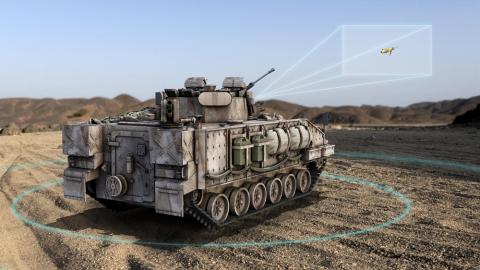
The orders were for the company’s software-defined radars, and will be used in “today’s most advanced defense applications,” RADA says, including active protection systems (APS) for armored vehicles, counter rocket artillery and mortar (C-RAM), counter UAS and short range air defense (SHORAD).
According to RADA, a third of the orders were follow-on-sales from existing customers, while the remaining orders were from “new and highly strategic customers,” such as leading defense organizations. Additionally, these orders represent initial sales from which RADA expects further follow-on orders in the future.
U.S. Navy awards CACI contract to support deployment of counter UAS platforms
The U.S. Navy has awarded CACI International Inc. a $48.5 million single-award, “indefinite delivery/indefinite quantity contract” to provide integration, installation, sustainment, and engineering services to the Naval Air Systems Command Naval Air Warfare Center Aircraft Division (NAWCAD) AIRWorks Rapid Development Capabilities Integrated Product team.
CACI develops, deploys, and integrates counter-UAS technologies with its SkyTracker product suite, providing “fixed site, on-the-move, and man-packable and small form factor technologies.”
Lockheed Martin selected as Integrated Systems Developer for US Army's TARDEC ExLF program
The U.S. Army's Tank Automotive Research, Development and Engineering Center (TARDEC) has selected Lockheed Martin as the Integrated Systems Developer for its Expedient Leader Follower (ExLF) program.
Under this role, Lockheed Martin will lead a three-year effort to develop, integrate and test “unmanned prototype systems” that support leader/follower convoy activities within an asymmetric threat environment.
Using the prototypes developed in the ExLF program, soldiers will conduct operational technology demonstrations to not only establish operating procedures, but also shape future programs of record.
GA-ASI completes testing of arresting hook Hold Down Damper for MQ-25 UAS
General Atomics Aeronautical Systems Inc. (GA-ASI) has finished performance testing of the arresting hook Hold Down Damper (HDD) for its proposed MQ-25 unmanned aerial refueling aircraft for the U.S. Navy.
GA-ASI worked with a team from GKN Aerospace’s Fokker business unit in Helmond, Netherlands. Fokker is scheduled to supply the arresting hook for GA-ASI's bid.
“The tests successfully validated the dynamic simulation model for our HDD for MQ-25,” says David R. Alexander, president, Aircraft Systems, GA-ASI.