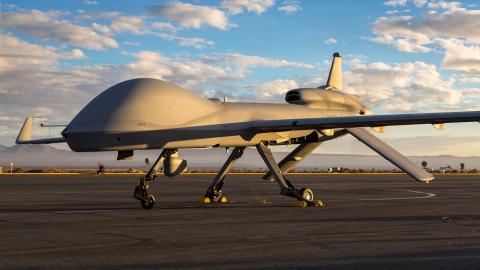
Patrick H. Mason, a member of the Senior Executive Service, and the relatively new deputy program executive officer for the U.S. Army’s PEO Aviation, has a challenging duty — helping bring the Army PEO Aviation’s 2018 Strategic Plan to life, which includes delivering capabilities to warfighters faster, streamlining the acquisition process and building a better workforce.
Mason assumed the Huntsville, Alabama-based role in May 2017. He was the commander of the Redstone Technical Test Center and most recently as the chief of staff for the Aviation Development Directorate of the U.S. Army Aviation and Missile Research, Development and Engineering Center.
Defense
Defense
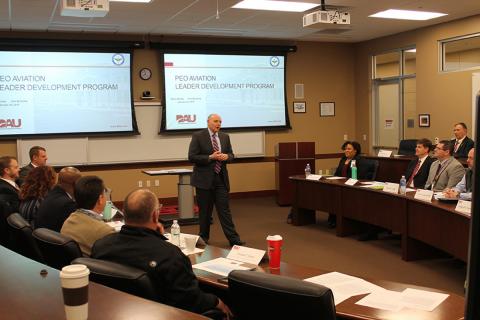
QinetiQ Target Systems and Canadian UAVs partner to provide UAS services for military and commercial markets in Canada
Two of Canada’s leaders in the UAS space have announced that they will begin working together.
QinetiQ Target Systems and Canadian UAVs (CUAVs) have signed a Memorandum of Understanding (MoU) that outlines their collaborative efforts to produce the “best of breed” platforms for military and commercial markets.
The focus of the agreement is providing services to clients that require long range, endurance and payload capacity primarily with the Skeldar V200 UAS, Mosquito UHV-T Group 2 UAS and the class 1 UAS Snyper.

Kratos opens new UAS production facility in Oklahoma City
Kratos Defense & Security Solutions Inc. recently cut the ribbon on its new 100,000 square foot UAS production facility, which is located in the Will Rogers Business Park in Oklahoma City, Oklahoma.
According to Kratos, the new facility will be used to accommodate existing and expected increased demand for its newest line of high performance, jet powered unmanned aerial tactical and target UAS.
Kratos says that over the next five years, it plans to hire at least 350 employees in Oklahoma. Kratos says that these employees will fill the “high-skilled engineering, design, and manufacturing functions” that will be needed to support the production contracts for these aircraft.
U.S. Army awards Raytheon $191 million contract for its counter-UAS radar
The U.S. Army has awarded Raytheon a $191 million contract for Ku-band radio frequency radars (KuRFS).
Described as an “advanced electronically scanned array system,” KuRFS fills an immediate operational need of the U.S. Army for a counter-UAS radar.
KuRFS, which is already deployed, not only delivers precision fire control, but it also provides a “sense and warn” capability for a variety of missions including detection of rocket, artillery, mortar and swarming UAS threats.
Kent State Aeronautics Professor receives grant to research intermediate-sized UAS for the Army
The Army Research Laboratory has awarded Blake Stringer, Ph.D., assistant professor of aerospace engineering in Kent State’s College of Aeronautics and Engineering, a grant worth more than $130,000 to study propulsion systems for a new generation of intermediate-sized UAS.
Currently, the military is limited to airplanes and helicopters when it needs to move people and supplies through the air.
With this in mind, Dr. Stringer, who retired after 20 years in the Army, will work with Army Research Laboratory consultants and researchers at the University of Tennessee to see how plausible it is to create a UAS that is somewhere in between the size of the military's current aviation options.
Textron prepares for Navy deployment, boosts COCO work
A new task order from the U.S. Naval Air Command (NAVAIR) will include putting the newest generation of Textron Systems’ Aerosonde unmanned aircraft on a Navy ship for up to 32 months, and increasing the percentage of Textron’s contractor owned, contractor operated (COCO) work with the U.S. military.
Textron Systems introduced the latest version of the venerable Aerosonde UAS last year and will be prepping it to serve on the USNS Hershel “Woody” Williams, an expeditionary sea base (ESB) ship aimed at supporting a variety of missions, next year, says David Phillips, senior vice president and general manager of Textron Systems.
U.S. Navy commissions first UAS test and evaluation squadron
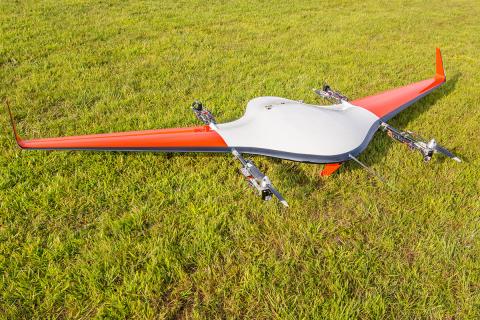
During a ceremony at Naval Air Station Patuxent River’s Webster Outlying Field on Oct. 18, the U.S. Navy commissioned its first UAS test and evaluation squadron.
Known as Air Test and Evaluation Squadron (UX) 24, the new unit flies over 23 fixed and rotary wing UAS, including the MQ-8 Fire Scout, RQ-20 Puma, RQ-21 Blackjack and RQ-26 Aerostar.
The ceremony marked UX-24’s official transition from what was formerly known as NAWCAD’s UAS Test Directorate, which was previously overseen by Commander Matthew Densing. Under Densing’s leadership, the directorate executed more than 2,200 flight hours and 2,000 ground test hours in support of UAS developmental test.
During the ceremony, Cdr. Densing officially assumed leadership of UX-24.
Alion awarded contract to develop, build, and support the U.S. Navy UUV Family of Systems
A McLean, Virginia-based company called Alion Science and Technology has been awarded a multiple award contract (MAC) Indefinite Delivery/Indefinite Quantity (ID/IQ) from the Department of Navy, Naval Undersea Warfare Center, Newport, Rhode Island, to develop, build, and support the U.S. Navy UUV Family of Systems (FoS).
According to Alion, the scope of the contract covers systems and subsystems required to support the advancement of UUV FoS, which not only includes current UUV systems and subsystems, but also any future UUV systems and subsystems.
Alion says that the value of the contract, with all option years, is $794M.

Harris Corporation and L3 technologies merging to create L3 Harris Technologies
In an effort to create a global defense technology leader that focuses on developing “differentiated and mission critical solutions” for customers across the globe, Harris Corporation and L3 Technologies Inc. have agreed to combine in an “all stock merger of equals” that results in a combined company called L3 Harris Technologies Inc.
Both companies are fully invested in the world of unmanned systems, as L3 recently acquired ASV Global—a USV and autonomous vessel control systems company—to create L3 ASV, while Harris is an FAA-approved vendor of the LAANC service, which provides UAS with access to the controlled airspace near airports.
GA-ASI completes Follow-On Operational Test & Evaluation for its MQ-1C ER Gray Eagle Extended Range UAS
General Atomics Aeronautical Systems Inc. (GA-ASI) and the U.S. Army recently completed Follow-On Operational Test & Evaluation (FOT&E) for GA-ASI’s MQ-1C ER Gray Eagle Extended Range UAS at Air Force Plant 42 in Palmdale, California.
Testing of the UAS, which began in early June, spanned 644 flight hours during the testing period.
According to GA-ASI, the successful test opens the door for MQ-1C ER initial fielding to the U.S. Army Intelligence & Security Command (INSCOM) and Special Operations Command (SOCOM), followed by units from Forces Command (FORSCOM).