Col. Joseph "Scott" Anderson has been named to manage the Program Executive Office for U.S.
Defense
Defense

AeroVironment and GD partner to integrate UAS and tactical missile systems with armored ground combat vehicles
AeroVironment Inc. has announced a new strategic relationship with General Dynamics Land Systems (GD) to produce “highly integrated and effective” tactical UAS and tactical missile systems (TMS) for armored ground combat vehicles.
“By integrating the leading small tactical UAS and loitering missile systems with the leading armored combat vehicles, our team will deliver a new level of battlefield lethality, survivability and combat effectiveness to protect and enable the warfighter,” explains Kirk Flittie, vice president and general manager of AeroVironment’s UAS business.

FLIR Systems' FLIR Black Hornet Vehicle Reconnaissance System features Black Hornet 3 nano UAS
FLIR Systems has announced the launch of its FLIR Black Hornet Vehicle Reconnaissance System (VRS), which features the Black Hornet 3 nano UAS designed for global military, government agency, and first responder vehicle-mounted operations.
Based on an adaption of the Black Hornet Personal Reconnaissance System (PRS), which is the world’s smallest combat-proven nano UAS according to FLIR, the Black Hornet VRS provides the warfighter with the ability to maintain situational awareness, threat detection, and surveillance for battle damage assessment, pre-deployment and route and point reconnaissance, and targeting information. All of this can be done without warfighters having to leave the vehicle.
Carnegie Mellon University team to compete in DARPA robotics competition
A team from Carnegie Mellon University (CMU) will compete in the systems track of the Defense Advanced Research Projects Agency (DARPA) Subterranean Challenge.
A multi-year robotics competition with a $2 million prize, the Subterranean Challenge will task robots to autonomously search tunnels, caves and underground structures.
The Carnegie Mellon team, which includes a member from Oregon State University, is one of just six teams that will receive up to $4.5 million from DARPA to develop the robotic platforms, sensors and software needed to accomplish these “unprecedented underground missions.”
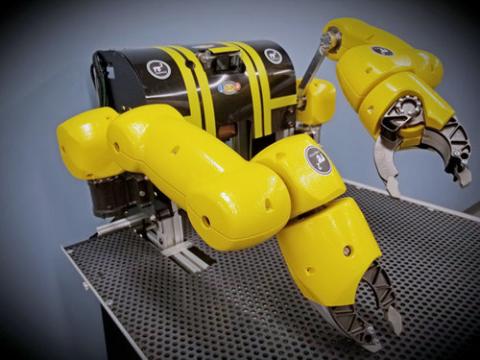
RE2 Robotics receives $2.5 million contract to continue developing its Dexterous Maritime Manipulation System
RE2 Robotics, which develops humanlike robotic manipulator arms, has received a $2.5 million contract from the Office of Naval Research to continue developing and commercializing its Dexterous Maritime Manipulation System (DM2S).
Equipped with RE2’s DM2S technology, Navy Explosive Ordnance Disposal (EOD) personnel will be able to “remotely and effectively” address Waterborne Improvised Explosive Devices (WBIEDs).
“As with the majority of our robotic technologies, the goal of the DM2S is to keep humans out of harm’s way while performing dangerous tasks,” says Jorgen Pedersen, president and CEO of RE2 Robotics.
Insitu's Integrator ER UAS delivers Group 4 and 5 capabilities in a Group 3 aircraft
During the Air Force Association’s annual Air, Space and Cyber Conference, Insitu announced its Integrator Extended Range UAS.
The UAS, which is a beyond line of sight (BLOS), SATCOM-enabled small UAS capable of “ranging modern combat theaters,” delivers Group 4 and 5 capabilities in a Group 3 aircraft.
Some of these capabilities include “high quality, full motion video on par with current ISR systems while flying at acoustically and visually undetectable altitudes; bandwidth throughput up to 10 megabits per second with a less than 1.5 second latency,” and a significantly reduced manpower footprint for operations, as it only takes a team of 12 operators, maintainers and mission commanders to operate the system.
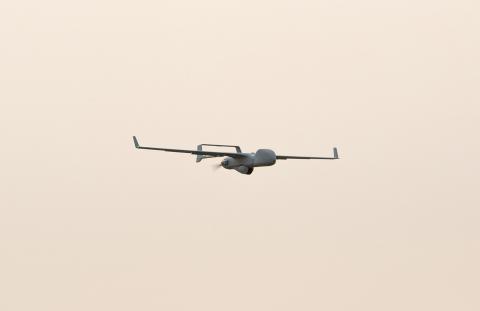
AeroVironment to provide Portuguese Army with Raven UAS
AeroVironment has announced that on Aug. 20, the company received a fixed-price contract award valued at $5.9 million from NATO Support and Procurement Agency (NSPA), which includes the procurement of the company’s Raven UAS equipped with Mantis i23 sensors and pocket Remote Video Terminals (p/RVT) for the Portuguese Army.
Delivery of the Raven UAS is scheduled over a three-year period.
Robotic Research awarded contract to work on Autonomous Unmanned Systems Teaming & Collaboration for Counter-WMD Mission
The U.S. Army's Armament Research, Development and Engineering Center (ARDEC) has awarded Robotic Research a five-year $50 million contract for Autonomous Unmanned Systems Teaming & Collaboration (AUSTC) for the Counter-WMD Mission in challenging subterranean and other environments.
Robotic Research is a Maryland-based engineering and technology company that provides autonomy software and robotic technology to several Federal and commercial customers.
AUSTC builds on prior and ongoing Robotic Research Small Business Innovative Research contracts—also with ARDEC—in support of the Mobile Autonomous Counter-WMD System, Increment B (MACS-B).
NSWC PHD and Aerial Alchemy looking into using UAS to enhance maintenance and fleet readiness for U.S. Navy
Naval Surface Warfare Center, Port Hueneme Division (NSWC PHD) and industry partner Aerial Alchemy are working together to research and investigate the use of UAS to enhance the U.S. Navy’s maintenance and fleet readiness.
The UAS are capable of visually capturing the exterior surface of naval ships, and this data could then be used to develop 3D digital models, to ultimately identify damage, corrosion, and alignment issues.
“Collaboration is key to rapidly increasing the lethality of our Navy,” says NSWC PHD Commanding Officer, Capt. Ray Acevedo, via the Defense Visual Information Distribution Service.
From Unmanned Systems Magazine: U.S. Navy’s new roadmap sees vast potential for unmanned systems
The U.S. Navy sees vast potential for unmanned systems and the capabilities they will bring, according to the service’s Strategic Roadmap for Unmanned Systems.
Use of unmanned and autonomous systems will create nothing less than "fundamental shifts" in the way the Navy operates, says an unclassified summary of the roadmap released in May. Their integration, it says, will allow reductions in manpower and risk to personnel, lower operating costs, increased persistence, faster and more accurate data processing, and a faster decision cycle.