QinetiQ has announced that it has been awarded a C$51m contract to deliver UAS to the Canadian Armed Forces.
The UAS, which have vertical takeoff capability, will provide the Royal Canadian Navy and Canadian Special Operations Forces Command with Intelligence, Surveillance, Target Acquisition and Reconnaissance (ISTAR) services for both domestic and international operations.
Based on the UMS SKELDAR V-200 UAS, the system will be equipped with a variety of sensors including an Active Electronically Scanned Array (AESA) radar and Electro-optic infrared (EO/IR) camera.
Defense
Defense
Spatial Integrated Systems announces extension of USV Swarming program
Spatial Integrated Systems Inc. (SIS), an engineering design and development company, has announced the extension of its USV Swarming program under the auspices of the Office of Naval Research (ONR).
According to SIS, USV Swarm 2019 will be the first integrated heterogeneous eight USV Swarm of autonomous Very Small (class 1) and Small (class 2) USVs. The USVs will conduct a coordinated mission.
The goal of Swarm 2019 is to showcase the utility of very small and small, inexpensive USVs that can be produced in large numbers quickly, SIS says.
Drone Aviation receives first contract award for its WASP Lite system
Drone Aviation Holding Corp. has received a contract award valued in excess of $1.1 million for its newly designed aerostat product, the WASP Lite. This is the company's first contract award for the product.
Under the contract, which is from a U.S. Army customer, Drone Aviation will provide multiple WASP Lite aerostat systems capable of enhancing and extending the modern networked battlefield supporting specialized waveform communications equipment and day/night Intelligence, Surveillance and Reconnaissance (ISR) payloads.

ESAero to support Planck Aerosystems' defense and commercial UAS business through new partnership
Aerospace manufacturer Empirical Systems Aerospace Inc. (ESAero) will support the defense and commercial UAS business of Planck Aerosystems (Planck Aero) through a new partnership between the two companies.
In support of increasing demand across Planck’s customer base, both domestically and internationally, ESAero will manufacture Planck Aero’s Group 1 UAS, Shearwater, in its manufacturing plant in San Luis Obispo, California, which will support Planck’s strategy to scale the company.
The companies note that the Shearwater UAS is the preferred small multi-rotor platform to host the Planck Autonomous Control Engine – ACETM navigation system, which enables the UAS to operate autonomously from moving vehicles and vessels, including vision-based precision landing.
Australian Government purchasing second MQ-4C Triton UAS from Northrop Grumman
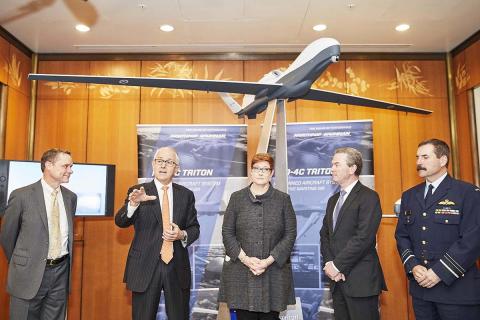
Northrop Grumman has announced that the Australian government will purchase a second MQ-4C Triton UAS from the company.
The UAS will be delivered through a cooperative program between Northrop Grumman and the United States Navy.
“Northrop Grumman is excited to develop this unrivaled capability for the Royal Australian Air Force,” says Doug Shaffer, vice president and program manager, Triton programs, Northrop Grumman. “Triton will provide the Australian Defence Force a high-altitude, long-endurance system for intelligence, reconnaissance and broad area surveillance missions to enhance the security of Australia’s borders.”
UAS helps U.S. Coast Guard inspect new Aids to Navigation structures
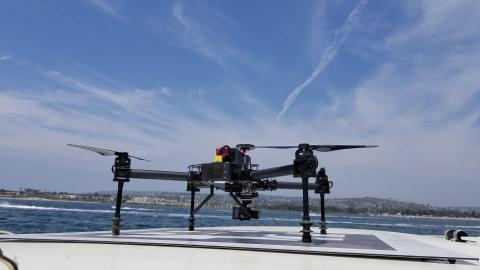
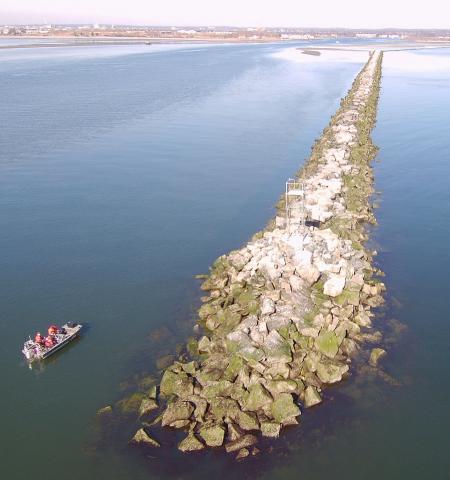
A UAS was recently used by U.S. Coast Guard Civil Engineering Unit (CEU) Providence, Rhode Island to inspect the construction of new Aids to Navigation (ATON) structures.
The inspections were conducted by Lt. Kieron D. McCarthy, who piloted the UAS from a small boat assigned to the U.S. Coast Guard Cutter Bollard (WYTL-65614), based in New Haven, Connecticut.
The UAS was hand launched from the boat, and helped the CEU inspect and approve the steel tower structures that serve as fixed channel markers at Housatonic River, Black Rock, and Duck Island.
According to McCarthy, using UAS saved the CEU more than 30 hours of work, while reducing the risk of having to climb the structures.
Army completes New Equipment Training for GA-ASI's MQ-1C ER UAS
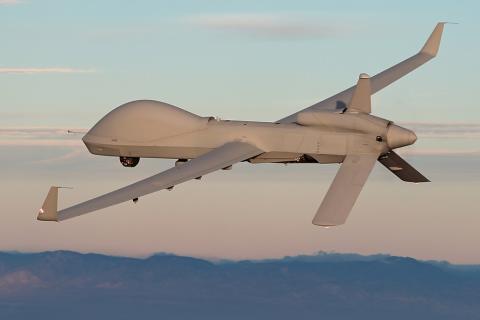
General Atomics Aeronautical Systems Inc. (GA-ASI) has announced that the U.S. Army has completed its New Equipment Training (NET) for GA-ASI’s MQ-1C ER Gray Eagle Extended Range UAS.
Covering new maintenance procedures, manuals and ground support equipment associated with the MQ-1C ER, the training—conducted at Fort Campbell, Kentucky—prepared the current Army Company, 160th Foxtrot, to operate the MQ-1C ER, while also preparing Echo Company to become the Army’s second Company to be trained to operate the UAS.
U-M's Automotive Research Center shifting focus to autonomous technologies for military ground vehicles
The University of Michigan has announced that its Automotive Research Center (ARC) has been awarded a $50 million contract from the U.S. Army, extending the ARC’s 25-year partnership with the Army through 2024.
With the funding, the ARC will shift its focus to autonomous technologies for military ground vehicles.
Launched in 1994, the ARC has served as a source of technology, modeling and simulation for the Army’s fleet of vehicles, which is the largest in the world.
Triumph Group selected to provide hydraulic system components for MQ-25 unmanned aerial refueling program
Boeing has awarded Triumph Group a contract to supply critical hydraulic system components for the MQ-25 unmanned aerial refueling program.
Headquartered in Berwyn, Pennsylvania, Triumph Group designs, engineers, manufactures, repairs and overhauls a diverse portfolio of aerospace and defense systems, components and structures.
The components for the hydraulic systems used in the landing gear and the aircraft's arresting systems will be provided by Triumph Integrated Systems, which also provides similar content on other Boeing defense aircraft.

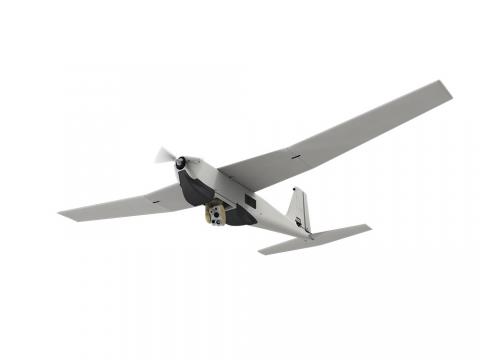
AeroVironment to provide allied nation with its Puma AE II small UAS, training and support
AeroVironment has received a $17,356,084 firm-fixed-price contract to provide an allied nation with its Puma AE II small UAS, training and support.
Delivery of the fully man-portable drone is expected by September 2019.
Designed for land and maritime operations, the AeroVironment Puma AE can land in water or on land. Equipped with its Mantis i45 sensor suite, the all-environment UAS provides the operator with extended flight time and a level of imaging capability never before available in the small UAS class, according to AeroVironment.