On Aug. 9, the Air Force Research Laboratory (AFRL) and DZYNE Technologies Inc. successfully completed the first flight of ROBOpilot, which they describe as a “revolutionary Robotic Pilot Unmanned Conversion Program.”
The flight, which lasted two hours, was conducted at Dugway Proving Ground in Utah.
“This flight test is a testament to AFRL’s ability to rapidly innovate technology from concept to application in a safe build up approach while still maintaining low cost and short timelines,” says Maj. Gen. William Cooley, AFRL Commander.
Defense
Defense

Liberty Dynamic, ReconRobotics collaborating to develop throwable robot with mounted flash-bang
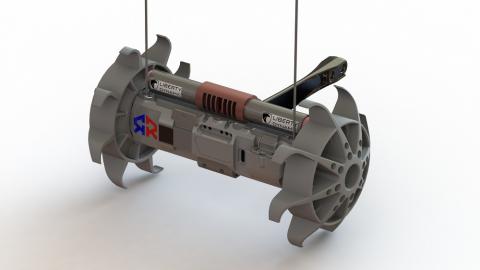
Liberty Dynamic has announced that it will begin working with ReconRobotics Inc. to equip the company’s tactical Throwbot 2 robot with an Enhanced Diversionary Device.
Equipped with a flash-bang, the robot will save military and law enforcement users “precious seconds” before detonation, while also providing them the benefit of real-time intelligence.
“It’s all about giving operators tactical advantage,” says John Chapman, CEO of Liberty Dynamic.
The Enhanced Diversionary Device is described as a “reusable, microprocessor-controlled flash-bang.” It is designed to be safer and more economical than the standard stun grenades that police officers and military personnel currently use.
Liteye Systems, Red Six Solutions partnering on counter-UAS tech
Liteye Systems Inc., the provider of manufacturing, integration, training, and services of the Anti-UAS Defense System (AUDS), has announced a partnership with a red team strategic advisory company called Red Six Solutions LLC.

ThayerMahan awarded $19.4 million contract to develop innovative autonomous systems
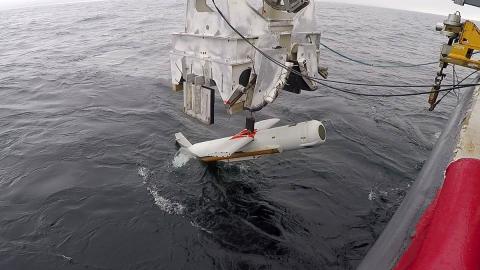
ThayerMahan Inc., a developer of autonomous maritime platforms, has been awarded a four-year, $19.4 million contract to develop innovative autonomous systems, and improve its proprietary acoustic and electronic search systems, in support of Navy and Marine Corps missions.
The Office of Naval Research (ONR) awarded ThayerMahan the contract as part of its continuing effort to promote the development and deployment of Unmanned Maritime Systems in support of US Navy missions.

BAE Systems successfully tests 'first of its kind' autonomous boat
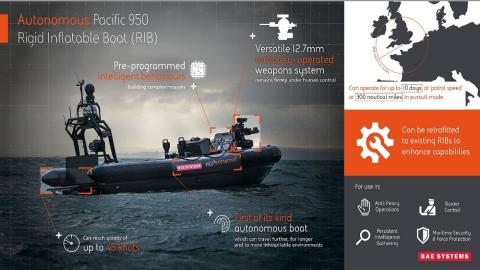
BAE Systems has successfully tested a ‘first of its kind’ autonomous boat that it says will give navies the ability to “go beyond the limits of human endurance with unmanned vessels that can travel further, for longer and to more inhospitable environments.”
Known as the autonomous Pacific 950 Rigid Inflatable Boat (RIB) demonstrator, the boat has been used to develop and prove a variety of technologies that could potentially make naval missions faster, easier and safer, which, according to BAE Systems, would take the relationship between human and machine to “new territories.”
GA-ASI marks 25th anniversary of Predator A UAS
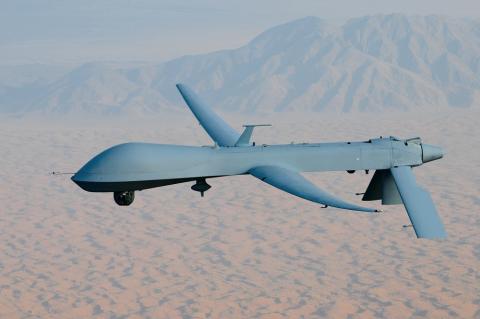
General Atomics Aeronautical Systems Inc. (GA‑ASI) recently marked the 25th anniversary of its Predator A UAS, which completed its first flight in July 1994, and made its operational debut the following year.
More than 320 Predator As have been delivered to customers across the world in support of global security. The product line remained in production until 2011.
Predator As have flown almost 141,000 missions, and have surpassed two million flight hours. GA-ASI notes that almost all of those hours were flown in support of combat missions.
“With innovation in mind, we have always looked for ways to challenge the industry standard,” says Linden Blue, CEO, GA-ASI.
Navy declares initial operational capability of MQ-8C Fire Scout
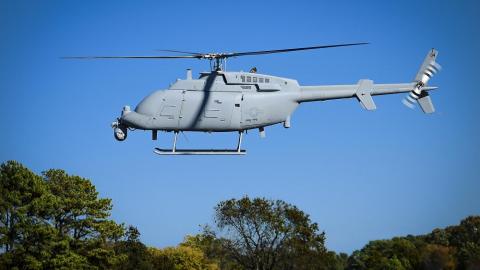
The U.S. Navy has declared initial operational capability of the MQ-8C Fire Scout unmanned helicopter, which clears the way for fleet operations and training.
A sea-based, vertical lift UAS, the MQ-8C Fire Scout is designed to provide ground, air and sea forces with reconnaissance, situational awareness, and precision targeting support.
“This milestone is a culmination of several years of hard work and dedication from our joint government and industry team,” says Capt. Eric Soderberg, Fire Scout program manager.
“We are excited to get this enhanced capability out to the fleet.”
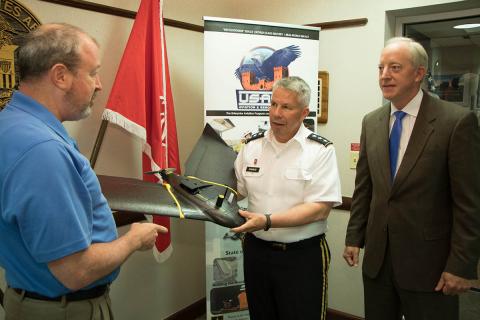
Exclusive: Q & A with Lt. Gen. Todd Semonite, 54TH chief of engineers and commanding general of The U.S. Army Corps of Engineers
Lt. Gen. Todd Semonite assumed his position as Chief of Engineers and Commanding General of the U.S. Army Corps of Engineers (USACE) on May 19, 2016.As the USACE commanding general, he is responsible for more than 32,000 civilian employees and 700 military personnel who provide project management, construction support and science and engineering expertise in more than 110 countries.
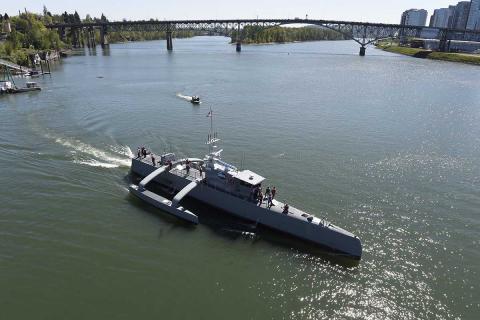
From Unmanned Systems Magazine: U.S. Navy wants to boost unmanned systems on the surface, underwater to meet challenges
U.S. Navy leaders want to move promptly to the widespread use of unmanned surface and undersea vehicles to bolster its manned fleet, citing the growing threat of a new and complex international environment in which China, Russia and other countries are increasingly using commercial technology to gain military advantage.
The Navy sees its projected new vehicles, and a network that would link them, as helping to allow appropriate responses to nearly any maritime challenge, and thus ensure American naval superiority — but the major investment and fast pace it recommends have prompted questions from Congress and other parties.
From Unmanned Systems magazine: Fiscal 2020 defense budget request includes billions for unmanned systems
In March, the White House released a fiscal 2020 defense budget request totaling $718.3 billion, which it said would invest in space and cyber warfighting domains, modernize air, maritime and land domains, innovate more rapidly to strengthen the nation's competitive advantage, and sustain the forces and readiness.
As part of the request, the services release budget estimates that detail unclassified procurement and research, development, test & evaluation (RDT&E) efforts.