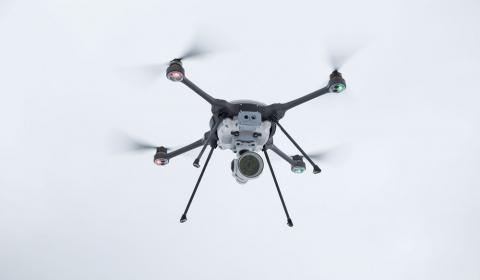
QinetiQ North America (QNA) has announced that it has won the competition for the U.S. Army’s Common Robotic System-Individual (CRS(I)) program.
Valued up to more than $164 million, the seven-year Indefinite Delivery Indefinite Quantity (IDIQ) contract is for the delivery of small ground robots, and includes a Low Rate Initial Production (LRIP) phase worth approximately $20 million over one-to-two years, which will be followed by a series of annual production releases.
As part of the LRIP phase, QNA has been awarded a $4,051,837 initial order.
Defense
Defense
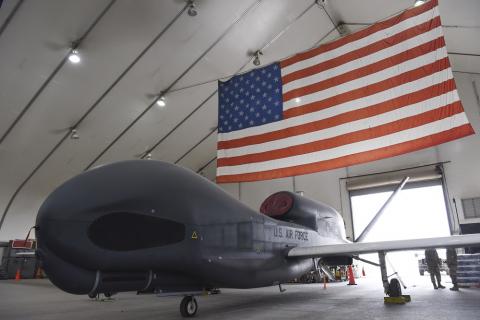
EQ-4 Global Hawk at Al Dhafra Air Base equipped with beyond line of sight capability
The EQ-4 Global Hawk flying missions from Al Dhafra Air Base (ADAB) can now operate beyond line of sight (BLOS), the Air Force has announced.
Previously, the remotely piloted aircraft required coordination with other bases to control it while in the air, but now this can be done locally.
“The BLOS plays a major role because it allows us to fly the jet farther than any Launch and Recovery Element could ever before, utilizing Satellite communication as its main link rather than a Line Of Sight link,” says Senior Airman Seth Oatridge, 380th Expeditionary Aircraft Maintenance Squadron ground communication technician.
Boeing unveils newest unmanned platform designed for global defense customers
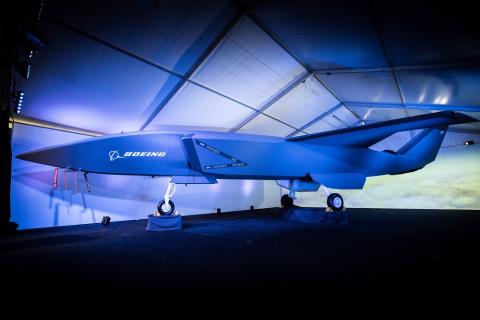
Boeing has introduced the Boeing Airpower Teaming System, which is the company’s newest unmanned platform.
According to Boeing, the Boeing Airpower Teaming System is the company's largest investment in a new unmanned aircraft program outside the United States, as the platform was designed by Boeing Australia for global customers.
Boeing says that the unmanned platform will have a number of capabilities. Measuring 38 feet long, the Boeing Airpower Teaming System will provide fighter-like performance, as it will be able to fly more than 2,000 nautical miles.
Mississippi State awarded $7.2 million defense contract to test emerging UAS tech
On Friday, Feb. 22, Mississippi State University was awarded a $7.2 million defense contract to test emerging UAS technologies.
Mississippi State was awarded the competitive U.S. Army contract to test and validate emerging UAS propulsion technologies. The contract extends through Feb. 2021, and is funded through research, development, test and evaluation appropriations provided to the Army.

Kansas State Polytechnic students meet with soldiers to learn about UAS
Students from the Kansas State University Polytechnic Campus recently toured 1st Infantry Division UAS facilities at the Fort Riley Military Base in Kansas.
During their tour, students met with soldiers and learned about the Shadow and Gray Eagle UAS from Army maintainers and pilots.
“It's really cool to be here and to see the pinnacle of UAS tech,” says K-State senior in the UAS operations program Chris Horton.
For Horton, who hopes to land jobs working as government contractors, this was his first time seeing Fenix Company's Gray Eagles up close and in person.
Simlat develops simulation capability for counter-UAS operations
Simlat has announced that it has developed a simulation capability for counter-UAS (C-UAS) operations that allows different sensors and effectors to be emulated with diverse capabilities and technologies.
High volume threats, which can include any kind of hostile platform(s) in any configuration, are simulated in complex environments such as airports, critical infrastructure settings, urban terrain and sensitive sites.
L3 ASV delivers long-endurance autonomous vessel to Royal Navy
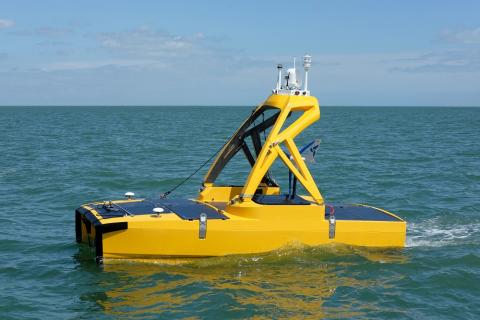
L3 ASV has delivered a long-endurance autonomous vessel known as the C-Enduro to the Royal Navy.
According to L3 ASV, the vessel will be used for military data gathering trials by the Mine countermeasures and Hydrographic Capability (MHC) program, as the Navy looks to utilize autonomous technology.
“We are proud to support the Royal Navy in their plans to explore the uses of marine autonomy as they continue to invest in new and exciting technology,” says Vince Dobbin, sales and marketing director for L3 ASV.
Endeavor Robotics awarded contract to modernize and maintain Army's fleet of robot platforms
The U.S. Army has awarded Endeavor Robotics a firm-fixed-price, Indefinite Delivery/Indefinite Quantity (IDIQ) contract to modernize and maintain its current fleet of robot platforms.
The five-year contract is potentially worth $32.4 million.
“We’re pleased to win this opportunity to help the Army keep its UGV inventory at an optimum state of readiness,” says Tom Frost, Endeavor Robotics president.
FLIR Systems announces acquisition of Aeryon Labs
On Monday, Jan. 28, FLIR Systems Inc. announced its acquisition of Aeryon Labs Inc., which is known for developing high-performance UAS for the global military, public safety, and critical infrastructure markets. FLIR acquired Aeryon for $200 million.
Founded in 2007, Aeryon is based in Waterloo, Canada, with offices in Denver, Colorado and Salt Lake City, Utah. The company designs and manufactures mission-focused Group 1 UAS technology built around aircraft that weigh less than 20 pounds.
20 militaries in more than 30 countries across the globe deploy Aeryon’s family of UAS, including the United States Department of Defense.