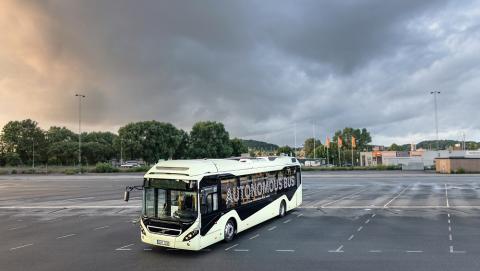
Volvo is showcasing its autonomous bus to specially invited guests during the Volvo Ocean Race competition in Gothenburg, Sweden.
Based on Volvo's commercially produced electric city bus, the prototype has been modified for autonomous operation.
Volvo says that at the demo event, there will be presentations to demonstrate how this technology can contribute to “safer and more comfortable travel,” as well as more efficient handling of vehicles in the depot.
Mobility
Mobility
Magna and May Mobility partner to develop and deploy self-driving shuttles
Through their newly announced partnership, Magna and May Mobility will “retrofit and scale up” May Mobility's fleet of self-driving shuttles set to enter the US market.
Magna is retrofitting low-speed self-driving micro transit electric vehicles from the chassis up, and the initial fleet of vehicles is expected to debut on June 26 with May Mobility's first commercial deployment, taking place in Detroit, Michigan.
“Magna is pleased to work with a company like May Mobility to help support new mobility in city centers,” says Swamy Kotagiri, Magna Chief Technology Officer.
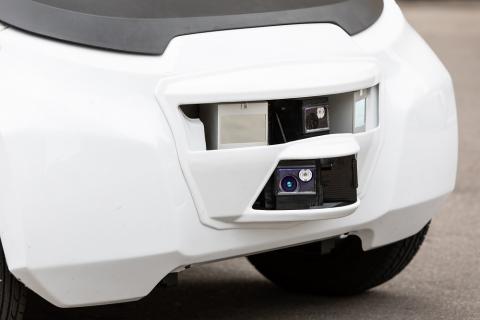
Autonomous shuttles to be tested on Singapore's Sentosa island next year
Starting in 2019, people in Sentosa—an island in Singapore—will be able to call for on-demand autonomous shuttles to transport them around the island, as part of a three-month public trial.
The vehicles will complement Sentosa’s on-island transportation network during the public trial, giving guests additional ways to access the island’s various unique leisure experiences.

NEVS and Phantom Auto partner to safely deploy electronic autonomous vehicles
In an effort to ensure “safe deployment of electric autonomous vehicles,” Swedish electric vehicle manufacturer NEVS has announced a collaboration with Phantom Auto, which provides teleoperation safety technology for autonomous vehicles (AVs).
Formerly Saab Automobile, NEVS will utilize Phantom Auto’s teleoperation safety technology to ensure the “optimally safe and efficient deployment” of its electric AVs across the globe.
“Our AVs must be able to drive from any point A to any point B, which means driving through all edge cases they experience on the road, such as inclement weather, road work, and any other road obstructions,” explains Stefan Tilk, CEO of NEVS.
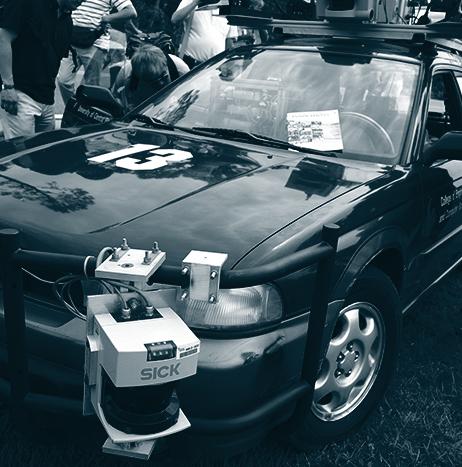
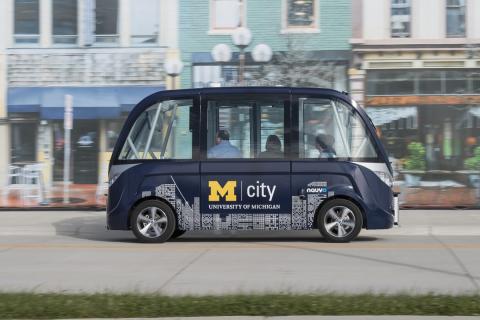
Mcity Driverless Shuttle begins operation at University of Michigan
The Mcity Driverless Shuttle research project at the University of Michigan (U-M) launched on U-M’s North Campus on Monday, June 4.
Through the project, Mcity is examining how passengers react to the driverless shuttles, in an effort to measure consumer acceptance of the technology.
During the project, data generated during operation will be captured using the shuttles’ onboard cameras and Wi-Fi communications. This is the first driverless shuttle project of its kind in the U.S., according to Mcity Director Huei Peng, who is also the Roger L. McCarthy Professor of Mechanical Engineering and the faculty lead on the shuttle research project.
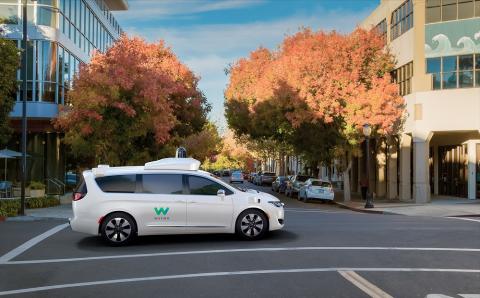
Fiat-Chrysler Automobiles to supply up to 62,000 Chrysler Pacifica Hybrid minivans to Waymo's self-driving fleet
Fiat Chrysler Automobiles (FCA) and Waymo have announced the expansion of their partnership, with an agreement to add up to 62,000 Chrysler Pacifica Hybrid minivans to Waymo’s self-driving fleet.
This announcement comes after FCA announced in January that it will deliver thousands of its Chrysler Pacifica Hybrid minivans to Waymo’s driverless transportation service. Thus far, FCA has delivered 600 Pacifica Hybrid minivans to Waymo.
“FCA is committed to bringing self-driving technology to our customers in a manner that is safe, efficient and realistic,” says Sergio Marchionne, Chief Executive Officer, Fiat Chrysler Automobiles N.V.
SoftBank Vision Fund investing $2.25 billion in GM Cruise to strengthen GM's plans of commercializing autonomous vehicle technology at large scale
The SoftBank Vision Fund will invest $2.25 billion in GM Cruise Holdings LLC (GM Cruise).
The investment, according to GM, will strengthen GM’s plans to commercialize autonomous vehicle technology at large scale.
“Our Cruise and GM teams together have made tremendous progress over the last two years,” says GM Chairman and CEO Mary Barra.
“Teaming up with SoftBank adds an additional strong partner as we pursue our vision of zero crashes, zero emissions and zero congestion.”

Sacramento mulling driverless car program
A driverless car program could be headed to the city of Sacramento, California.
According to CBS Sacramento, Sacramento’s Chief Innovation Officer Louis Stewart is “paving the way” for Phantom Auto—which offers a “teleoperation-as-a-service safety solution” for all autonomous vehicles—to launch a test program on city streets by June.
For Stewart, Sacramento is the perfect location for a program like this.
“Sacramento is the locus of power,” Stewart says. “We have all the politicians here, we have all the regulatory bodies here, and we have a citizenry that’s actually hungry for this kind of technology.”
Jacksonville Transportation Authority converting part of Skyway 'people mover' for autonomous vehicle testing
The Jacksonville Transportation Authority (JTA) has announced that it will convert a portion of the existing Skyway “people mover” into an elevated test track for autonomous vehicles.
The Skyway track conversion will allow JTA to test autonomous vehicles in an elevated environment, and ultimately provide a road map to eventually convert the Skyway system for new autonomous electric vehicles, according to JTA CEO Nathaniel Ford.
“We are advancing whatever is the mobility or whatever the mode that fits the bill, and not just our 40-foot bus,” Ford told News4Jax, via WJCT.
Team Polaris' MRZR X selected by U.S. Army for trials as part of SMET program
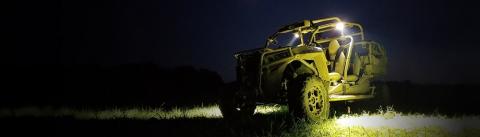
The U.S. Army has selected Team Polaris—made up of Polaris Industries Inc., Applied Research Associates Inc. (ARA) and Neya Systems LLC—and its advanced MRZR X multi-mode vehicle platform to be one of the robotic systems used by infantry brigade combat teams for the next year of trials, as part of the Squad Multipurpose Equipment Transport (SMET) program.
Warfighters using the MRZR X are provided with a “modular, multi-mission support platform” that has several modes of operation, from traditional operator driving to multiple levels of autonomy, including the capability for remote control, teleoperation, follow-me, leader-follower and full autonomy.