
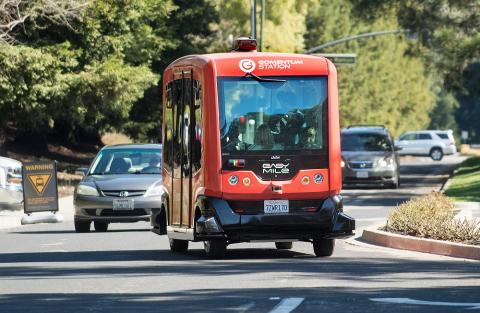
An EasyMile autonomous shuttle bus became the first vehicle to operate on California's roads without a driver behind the wheel on Tuesday, March 6. The vehicle operated on the roads of San Ramon, California.
With its historic journey, EasyMile’s autonomous shuttle bus became the first vehicle to take advantage of recently approved regulations governing the driverless testing and public use of autonomous vehicles on California roads.
Mobility
Mobility
Self-driving shuttle developer May Mobility receives financial backing from BMW and Toyota
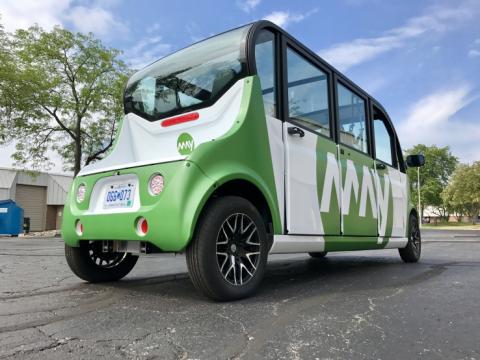
May Mobility, which claims to be the “first autonomous vehicle company to replace existing transportation systems with its fleets of self-driving micro-shuttles,” has announced that it raised $11.5 million in seed funding during a seed round in which BMW i Ventures and Toyota AI Ventures were the co-leaders for.
May Mobility, which plans to launch commercial operations this year, says that this funding will allow the company to launch new deployments across the country.
California paves way for testing of truly driverless cars in state
On Feb. 26, the California Department of Motor Vehicles (DMV) announced that the Office of Administrative Law approved regulations governing the driverless testing and public use of autonomous vehicles on California roads.
Before the approval of these regulations, autonomous vehicles could only be tested in California with an approved driver.
“This is a major step forward for autonomous technology in California,” says DMV Director Jean Shiomoto. “Safety is our top concern and we are ready to begin working with manufacturers that are prepared to test fully driverless vehicles in California.”

Nissan and DeNA to begin a field test of "robo-vehicle mobility service" in Japan in March
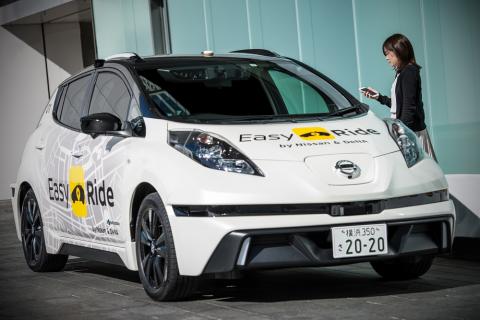
On March 5, Nissan Motor Co., Ltd. and DeNA Co., Ltd. will begin a field test of their “robo-vehicle mobility service,” Easy Ride, which is envisioned as a mobility service “for anyone who wants to travel freely to their destination of choice in a robo-vehicle.”
The field test will take place in the Minatomirai district of Yokohama, in Japan's Kanagawa Prefecture. During testing, participants will travel along a set route in vehicles equipped with autonomous driving technology. The route is about 4.5 kilometers between Nissan's global headquarters and the Yokohama World Porters shopping center.
University at Buffalo researching, and planning to test, recently acquired driverless bus
The University at Buffalo (UB) recently purchased a driverless Olli bus that it plans on testing once the bus is delivered to the university, which is expected to happen towards the end of April.
A product of Local Motors that has been tested in several countries throughout Europe, the Olli bus will be operated by researchers at UB on private or sanctioned-off roads on UB’s campus.
New York State law requires that the bus be operated on North Campus’ Service Road, which is not public. If UB researchers want to test the bus on public roads, they must apply to test through the DMV, pay $5,000,000 in liability fees and arrange for a police escort. New York has allowed UB to test its newly-purchased vehicle on campus roads.

Terabee's new TeraRanger Hub Evo provides 'lean sensing' for robotics
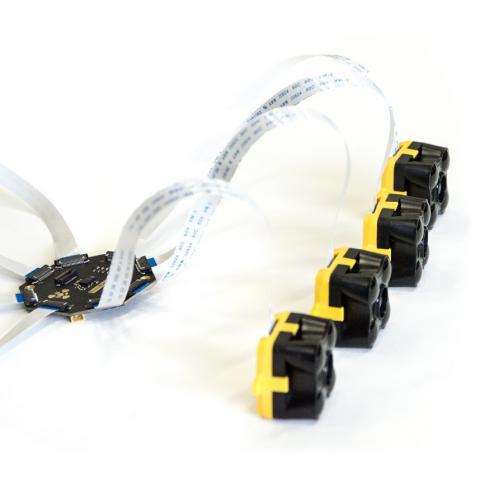
Terabee, which created the TeraRanger Time of Flight distance sensors, has announced the release of the TeraRanger Hub Evo, which the company describes as a new generation “plug and play solution for using multiple distance sensors.”
A “small, octagonal, PCB,” the TeraRanger Hub Evo allows users to connect up to eight TeraRanger Evo distance sensors and place them in whatever configuration they might need, so that they can monitor and gather data from just the areas and axes they need, and create custom point clouds, optimized to their application.
Waymo receives permission to launch ride-hailing service using its driverless vehicles
Waymo is preparing to launch a ride-hailing service that utilizes its driverless vehicles, after the company received a permit from the Arizona Department of Transportation to operate as a Transportation Network Company (TNC) in late January.
According to Bloomberg, the designation allows Waymo’s fleet of driverless Chrysler Pacifica minivans to pick up and drop off paying riders in Arizona through a smartphone app or website.
Since April 2017, Waymo has been testing a self-driving car service in the Phoenix area that lets passengers hail cars through an app, similar to ride-hailing services such as Uber and Lyft.
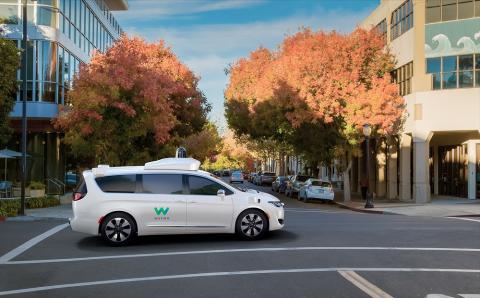
Fiat-Chrysler Automobiles to supply Waymo with thousands of Chrysler Pacifica Hybrid minivans
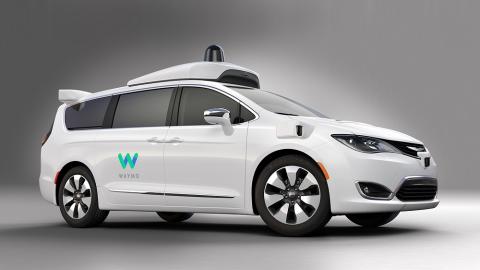
Fiat-Chrysler Automobiles (FCA) has announced that it will deliver thousands of its Chrysler Pacifica Hybrid minivans to Waymo, to support the launch of the world’s first driverless ride-hailing service.
This will not be the first mass delivery of Pacifica Hybrid minivans from Fiat-Chrysler Automobiles to Waymo, as in 2016, the automobile company delivered 100 Pacifica Hybrid minivans, adapted for self-driving, to Waymo. 500 more were delivered in 2017.
The collaboration between Waymo and FCA engineers allowed the teams to design a “self-driving vehicle built on a mass production platform.”
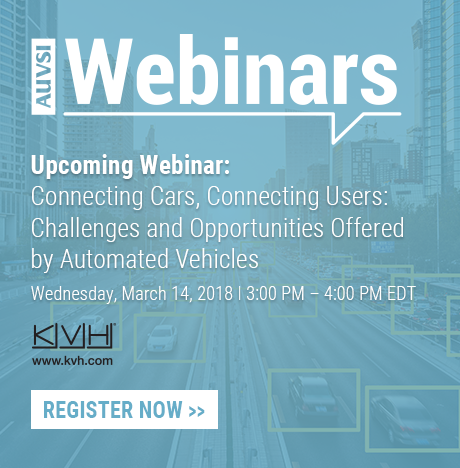
Connecting Cars, Connecting Users: Challenges and Opportunities Offered by Automated Vehicles
Recently a range of diverse companies have launched high-profile automated vehicle programs and have begun describing their implementation plans. As automated vehicles gain traction and garner headlines, complex questions have arisen in the automated vehicles community, some of which were expected and others more surprising.
Innovators are exploring seemingly next-gen possibilities today. Ideas such as driverless delivery, smart roads, and AI are becoming actualities. This webinar will explore these topics and more, as industry leaders discuss their visions for future mobility and what it holds for road users.
Who Should Attend
Development of self-driving vehicles one of the focus areas of GM Canada's new Canadian Technical Centre
On Jan. 19, GM Canada opened its new Canadian Technical Centre (CTC) in Markham, Ontario, Canada.
One of the areas of focus at the CTC Markham Campus will be software development and innovation in the area of software and controls related to GM’s development of self-driving vehicles.
The CTC Markham Campus will be the largest new automotive and mobility software center in Canada, with more than 700 staff, as it leverages a large network of university and local company partnerships.