After receiving approval from city officials, Optimus Ride, a developer of self‑driving technologies, will begin using its autonomous vehicles to carry passengers in Boston, according to the Boston Herald.
To start, the vehicles will only carry passengers in the Raymond L. Flynn Marine Park in South Boston, where Optimus is based. Optimus has been talking to other Marine Park-based companies about giving rides and getting feedback from their employees.
Ryan Chin, chief executive officer of Optimus Ride, says that a software company called Autodesk has agreed to take part in the rides.
Mobility
Mobility

Samsung introduces DRVLINE platform for autonomous driving market
During CES 2018 in Las Vegas, Samsung Electronics Co., Ltd. introduced its new Samsung DRVLINE platform, which is an “open, modular, and scalable hardware and software-based platform” for the autonomous driving market.
Samsung says that the DRVLINE platform is a valuable technology for automakers because it can “integrate best-in-class technology into new vehicles, while also building a foundation for fleets of the future.”

AEye announces AE100, a 'leading-edge robotic perception system for autonomous vehicles'
AEye, which develops advanced vision hardware, software and algorithms that serve as the eyes and visual cortex of autonomous vehicles, has announced the AE100, which the company calls a “leading-edge robotic perception system for autonomous vehicle, ADAS, and mobility markets.”
The AE100 is a "solid state, cost-optimized system" that is based on AEye’s Intelligent Detection and Ranging (iDAR) technology, which is a “new form of intelligent data collection that enables rapid, dynamic perception and enhanced path planning.”
BlackBerry and Baidu partner to work on connected and autonomous vehicle technology
BlackBerry Limited and Baidu, Inc. have announced that they will work together to accelerate the deployment of connected and autonomous vehicle technology for automotive original equipment manufacturers (OEMs) and suppliers across the world.
The two companies have signed a statement of intent to make BlackBerry QNX’s safety operating system (OS) the foundation for Baidu’s Apollo autonomous driving open platform, which was announced in April 2017.
Ford moving autonomous and electric vehicle teams to Detroit
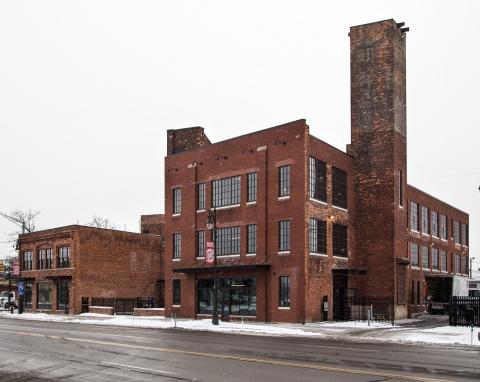
Ford Motor Company has announced plans to move its key autonomous vehicle and electric vehicle business and strategy teams to a historic building known as The Factory, in Detroit’s Corktown neighborhood.
Expected to be up and running in early 2018, The Factory will serve as a place for the teams to work on urban mobility challenges and solutions. More than 220 employees will work at The Factory.
“We’re excited to choose this inspirational location in one of Detroit’s resurgent neighborhoods to accelerate our work on electric and autonomous vehicles,” says Jim Hackett, Ford president and CEO.
NAVYA unveils AUTONOM CAB, the company's fully autonomous taxi
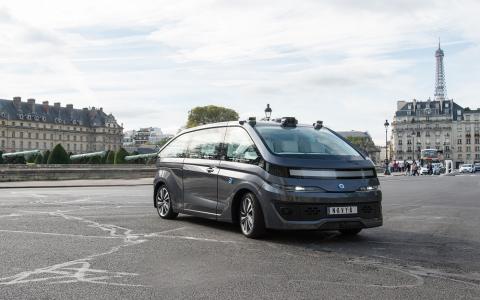
Navya has unveiled its AUTONOM CAB, which is an autonomous, personalized and shared vehicle designed to address the “major challenges urban populations face traveling in and around cities.”
The AUTONOM CAB is equipped with extremely sophisticated multi-sensor technology, with no fewer than 10 Lidar sensors, six cameras, four radars, two GNSS antennae and one inertial measurement unit (IMU). Navya says that these sensors provide “at least a triple redundancy across all functions,” which guarantees exceptional reliability.
Florida's HART and others set to introduce self-driving shuttles to Hillsborough County
The entity responsible for providing public transportation service within Hillsborough County, Florida—the Hillsborough Area Regional Transit Authority (HART)—has selected engineering services company Stantec to provide autonomous mobility services for the Marion Street Transitway, which will result in the “first continuously operated shared autonomous project in the United States that will function in an open environment on public roads with mixed traffic.”
The goal of the project is to document the safety benefits of this kind of service, while seeking to bring Automated Vehicles (AVs) forward within a Connected Vehicle (CV) environment.
Wal-Mart deploying shelf-scanning robots in 50 of its stores
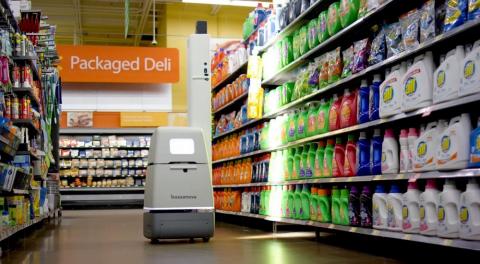
After testing shelf-scanning robots in stores in Arkansas, Pennsylvania and California, Wal-Mart has announced that approximately 50 of its stores across the United States will start using the robots to “replenish inventory faster,” in an effort to save employees time when products run out.
The two-foot tall robots, which are a product of a company called Bossa Nova Robotics, are equipped with cameras that scan aisles to check stock and identify items that are missing and misplaced, as well as incorrect prices and mislabeling. The data obtained by the robots is passed on to store employees, who then stock the shelves and correct errors.
U.S. Navy selects RE2 Robotics to develop an autonomous robotic cargo handling system
Being that personnel are still responsible for manually loading and unloading cargo from an air vehicle for cargo missions today, the U.S. Navy has tasked RE2 Robotics with developing an Autonomous Robotic Cargo Handling (ARCH) system.
This system will be demonstrated in concurrence with the Autonomous Aerial Cargo Utility System (AACUS) equipped UH-1H Optionally Piloted Aircraft (OPA), which will provide the ability to deliver supplies autonomously.
Aerovel's unmanned Flexrotor sets VTOL endurance record
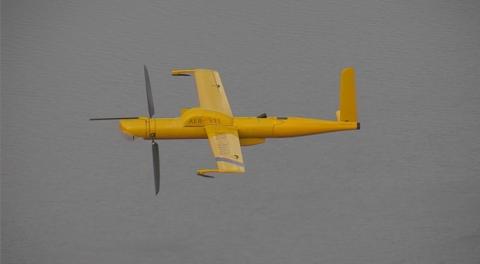
Aerovel has announced that its unmanned Flexrotor, named Actaea, set a VTOL endurance record, as it flew just over 32 hours.
During its flight, Actaea, which is a unique miniature tailsitter, transitioned from hover to wing-borne flight, and conducted its journey through a “showery day, a blustery night, and then another day in the breezy and unsettled air behind a cold front.”
The UAS transitioned back to hover as dusk fell, and “dropped gently down onto a 12-foot square helideck underway at 8 kt.”
The UAS flew for a total of 32 hours and eight minutes, and had more than three hours’ worth of gasoline left in its tank upon landing. When it took off, the UAS had 7.5 kg of fuel onboard.