The National Science Foundation (NSF) has awarded Dr. Yang Hu, assistant professor of electrical engineering at The University of Texas at Dallas, a five-year, $500,000 grant to develop new hardware and software capable of handling the complexity of an automated driving ecosystem in which cars not only communicate with other cars, but with roadside information nodes as well.
A member of the Erik Jonsson School of Engineering and Computer Science (ECS) since 2017, Hu earned the NSF Faculty Early Career Development (CAREER) Award for his project, “Rethinking the Architectures and Systems for Autonomous Driving Infrastructure.”
Research
Research

Locomation to test its autonomous truck platforms at Ohio's Transportation Research Center
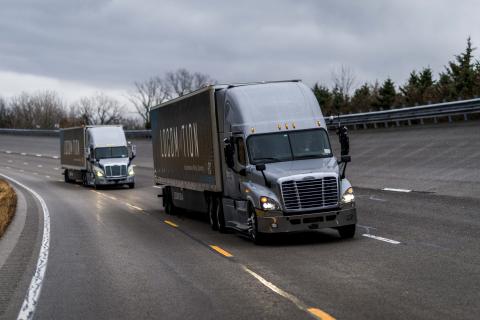
Locomation, the provider of what it calls the world’s first trucking technology platform to offer human-guided autonomous convoying, has announced a research project with the Transportation Research Center Inc. (TRC) in East Liberty, Ohio.
Alongside TRC’s extensive research and development team, Locomation will actively test at the research center to advance its autonomous truck platforms, in an effort to facilitate more innovation on the testing and validation of the company's autonomy technology.
Weekend Roundup: April 24, 2020
This Week in the Unmanned Systems and Robotics World
The University of North Florida College of Computing, Engineering and Construction has been awarded a grant to research the use of autonomous robotics for agriculture in Northeast Florida. The research grant will focus on using a multi-robot system to securely and efficiently collect agricultural information. (University of North Florida)

OSU to use funding to improve safety for UAS flying in Advanced Air Mobility operations
A team of researchers from Oklahoma State University (OSU) has been recognized with the University Leadership Initiative (ULI) Award from NASA, and will receive $5.2 million in funding over the next four years to address some of NASA’s strategic research initiatives.
Featuring faculty members and students from the College of Engineering, Architecture and Technology, the OSU team will seek to improve real-time weather forecasting of low-level winds and turbulence in both rural and urban environments, with the ultimate goal of improving safety for UAS flying in Advanced Air Mobility (AAM) operations.
North Carolina A&T-led interdisciplinary team to develop air passenger taxis
To address traffic congestion, NASA has awarded an interdisciplinary team led by North Carolina Agricultural and Technical State University (North Carolina A&T) a four-year, $8 million award to develop, test and eventually deploy air passenger taxis as a supplemental means of transportation.
The first historically black college or university (HBCU) to lead a project for NASA’s University Leadership Initiative (ULI), North Carolina A&T notes that the grant is the second-largest award the university has received in its history.
FAA awarding $2.6 million in grants to universities to advance drone ops
U.S. Transportation Secretary Elaine L. Chao recently announced that the FAA is awarding $2.6 million in research, education, and training grants to universities that make up the agency’s Air Transportation Center of Excellence (COE) for UAS, which is also known as Alliance for System Safety of UAS through Research Excellence (ASSURE).
The grants are designed to advance specific goals and projects.
“The research funded by these grants will provide valuable data as the Department leads the way to chart a course for the safe integration of drones into our national airspace,” Secretary Chao said.

Weekend Roundup: April 3, 2020
This Week in the Unmanned Systems and Robotics World
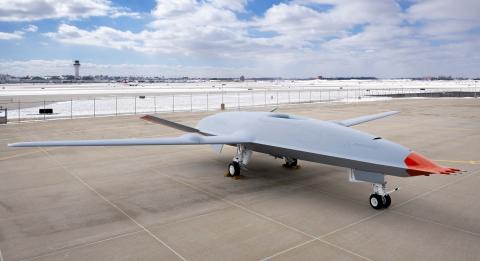
As part of a modification to a previously awarded contract, the Navy has exercised contract options with Boeing worth $84.7 million to buy three MQ-25A Stingray unmanned aerial refueling tankers. According to the contract announcement released by the Pentagon on Thursday, April 2, the three MQ-25s covered by the contract options are to be completed by August 2024. (USNI News)
MIT researchers invent simulation system to train driverless cars to navigate worse-case scenarios
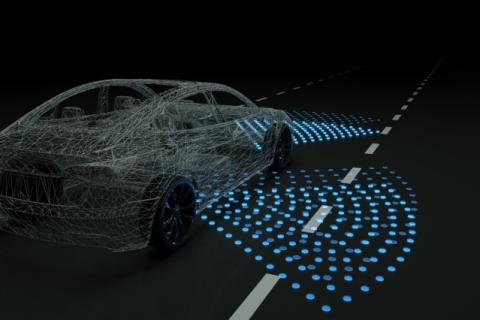
To help driverless cars learn to navigate a variety of worse-case scenarios before they begin operating on real roads, researchers at MIT have invented a simulation system to train driverless cars that creates a photorealistic world with “infinite” steering possibilities.
According to the researchers, control systems—also known as “controllers” —for autonomous vehicles largely rely on real-world datasets of driving trajectories from human drivers. The vehicles use this data to learn how to emulate safe steering controls in different situations. Researchers note, though, that real-world data from hazardous “edge cases,” such as nearly crashing or being forced off the road or into other lanes, are rare.
Drone equipped with special cameras can dodge fast-moving objects
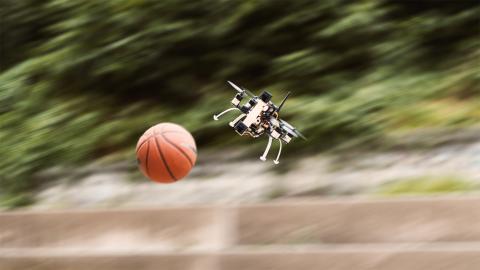
Researchers from the University of Zurich have equipped a drone with a novel type of camera to give it the ability to detect and avoid fast-moving objects.
According to the researchers, drones that are equipped with cameras typically take 20 to 40 milliseconds to process an image and react in order to detect obstacles, which is not quick enough to avoid a bird or another drone. It also isn't quick enough to avoid a static obstacle when the drone itself is flying at high speed.
QUT researchers to use drones to identify wildlife populations in bushfire affected areas
As part of a collaborative project, researchers at Queensland University of Technology (QUT) in Queensland, Australia will use drones and infrared imaging to identify wildlife populations in bushfire affected areas.