
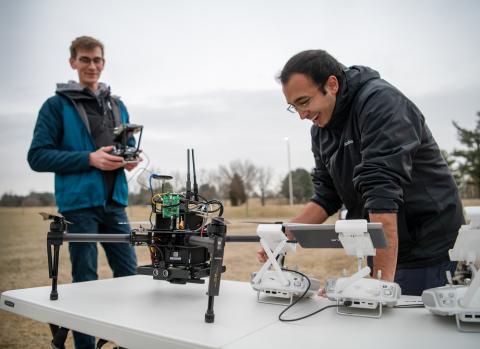
With the help of a grant from the National Science Foundation worth $1.5 million, a group of Virginia Tech engineers will pair up human researchers with UAS, in hopes of redefining search and rescue protocols.
Utilizing autonomous algorithms and machine learning, the UAS will complement search and rescue efforts from the air. Additionally, they will suggest tasks and send updated information to human searchers on the ground.
The researchers hope to make searches more effective by using mathematical models based on historical data that reflect what lost people actually do combined with typical searcher behavior, which balances autonomy with human collaboration.
Research
Research
Stanford University researchers develop system to help autonomous cars safely navigate unknown circumstances
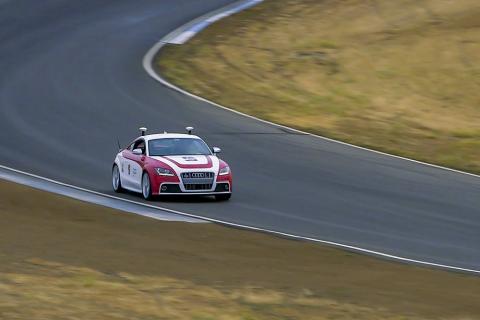
Stanford University researchers have announced that they have developed a new way of controlling autonomous cars that integrates prior driving experiences, which will help cars perform more safely in extreme and unknown circumstances.
Two of Stanford’s autonomous vehicles, Niki and Shelley, were used to test the system at the limits of friction on a racetrack. Researchers say that the system performed about as well as an existing autonomous control system and an experienced racecar driver.
Pittsburgh Mayor announces 'Pittsburgh Principles' for autonomous vehicles
On Monday, March 4, Pittsburgh Mayor William Peduto issued an executive order that outlines city objectives and expectations for the safe testing of autonomous vehicles in Pittsburgh.
Known as the “Pittsburgh Principles,” the order also assigns responsibilities for the development of transparent and constructive reporting guidelines for the growing technology sector.
“Autonomous vehicle technology has the potential to dramatically improve safety on our city streets and yield transformative benefits to equitable access and quality of life for all in our city. This can only happen when industry, agencies and people understand one another and work together,” says Mayor Peduto.

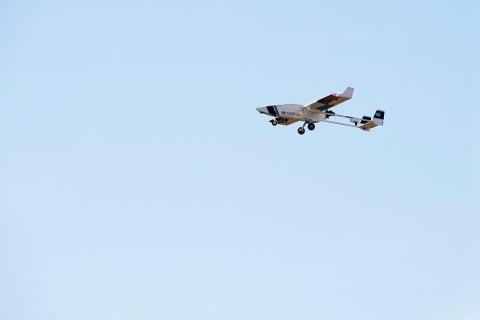
Mississippi State University's Raspet Flight Research Laboratory acquires TigerShark XP3 UAS
Mississippi State University’s Raspet Flight Research Laboratory has acquired two of the latest TigerShark XP3 aircraft, which will help expand its UAS research and support capabilities.
Expected to substantially increase Raspet’s UAS core flight research capabilities, the TirgerShark XP3 UAS will allow the Raspet team to fly at higher altitudes and for a longer period of time, which will increase the research lab's ability to meet the needs of its federal research partners, and directly support Mississippians in times of emergency, according to Raspet Lab Director Dallas Brooks.
Mississippi State awarded $7.2 million defense contract to test emerging UAS tech
On Friday, Feb. 22, Mississippi State University was awarded a $7.2 million defense contract to test emerging UAS technologies.
Mississippi State was awarded the competitive U.S. Army contract to test and validate emerging UAS propulsion technologies. The contract extends through Feb. 2021, and is funded through research, development, test and evaluation appropriations provided to the Army.
Arizona State University creates new master's degree program in robotics and autonomous systems
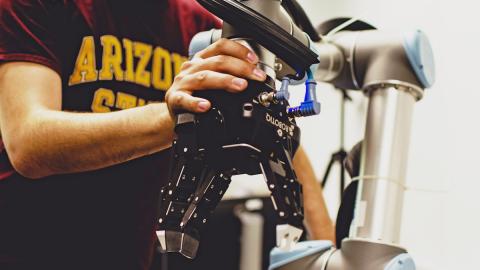
Arizona State University’s Ira A. Fulton Schools of Engineering has created a new master’s degree program in robotics and autonomous systems.
The program is designed to train the next generation of robotics researchers with multidisciplinary knowledge in a variety of advanced topics, including but not limited to, artificial intelligence, computer science and machine learning.
“In the future, we’re going to be interacting with intelligent machines a lot in our everyday lives,” says Panagiotis Artemiadis, the robotics and autonomous systems graduate program chair and an associate professor of aerospace and mechanical engineering.
Sinclair College's National UAS Training and Certification Center partners with senseFly
Through a recently announced partnership, Sinclair Community College’s National UAS Training and Certification Center will become the primary North American partner of senseFly, providing standardized OEM training platforms for senseFly’s clients, in an effort to complement direct training and training through authorized senseFly distribution partners.
Sinclair and senseFly say that their partnership will broaden the reach of senseFly’s expertise in UAS technology, while also expanding its offering of high-quality training through Sinclair’s National UAS Training and Certification Center.
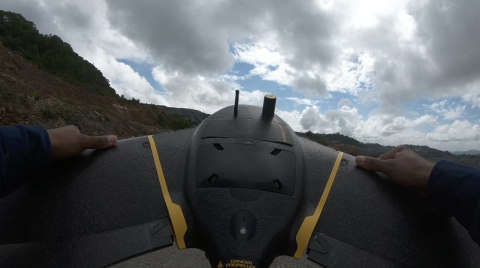
NUAIR Alliance and others test impact of wind on air worthiness and performance of UAS
The New York State UAS Test Site, TruWeather Solutions, the NUAIR Alliance and a company called Windshape have announced that using “industry-leading” micro-weather stimulations, they tested the impact of wind on the air worthiness and performance of various types of UAS.
Testing took place at the New York State UAS Test Site at Rome, New York's Griffiss International Airport.
“We know that weather impacts small drones in a variety of ways and these tests enabled us to evaluate that impact and each platform’s capacity to reject atmospheric disturbances and maintain safe flight,” explains Major General Marke F. “Hoot” Gibson (ret), chief executive officer, NUAIR Alliance.
Researchers from MIT and Microsoft uncover "blind spots" of artificial intelligence systems
Researchers from MIT and Microsoft have developed a model that identifies instances where autonomous systems have “learned” from training examples that don’t match what’s actually happening in the real world.
The researchers say that this model could be used by engineers to improve the safety of artificial intelligence (AI) systems, such as driverless vehicles and autonomous robots.
According to the researchers, AI systems that power driverless cars are thoroughly trained in virtual simulations to prepare the vehicle for nearly every event on the road. Sometimes, though, the car makes an unexpected error in the real world because an event occurs that should, but doesn’t, change the car’s behavior.
Georgia State researcher and collaborators awarded grant to develop UAS to battle wildfires
Through the National Robotics Initiative 2.0: Ubiquitous Collaborative Robots program, the United States Department of Agriculture-National Institute of Food and Agriculture has awarded Georgia State researcher Xiaolin Hu and collaborators a four-year federal grant worth $1.2 million to develop the use of UAS in wildfire management.
The goal of the project is to provide more timely data that could allow authorities to give residents in affected areas more time to evacuate, while also helping firefighters working on the ground.