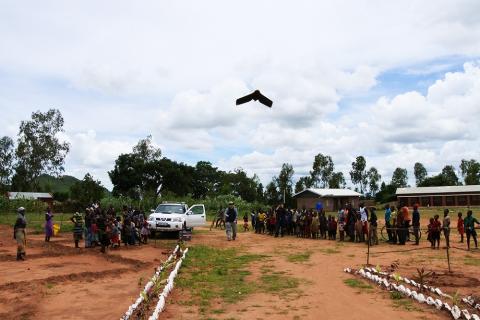
Kansas State University Polytechnic Campus has become the first university to receive a waiver from the FAA to fly UAS beyond the line of sight (BLOS).
The FAA certificate to Kansas State Polytechnic's Applied Aviation Research Center waives the rules regarding visual sight of aircraft operations by the pilot and visual observers, which will allow K-State Polytechnic to conduct research and operations where pilots and observers can no longer see their UAS.
“These operations and research will provide valuable insight into regulation and safety measures for UAS in the national airspace,” says Travis Balthazor, Kansas State Polytechnic's UAS flight operations manager.
Research
Research
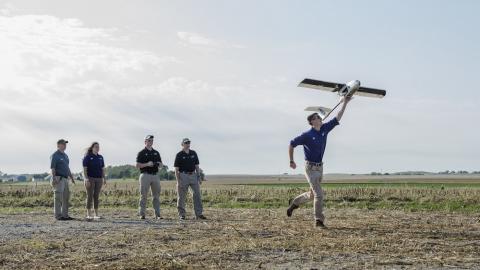
University of Colorado Boulder and others collect data on monster storm using UAS
A team of aerospace engineers from the University of Colorado Boulder (CU) recently spent the first half of June traveling across the Midwest in search of monster storms.
During this time period, the CU team, which was made up of 16 CU employees and students, encountered a storm on June 8 outside Norris, South Dakota, and used one of its three “TTwistor” UAS to fly through the dark skies to collect data from the storm.
“It is amazing to me how you're driving along for several hours and it's nice, clear, sunny skies, and all of sudden you're under these clouds and it gets dark pretty fast,” says Eric Frew, CU associate professor, via the Daily Camera.
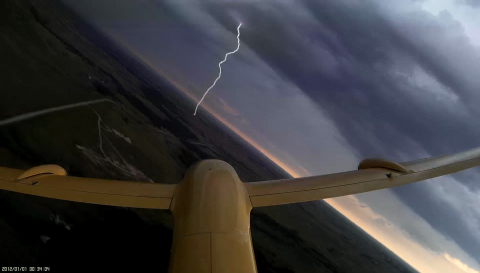
Liquid Robotics' Wave Gliders USV selected to conduct scientific research in Arctic and Southern Oceans
Liquid Robotics’ Wave Glider USV has been selected as the sensor platform to conduct advanced scientific research in the “most inhospitable and remote regions” of the Arctic and Southern Oceans by top oceanographers from Scripps Institution of Oceanography (Scripps) and the Applied Physics Laboratory of the University of Washington (APL-UW).

RoboBusiness
RoboBusiness is the pioneering event of the global robotics ecosystem and the most important gathering of the year for those seeking to learn about and profit from robotics. For over 13 years, RoboBusiness has brought together thousands of executives, engineers, investors, startups, robotics experts, and those implementing robotics into their businesses from around the world to learn from one another, build relationships, and craft robotics strategies that can be immediately put to use to grow their businesses and stay ahead of the competition.
Alta Devices' solar technology selected to help power Hybrid Tiger UAV
The U.S. Naval Research Laboratory (NRL) will use Alta Devices’ “highly efficient, flexible, and light-weight” solar technology to help power the “breakthrough” Hybrid Tiger UAV.
The Hybrid Tiger is a project designed to create a Group-2 UAV that will stay aloft for at least three and a half days, and Alta Devices says that technologies developed for the project will be applicable to other unmanned vehicles.
ASV Global and Peel Ports Group partner to develop use of autonomous vessel technology for UK port operations
ASV Global (ASV) and Peel Ports Group have launched a partnership to “develop the use of autonomous vessel technology for UK port operations.”
The partnership, which was cemented in March when the companies signed an official Memorandum of Understanding, began with a visit from ASV’s team to the Port of Liverpool to demonstrate an autonomous vessel called the C-Cat 3, which is ideal for shallow survey operations.
Operating in Brocklebank Dock, the C-Cat 3 conducted seabed survey using a Norbit iWBMS multibeam echosounder. The successful demonstration led Peel Ports Group to look into the possibility of using the technology at its other sites throughout the United Kingdom.
DARPA soliciting proposals for second 'swarm sprint' for its OFFSET program focused on unmanned systems
DARPA has announced that it is soliciting proposals for the second “swarm sprint” for its OFFensive Swarm-Enabled Tactics (OFFSET) program.
OFFSET envisions future small-unit infantry forces using small UAS and/or small unmanned ground systems (UGSs) in swarms of 250 robots or more to accomplish “diverse missions in complex urban environments.”
According to DARPA, each of the five core “sprints” focuses on one of the key thrust areas: Swarm Tactics, Swarm Autonomy, Human-Swarm Team, Virtual Environment, and Physical Testbed.
The second group of “Swarm Sprinters” will get the chance to work with one or both of the OFFSET Swarm Systems Integrator teams to develop and assess tactics, as well as algorithms, to enhance autonomy.
University of Waterloo partners with Chinese institutions to advance research related to connected and autonomous vehicle technology
In an effort to “advance research in the areas of connected and autonomous vehicle technology,” the University of Waterloo is partnering with the Qingdao Academy of Intelligent Industries (QAII), and the State Key Laboratory for Management and Control of Complex Systems (SKL-MCCS), both of which are institutes in China.
The entities recently signed an agreement to solidify the partnership.
The agreement outlines several initiatives, including faculty and graduate student exchanges, a Waterloo PhD program focused on autonomous vehicles, and the establishment of a shared research center for automated driving.
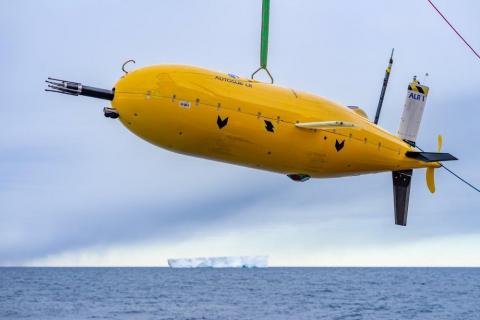
Boaty McBoatface AUV successfully completes first under-ice Antarctic mission
Last week, the National Oceanography Centre’s (NOC) Autosub Long Range (ALR) AUV —popularly known around the world as ‘Boaty McBoatface’—was successfully recovered following its first under-ice mission beneath the Filchner Ice Shelf in West Antarctica.
The AUV was deployed in the southern Weddell Sea from January to February 2018 during RV Polarstern cruise PS111, as part of the Filchner Ice Shelf System (FISS) Project, which is a collaboration that involves several leading UK research institutions, including the NOC.
The AUV plays an important role in the project that aims to investigate and describe the “current state of the complex atmosphere-ice-ocean system.”
Oakland University professor uses UAS to combat ill effects of climate change on crops in Africa
Oakland University professor Jon Carroll, Ph.D., is part of a team of scholars that is using UAS technology to “promote sustainable agriculture in Africa.”
Recently, Carroll, who is also an FAA-licensed UAS pilot and a Registered Professional Archaeologist, traveled to Liwonde, Malawi to work on a research project called “Precision Agriculture for Smallholder Systems in Africa,” which is helping farmers boost crop production in the face of emerging threats posed by climate change.