The Army Research Laboratory has awarded Blake Stringer, Ph.D., assistant professor of aerospace engineering in Kent State’s College of Aeronautics and Engineering, a grant worth more than $130,000 to study propulsion systems for a new generation of intermediate-sized UAS.
Currently, the military is limited to airplanes and helicopters when it needs to move people and supplies through the air.
With this in mind, Dr. Stringer, who retired after 20 years in the Army, will work with Army Research Laboratory consultants and researchers at the University of Tennessee to see how plausible it is to create a UAS that is somewhere in between the size of the military's current aviation options.
Research
Research
U.S. Navy commissions first UAS test and evaluation squadron
During a ceremony at Naval Air Station Patuxent River’s Webster Outlying Field on Oct. 18, the U.S. Navy commissioned its first UAS test and evaluation squadron.
Known as Air Test and Evaluation Squadron (UX) 24, the new unit flies over 23 fixed and rotary wing UAS, including the MQ-8 Fire Scout, RQ-20 Puma, RQ-21 Blackjack and RQ-26 Aerostar.
The ceremony marked UX-24’s official transition from what was formerly known as NAWCAD’s UAS Test Directorate, which was previously overseen by Commander Matthew Densing. Under Densing’s leadership, the directorate executed more than 2,200 flight hours and 2,000 ground test hours in support of UAS developmental test.
During the ceremony, Cdr. Densing officially assumed leadership of UX-24.

Meet the IPP Sites: Mid-Atlantic Aviation Partnership to spearhead Virginia's work for IPP project
A White House and FAA initiative, the UAS Integration Pilot Program involves 10 locations that will use unmanned aircraft in a wide variety of ways. AUVSI is writing a series of profiles on the locations.
Minority Serving Institutions to use grants from NASA to focus on UAS and robotics-related education
In an effort to build the interest, skills and knowledge necessary for K-12 students to pursue science, technology, engineering, and mathematics (STEM) careers, NASA's Minority University Research and Education Program (MUREP) Aerospace Academy (MAA) is providing nearly $2.3 million in grants to seven Minority Serving Institutions (MSIs).
Michigan Technological University set to open Maritime Autonomy Research Site
According to the Detroit News, Michigan Technological University is opening the Maritime Autonomy Research Site, which will give researchers a space to try out new technologies that would facilitate greater use of unmanned research and survey vessels.
Located on Lake Superior’s Portage Canal in the Upper Peninsula city, the Maritime Autonomy Research Site is the first freshwater testing spot of its kind in the world, according to officials.
A launch ceremony for the site was scheduled for Friday, August 10, and on the same day, a new organization called the Smart Ships Coalition was also scheduled to be announced.
GA-ASI expanding presence at Grand Sky civil UAS-focused research and development park
General Atomics Aeronautical Systems Inc. (GA-ASI) will “significantly expand” its presence on Grand Sky, the first and only fully operational civil UAS-focused research and development park in the U.S.
Under the agreement, GA-ASI will expand its current leased space of 5.5 acres to 20 acres, all located along Grand Sky’s “beachfront,” which provides immediate access to Grand Forks Air Force Base’s 12,351-foot runway. Terms of the lease are in place for 10 years.
“This announcement is validation of the value Grand Sky provides to Grand Forks and the industry as a whole,” says Thomas Swoyer, Jr., president of Grand Sky Development Company.
Griffiss International Airport to receive $800,000 in state funding for UAS technology
On Tuesday, July 24, New York State Senator Joseph Griffo announced that Griffiss International Airport is set to receive $800,000 in state funding for UAS technology.
$500,000 of that funding will be used to transform a hangar at the airport into a year-round UAS experimentation environment known as a “Sky Dome,” which will support the development of UAS technologies to operate safely and securely in the National Air Space (NAS).
This funding is in addition to $450,000 that was previously announced, Griffo says.
Flirtey celebrates three-year anniversary of its 'Kitty Hawk' moment
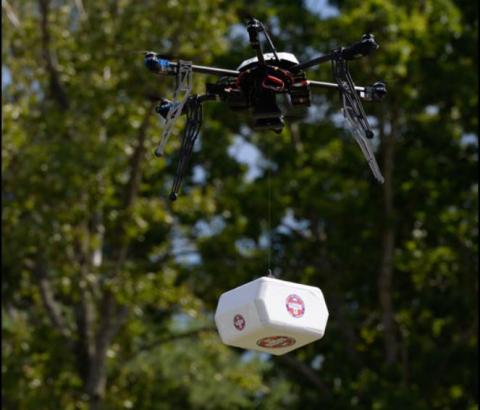
On this day three years ago, Flirtey successfully completed the first FAA-approved drone delivery in the United States.
In collaboration with NASA's Langley Research Center in Hampton, Virginia, Flirtey delivered pharmaceuticals and other medical supplies to an outdoor free clinic in Wise County, Virginia.
During the flights, a NASA Langley fixed-wing Cirrus SR22 aircraft picked up 10 pounds of pharmaceuticals and supplies from an airport in Tazewell County in southwest Virginia. With a safety pilot on board, the plane delivered the medicine to the Lonesome Pine Airport in Wise County.
Ohio leaders break ground on autonomous vehicle testing center
On July 9, Ohio Governor John Kasich and leaders from The Ohio State University, the Ohio Department of Transportation (ODOT), JobsOhio and other organizations came together to break ground on the Transportation Research Center’s (TRC) new SMART Center in East Liberty, Ohio.
The SMART Center will serve as a testing ground for autonomous and connected vehicles.
“What this is going to do is give people the opportunity all over the world to be going 24/7, to test in all conditions and to have multiple cars on the road,” Kasich explains. “This is going to be the coolest place to go with your kids.”

Liquid Robotics' Wave Glider USVs help study effects of lava flow from Hawaii's Kilauea Volcano
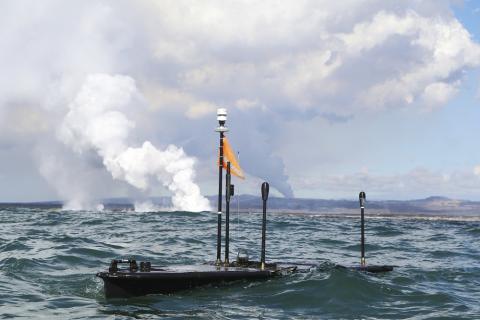
Liquid Robotics recently deployed two of its Wave Glider USVs to help scientist study the effects of the lava from Kilauea Volcano in Hawaii when it enters the ocean and the large plume it creates, as well as the impacts on marine life.
As evident by its name, the Wave Glider is wave powered, meaning that it doesn't require any fuel power other than the waves of the ocean to carry it place to place. In this particular use case, Wave Gliders provide researchers a no risk way to monitor the volcanic activity.