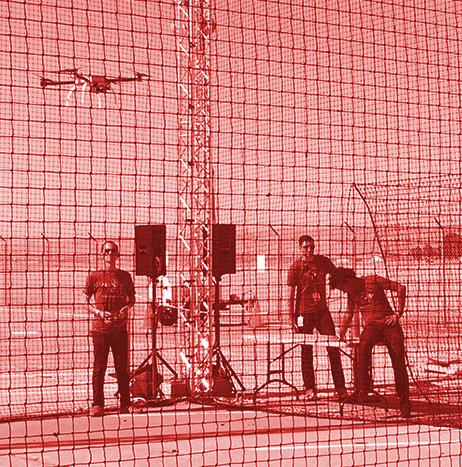
MetLife Stadium, home to the National Football League’s New York Jets and New York Giants, has selected AirWarden—the drone detection system from AeroDefense, a provider of domestically legal drone detection systems—to provide an early warning system for drones.
Also the host of large scale events such as concerts, international soccer, and college football games, MetLife Stadium began evaluating various types of drone detection systems in 2017, including radar, radio frequency (RF), acoustic, and camera systems. According to Daniel DeLorenzi, vice president Security & Safety Services at MetLife Stadium, RF proved to be the best option.
Software
Software
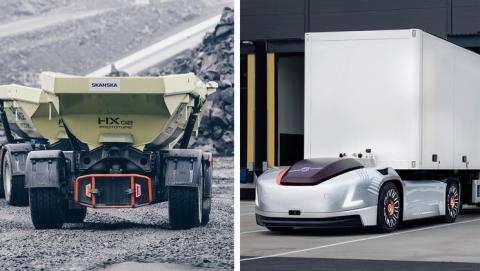
Newly established Volvo Autonomous Solutions to accelerate development of autonomous transport platforms
The Volvo Group has established Volvo Autonomous Solutions, a new business area that will accelerate the development, commercialization and sales of autonomous transport platforms.
According to the Volvo Group, this new business area will allow it to meet a growing demand, and ultimately offer customers in segments such as mining, ports and transport between logistics centers, the best possible platforms as a complement to today’s products and services.
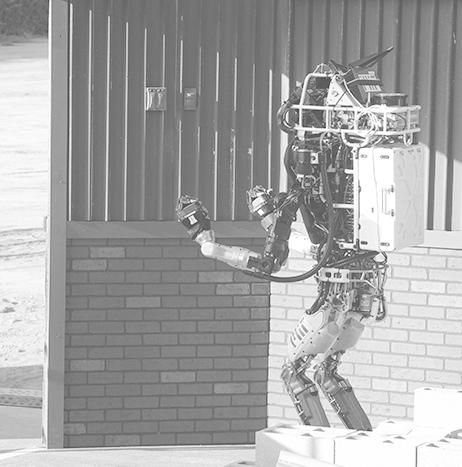
Realtime Robotics to use funding to accelerate development of more commercial product releases
Realtime Robotics, the developer of responsive motion planning for industrial robots and autonomous vehicles, has raised $11.7 million in Series A funding.
This capital will be used for several efforts, including accelerating the development of more commercial product releases, and growing the Realtime Robotics team to support key customers and partners across the world.
“The commitment garnered from strategic investors reflects both the need and the demand for smarter robots,” says Peter Howard, CEO, Realtime Robotics.
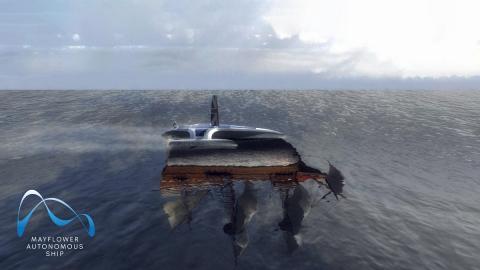
Mayflower Autonomous Ship to utilize IBM AI and other tech to autonomously cross Atlantic
Led by marine research organization ProMare, a global consortium of partners is building an unmanned, fully-autonomous ship that will cross the Atlantic on the fourth centenary of the original Mayflower voyage in September 2020.
IBM has joined that consortium, and the Mayflower Autonomous Ship (MAS) will utilize IBM’s artificial intelligence (AI), most powerful servers, cloud and edge computing technologies to autonomously navigate and avoid ocean hazards as it travels from Plymouth, England to Plymouth, Massachusetts.
If the voyage proves successful, MAS will be one of the first self-navigating, full-sized vessels to cross the Atlantic Ocean.
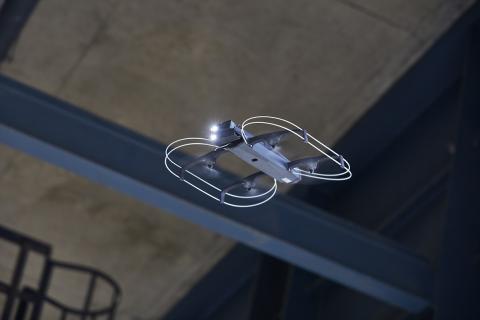
U-ROB's ROBi drone designed for industrial applications
U-ROB, a German drone manufacturer, has developed a drone for industrial applications called ROBi.
“This includes applications such as the inspection of pipelines and combustion chambers in power plants, the inspection of chimneys and the interior of bridge structures as well as the inspection of tanks and sewage pipes,” says Joseph Metz, founder and managing director of U-ROB GmbH.
Launched into market earlier this year, ROBi is equipped with an exchange mechanism for different sensors and camera systems, which gives the system a high level of flexibility.
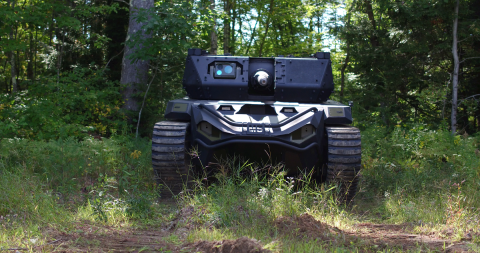
Textron Systems, Howe & Howe and FLIR Systems unveil Ripsaw M5 Robotic Combat Vehicle
During the 2019 AUSA Annual Meeting & Exposition in Washington, D.C., Textron Systems, Howe & Howe and FLIR Systems debuted the Ripsaw M5 Robotic Combat Vehicle (RCV).
The Team Ripsaw offering for the U.S. Army’s RCV program, the Ripsaw M5, which is described as a “low-risk, ready-now solution,” is capable of performing a variety of missions thanks to its aggressive mobility and modularity.
“Bringing together Howe & Howe, Textron Systems and FLIR Systems really represents a dream team,” says President & CEO Lisa Atherton of Textron Systems.
Oklahoma State University, Vigilant Aerospace Systems conduct autonomous demonstration flight at OSU's BVLOS corridor
Oklahoma State University (OSU) and Vigilant Aerospace Systems recently conducted a demonstration flight that used OSU’s 13-mile beyond visual line-of-sight (BVLOS) corridor east of Stillwater, Oklahoma.
The demonstration, which took place on Oct. 8, evaluated BVLOS capabilities, while also demonstrating Vigilant's latest FlightHorizon software, which provided airspace situational awareness throughout the flight.
The fully autonomous demonstration flight covered more than 18 miles.
The first full exercise of the FAA-authorized 13-mile UAS corridor—located in central Oklahoma—the flight was considered a “major field test” for the latest version of Vigilant Aerospace's management and active detect-and-avoid (DAA) system, FlightHorizon 2.
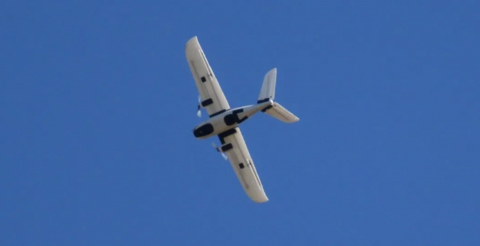
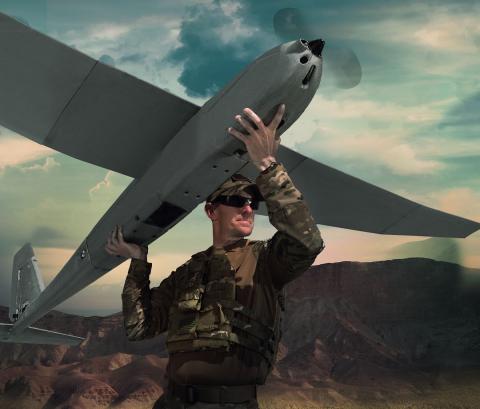
AeroVironment launches Puma Long Endurance UAS
AeroVironment has launched its Puma Long Endurance (LE) UAS, which is the next generation in the company’s Puma All Environment (AE) small UAS product line.
With new capabilities, increased range, and expanded payload capacity, the Puma LE builds on the Puma AE legacy, delivering Group 2 capabilities in a Group 1 footprint. The UAS is equipped with Mantis i45 gimbaled EO/IR sensor and NVG-visible laser illuminator, helping to provide the warfighter with superior imagery for intelligence, surveillance, and reconnaissance (ISR) during day, night and low-light operations on land and in maritime environments.
Indshine announces thousandth user of drone mapping platform
Indshine has announced that Palacios Robert from Orux Drone is the thousandth user of its drone mapping platform.

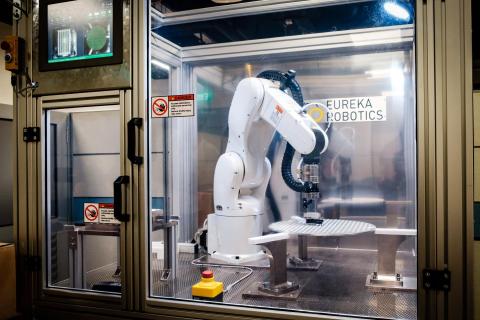
Eureka Robotics unveils robot with the precision and dexterity of a human hand
Eureka Robotics has unveiled Archimedes, a new robot capable of picking up delicate optical lenses and mirrors with the care and precision of a human hand.
A robotics technology start-up from Nanyang Technological University, Singapore (NTU Singapore), Eureka says Archimedes can slot lenses and mirrors of different sizes into a custom loading tray to prepare them for coating.
Archimedes features a six-axis robot arm controlled by algorithms that use Artificial Intelligence (AI) to plan its motion and how much force to exert in its grip, creating a system that can mimic the dexterity of human fingers and the visual acuity of human eyes.