Technology
Technology
Starship Technologies' autonomous delivery robots take to the streets of the UK
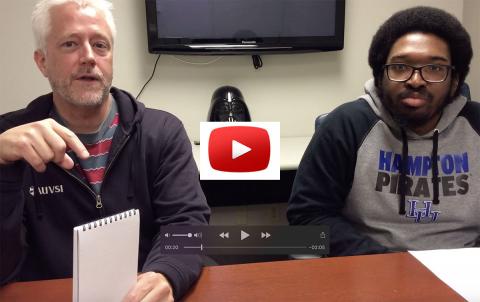
On Oct. 31, Starship Technologies launched what it calls the world’s first autonomous package delivery service, as hundreds of the company’s robots will be used to deliver packages straight to the front doors of consumers.
Right now, the service is available through Starship’s official app for residents living in the UK (Milton Keynes). By simply clicking a button, these residents can have packages delivered to their front door whenever they choose.
According to Starship, once people sign up on the app, they will receive a ‘personal address’ in place of their home address or whichever location they normally get parcels delivered to. This personal address will be the location of a Starship managed local facility.
Kent State Aeronautics Professor receives grant to research intermediate-sized UAS for the Army
The Army Research Laboratory has awarded Blake Stringer, Ph.D., assistant professor of aerospace engineering in Kent State’s College of Aeronautics and Engineering, a grant worth more than $130,000 to study propulsion systems for a new generation of intermediate-sized UAS.
Currently, the military is limited to airplanes and helicopters when it needs to move people and supplies through the air.
With this in mind, Dr. Stringer, who retired after 20 years in the Army, will work with Army Research Laboratory consultants and researchers at the University of Tennessee to see how plausible it is to create a UAS that is somewhere in between the size of the military's current aviation options.

Kansas Department of Transportation and Iris Automation begin UAS test flights under UAS IPP this week
This week, the Kansas Department of Transportation (KDOT) is starting the testing phase of the UAS Integration Pilot Program (IPP).
One of KDOT’s partners for the program, Iris Automation, will focus on enabling new detect and avoid capabilities for UAS.
The winner of AUVSI’s 2018 Startup Showdown during XPONENTIAL 2018, Iris Automation will test its collision avoidance technology in the airspace above Gypsum’s farmlands. Using computer vision and artificial intelligence, the technology allows UAS to see the world the way a pilot does, which ultimately facilitates beyond visual line of sight (BVLOS) flights.
Test flights will take place throughout the week, and the technology will be evaluated through controlled UAS flights against a manned aircraft.
Waymo granted landmark permit to test fully driverless cars on public roads in California
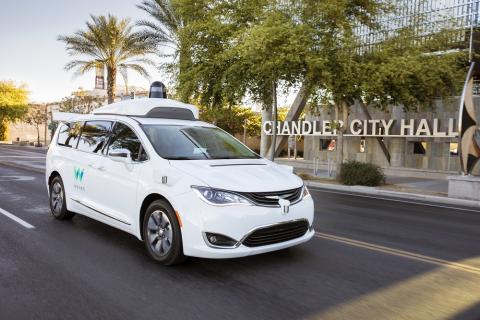
Just a few weeks after its self-driving vehicles surpassed 10 million miles driven on public roads, Waymo has announced that the California Department of Motor Vehicles has granted the company the first permit in the state to begin driverless testing on public roads.
According to Waymo, the permit is the result of new DMV regulations that took effect in April that allow companies to apply for fully driverless testing within carefully defined limits.
Waymo, which has been testing its technology in the state of California for almost a decade, notes that this is the first time California has allowed tests on public roads of fully driverless cars without a test driver sitting in the driver’s seat.

MBARI engineers demonstrate using long-range AUV for detecting and tracking oil spills
Late last month, Monterey Bay Aquarium Research Institute (MBARI) engineers demonstrated using MBARI’s long-range AUV (LRAUV) for detecting and tracking oil spills.
The engineers, who worked with the US Coast Guard and collaborators at Woods Hole Oceanographic Institution (WHOI), equipped an LRAUV with special instruments (fluorometers) that can detect oil in water. During the recent test in Monterey Bay, the MBARI team simulated an oil spill using non-toxic, biodegradable dye.
According to MBARI, the Coast Guard is very interested in testing robots that can find and track oil spills under ice; a capability that will be crucial as ship traffic and oil exploration expands in the Arctic Ocean, MBARI says.
SenseFly and IN-FLIGHT Data complete historic urban BVLOS UAS project
SenseFly and IN-FLIGHT Data recently completed what they are calling North America’s first urban beyond visual line of sight (BVLOS) UAS project in a major city.
Conducted in Calgary, Alberta, Canada, the project’s goal was to collect mapping data to support the development of a new graveyard site, which will be the first new cemetery in the city since 1940.
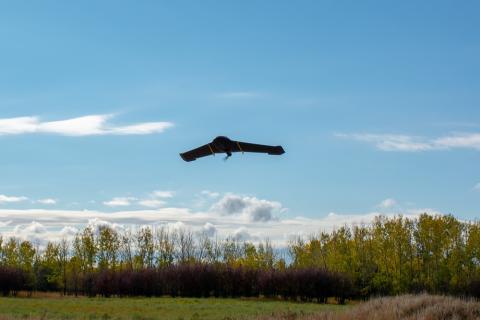
Using a senseFly eBee Plus fixed-wing UAS, the IN-FLIGHT Data team mapped the area by conducting a total of 257 miles’ worth of BVLOS operations at an average distance of 1.46 miles from the pilot.
Meet the IPP Sites: Memphis airport authority looks to show how UAS can benefit airports, manned aircraft
The Memphis-Shelby County Airport Authority (MSCAA) will spend the next three years conducting a variety of UAS operations across Memphis under the UAS Integration Pilot Program.
The only lead applicant selected for the program that is an airport, MSCAA is especially interested in the benefits that drones can offer airports, and ironically enough, manned aircraft.
Airports are increasingly looking to integrate UAS into their operations, which is something that MSCAA’s President and CEO, Scott Brockman, is also looking to do.