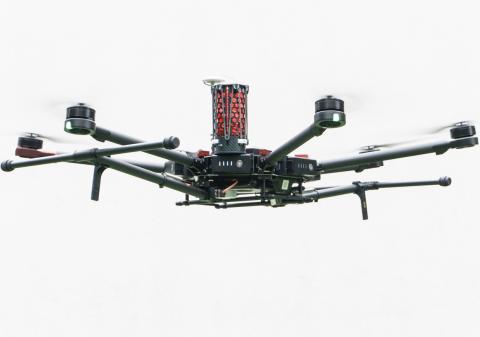
On Friday, Oct. 19, Drive.ai officially launched its self-driving program in the city of Arlington, Texas.
For Drive.ai, this is the second self-driving service that it has launched on public roads in the last four months, with the first launching in Frisco, Texas back in July.
During the program in Arlington, Drive.ai is deploying its fleet of self-driving vehicles in Arlington’s downtown district, making the technology available to more than 400,000 residents, as well as visitors to the area.
Technology
Technology
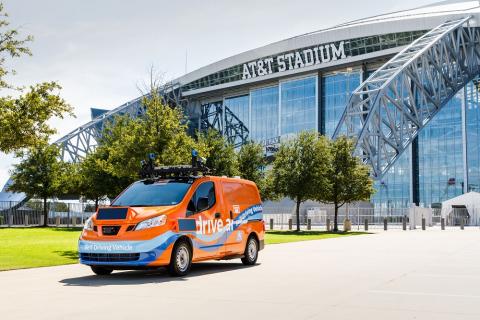
FLIR announces UAS flight management software platform designed for public safety applications
FLIR Systems Inc. has announced a UAS flight management software platform designed for public safety applications called DroneSense–FLIR Edition.
According to FLIR, DroneSense-FLIR Edition is the only software platform that combines thermal and visual imaging processing with flight data planning and management capabilities across public safety organizations to help improve incident response.
This is the first product under a collaboration between FLIR and DroneSense. DroneSense is a UAS software platform maker based in Austin, Texas that FLIR announced a strategic investment in earlier this year.

UAVOS and Stratodynamics Aviation finalizing balloon-launched unmanned glider
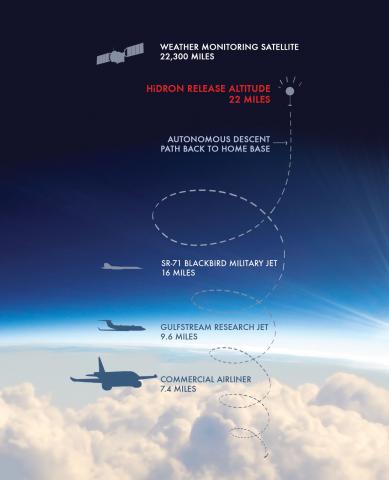
UAVOS Inc., along with Stratodynamics Aviation Inc., is finalizing manufacturing of HiDRON, a stratospheric aircraft that is built to provide a “new dynamic method for measuring and evaluating atmospheric phenomena at various altitudes in a variety of geographical locations.”
Designed to collect high-altitude atmospheric data, the balloon-launched unmanned glider is capable of autonomous and soaring flight modes.
During a campaign next month, the HiDRON will reach altitudes up to 82,000 feet, the companies say.
Calgary's first driverless shuttle pilot project welcomes 4,500 passengers
According to the Canadian Broadcasting Corporation (CBC), the first public trial of a driverless shuttle in Calgary, Alberta, Canada has come to an end.
During the 22-day pilot project, a total of 4,500 visitors were shuttled between Telus Spark and the Calgary Zoo, as the vehicle operated on a separate roadway free of other vehicles, cyclists and pedestrians.
According to City transportation engineer Colin Chapman, passengers had a lot of questions about the vehicle.
“They were interested to see a vehicle that doesn't have a steering wheel, and obviously a bit unsure while they're getting on,” Chapman says via CBC.
UAVOS completes first stage of flight tests of HAPS ApusDuo UAS
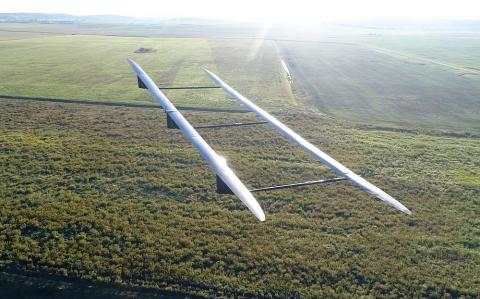
UAVOS Inc. recently completed the first stage of flight tests of the 10-meter prototype of the High Altitude Pseudo Satellite (HAPS) ApusDuo UAS.
HAPS ApusDuo was manufactured as part of the development program of the ApusDuo solar aircraft.
The prototype was made for testing control algorithms such as take-off and landing and full-scale verification of HAPS aerodynamics.
UAVOS says that test flights “fully confirmed” the flight characteristics of the UAS.
Video footage of the flight tests can be seen below:
Honeywell and Fetch Robotics collaborating to deliver autonomous mobile robots to distribution centers
Honeywell and Fetch Robotics are partnering to deliver autonomous mobile robots (AMRs) to distribution centers, in an effort to help them “more effectively fulfill growing volumes of e-commerce orders.”
The collaboration between the two entities enables Honeywell Intelligrated's customers to increase productivity and boost labor efficiency by deploying Fetch Robotics' AMRs, which transport items through distribution centers without human guidance or fixed paths, all while operating safely alongside people.
With Fetch Robotics’ AMRs a part of its smart robotics portfolio, Honeywell Intelligrated can provide customers with a range of flexible automation technology that can be adjusted to address current and future operational needs.
From Unmanned Systems Magazine: Good teams, good strategies, compelling tales: Successful startups describe their strategies
With technological advances emerging nearly every day, companies in the unmanned systems industry are competing to build better, stronger, faster, more agile machines for every type of customer, from governments to businesses to consumers. The technology is becoming more affordable and accessible, making the UAS industry one of the most dynamic, unpredictable and exciting marketplaces on earth.
Now more than ever, the path to competing in the market is paved with opportunity. As more countries have developed regulations allowing drone operations, and as more industries have created standards for the use and incorporation of unmanned systems into business functions, widespread adoption is racing ahead.
RTI's Connext 6 includes first connectivity software designed to accelerate development and deployment of highly autonomous systems
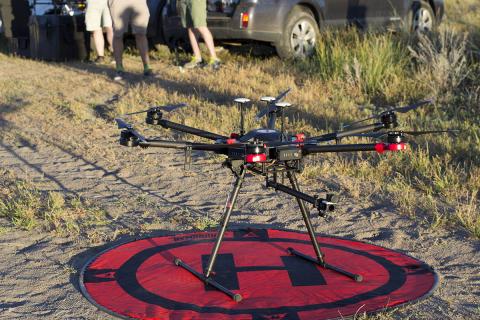
On Oct. 16, industrial internet of things (IIoT) connectivity company Real-Time Innovations (RTI) announced the newest release of its Connext product suite, Connext 6, which includes the first connectivity software designed to accelerate the development and deployment of highly autonomous systems.
With Connext 6, autonomous vehicle developers are provided with the advanced technology necessary to address the complex data distribution challenges of Level 4 and Level 5 autonomy.
NATE hosts UAS showcase event to highlight wireless industry use
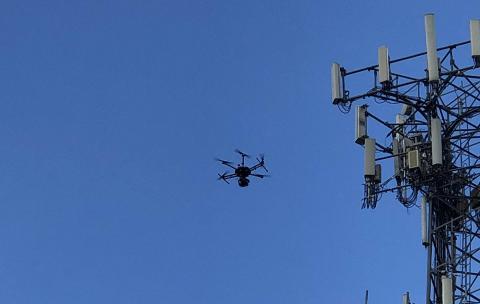
The National Association of Tower Erectors hosted key stakeholders from federal government agencies, industry and media at the inaugural NATE UAS Operations “Field Day Showcase” on Tuesday, Oct. 9 in Gainesville, Virginia, near the Washington, D.C. Beltway.
The event was held at a Crown Castle tower site. Crown Castle operates and leases more than 40,000 cell towers across the United States. At the event, attendees watched live flight demonstrations conducted by ETAK Systems; Talon Aerolytics; Ehresmann Engineering; and B+T Group.
Attendees were also able visit with drone and aviation subject matter experts about the transformative impact this technology is having on the wireless industry.
Drone Rescue Systems GmbH to present parachute system for UAS during Intergeo 2018
During Intergeo 2018, Austria’s Drone Rescue Systems GmbH will present the parachute system DRS-10 for the first time.
The company has also developed the parachute system DRS-M600 specifically for the DJI Matrice 600 (M600) UAS.
The parachute system DRS-10 is designed for multicopters with a total weight of five to 20 kilograms, making it well suited to be adapted to the DJI M600.
“The M600 is the workhorse of the drone fleet for many service providers,” says Andreas Ploier, CEO and co-founder of Drone Rescue Systems GmbH.
“Many different cameras and gimbals are compatible and fully integrable, which makes the M600 very versatile. For this reason it is all the more important, that the aircraft as well as the payload are protected from crashes.”