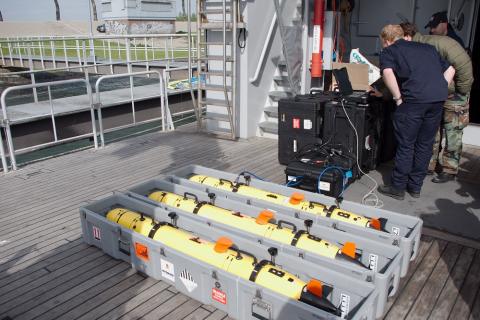
The Royal Netherlands Navy (RNLN) has successfully integrated SeeByte’s Neptune software into its New Generation Remus 100 AUV Fleet.
Neptune is SeeByte’s goal based mission planning and autonomy engine software. The software allows for the expedition and optimization of single and multi-vehicle operations.
“We are privileged to be in a position to continue working with The Royal Netherlands Navy and assist in their goal to achieve security at and from the sea,” says SeeByte’s Technical Client Manager, Alastair Cormack.
Technology
Technology
Royal Netherlands Navy equips its New Generation Remus 100 AUV Fleet with SeeByte's Neptune software
UAVOS completes series of test flights with its new Sitaria UAS
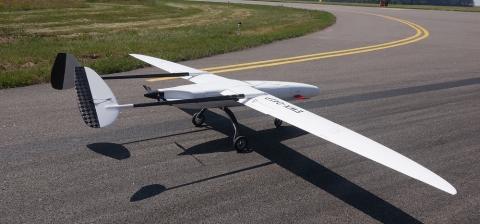
UAVOS Inc. has announced that it has completed a series of test flights with Sitaria, its new fixed-wing UAS.
The UAS is designed to carry out a variety of tasks, including patrol and observation missions, and aerial photography of terrain area with a radius of up to 120 kilometers. The UAS is also “purposely designed” to work with the LIDAR airborne laser scanning equipment as payload.
With a wide range of speeds—a stall speed of 65 kilometers per hour and a maximum speed of 150 kilometers per hour—Sitaria can conduct missions at minimum flight speeds close to 70 kilometers per hour.
Greenville Police Department investing in UAS thanks to federal grant
By Spring 2019, Greenville, South Carolina’s Police Department will have UAS technology as part of its operations.
According to Police Chief Ken Miller, the department can invest in the technology thanks to receiving a federal grant.
“Our intentional use is to purchase some sort of unmanned aircraft systems,” Miller says via WSPA-TV.
UAS have been used in the state to survey the flooding caused by Hurricane Florence. Miller says that there is no shortage of ways to utilize this technology.
“There are many departments in the city that have interest in this technology,” Miller says.
Carnegie Mellon University team to compete in DARPA robotics competition
A team from Carnegie Mellon University (CMU) will compete in the systems track of the Defense Advanced Research Projects Agency (DARPA) Subterranean Challenge.
A multi-year robotics competition with a $2 million prize, the Subterranean Challenge will task robots to autonomously search tunnels, caves and underground structures.
The Carnegie Mellon team, which includes a member from Oregon State University, is one of just six teams that will receive up to $4.5 million from DARPA to develop the robotic platforms, sensors and software needed to accomplish these “unprecedented underground missions.”

New South Wales Driverless Shuttle welcomes first passengers
This week, the New South Wales (NSW) Driverless Shuttle at Sydney Olympic Park welcomed its first passengers, as a select group of competition winners from the 2018 Easter Show took a ride in the vehicle, and effectively opened stage two of the state’s first driverless shuttle trial.
“I’m very excited to see passengers on these vehicles,” says Minister for Transport and Infrastructure Minister Andrew Constance.
“We know self-driving cars will play a major role in the future and that’s the future we’re preparing for right now.”
Tippecanoe County Sheriff's Department finds UAS beneficial when conducting crash site assessments
Crash assessments can take a lot of time, but the Tippecanoe County Sheriff’s Department in Lafayette, Indiana has found that UAS can be very beneficial when it comes to conducting crash site assessments.
Lieutenant Robert Hainje of the Tippecanoe County Sheriff’s Department says that the department’s methods of using close range photogrammetry with its camera systems that it has in place causes the department to keep the road way closed down while they take photographic evidence.
Aerospace Cornwall and UAVAid to launch first UAS flight from Cornwall Airport Newquay in May 2019
Aerospace Cornwall has partnered with UK based UAS developer and operator UAVAid to launch the first UAS flight from Cornwall Airport Newquay in England during a capability event in May 2019.
During the event, UAVAid will showcase Hansard, its humanitarian UAS platform. The UAS is designed to not only “fundamentally improve the way aid agencies can respond to large scale disasters,” but also “boost healthcare and economic development in the developing world.”
Each UAS has a variety of capabilities, including long range cargo delivery, live streaming aerial video and large area mapping, in low infrastructure contexts.
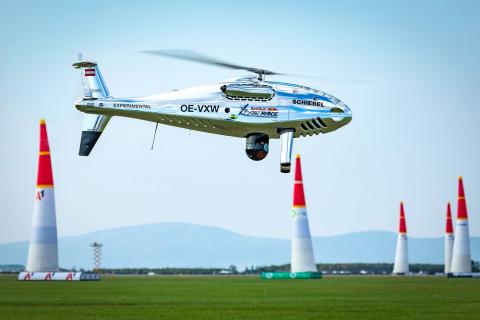
Schiebel's Camcopter S-100 UAS conducts flight display during Red Bull Air Race
During the Red Bull Air Race in Wiener Neustadt, Austria, Schiebel’s Camcopter S-100 UAS conducted a flight display.
Returning to its Austrian roots for the sixth race of the season, the Red Bull Air Race partnered with Schiebel in Wiener Neustadt, which is where the Camcopter S-100 production facility is located.
“The history of our company is strongly connected to the location of Wiener Neustadt and we are excited to be partnered with Red Bull Air Race 2018,” says Hannes Hecher, CEO of Schiebel.
“This presents a wonderful opportunity to bring together unmanned and manned aviation and give the audience a taste of the expertise and vision represented by the two sectors.”
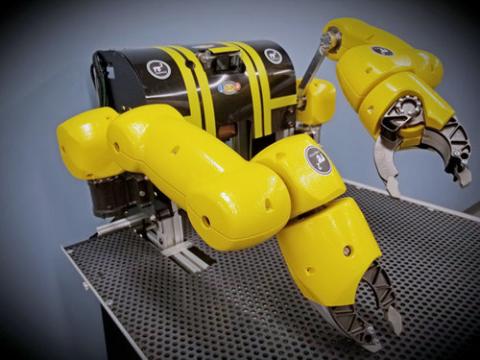
RE2 Robotics receives $2.5 million contract to continue developing its Dexterous Maritime Manipulation System
RE2 Robotics, which develops humanlike robotic manipulator arms, has received a $2.5 million contract from the Office of Naval Research to continue developing and commercializing its Dexterous Maritime Manipulation System (DM2S).
Equipped with RE2’s DM2S technology, Navy Explosive Ordnance Disposal (EOD) personnel will be able to “remotely and effectively” address Waterborne Improvised Explosive Devices (WBIEDs).
“As with the majority of our robotic technologies, the goal of the DM2S is to keep humans out of harm’s way while performing dangerous tasks,” says Jorgen Pedersen, president and CEO of RE2 Robotics.