
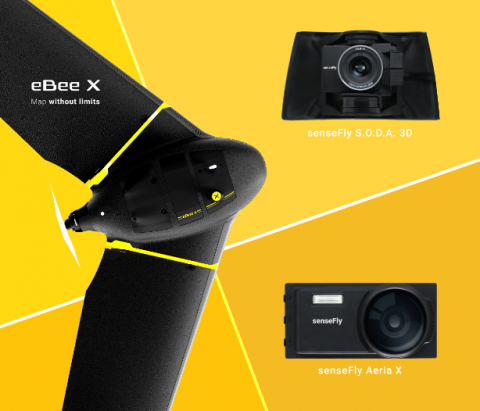
SenseFly recently announced the launch of its eBee X fixed-wing drone, which allows operators to map without limits, the company says.
Part of the Parrot Business Solutions portfolio, the eBee X is designed to boost the quality, efficiency and safety of an operator’s geospatial data collection, as it offers a camera for every job, as well as the accuracy and coverage capabilities to meet the requirements of even the most demanding projects, and the durability to work virtually every site.
Technology
Technology
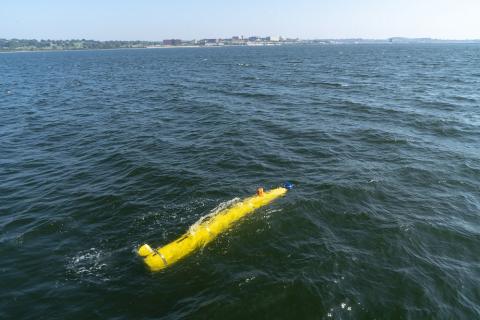
General Dynamics demonstrates C3 capabilities among UUVs, submarines and land-based mission operations centers
As part of the Advanced Naval Technology Exercise (ANTX) 2018, a team led by General Dynamics Mission Systems demonstrated “cross-domain, multi-level command, control and communication (C3) capabilities” among UUVs, submarines and land-based mission operations centers.
The demonstration, which took place at the U.S. Naval Undersea Warfare Center (NUWC) in Newport, Rhode Island, provided technological answers to the challenges of communicating among several platforms in contested underwater environments, from high-level operation planning to tactical mission execution.
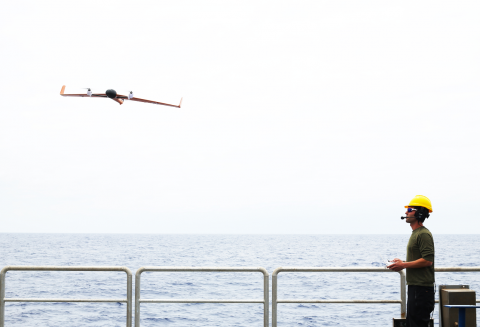
FlightWave demonstrates Edge's capabilities during three-week voyage in Pacific Ocean
Over a three-week period this summer, FlightWave Aerospace participated in the “Exploring Fronts with Multiple Robotics expedition,” as part of a high-tech research mission in the Pacific Ocean, approximately 1,000 miles west of Southern California in an area called the Subtropical Front.
Braille Battery completes test trials for its customized lithium batteries for commercial UAS applications
Braille Energy Systems Inc. has announced the completion of Braille Battery’s test trials for its customized lithium batteries for commercial UAS applications such as Aerial LiDAR surveys, Aerial Photogrammetry and other Aerial Inspections.
According to Braille, the trials showed that Braille Battery batteries provide longer discharge cycles—with a lot less weight—than the incumbent battery.
Braille Battery is “extremely pleased with the results of its trials and the achievement of meeting another key milestone,” especially with the commercial UAS market projected to grow steadily in the upcoming years.

From Unmanned Systems Magazine: U.S. Navy’s new roadmap sees vast potential for unmanned systems
The U.S. Navy sees vast potential for unmanned systems and the capabilities they will bring, according to the service’s Strategic Roadmap for Unmanned Systems.
Use of unmanned and autonomous systems will create nothing less than "fundamental shifts" in the way the Navy operates, says an unclassified summary of the roadmap released in May. Their integration, it says, will allow reductions in manpower and risk to personnel, lower operating costs, increased persistence, faster and more accurate data processing, and a faster decision cycle.

Weekend Roundup
This Week in the Unmanned Systems and Robotics World
Kespry has released the pulp and paper industry’s first UAS-based aerial intelligence platform. According to Kespry, the platform delivers more accurate and timely supply chain material inventory data, while improving site operations and safety. (Kespry)
Persistent Systems' Embedded Module receives new security validation from NIST
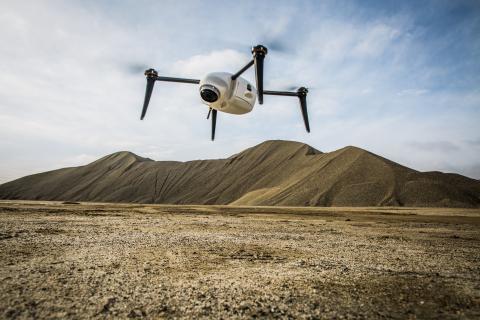
Persistent Systems’ Embedded Module, which is a low-size, -weight and -power mobile ad hoc networking (MANET) unit for sensors and unmanned vehicles, has received a Federal Information Processing Standards (FIPS) 140-2 Level 2 security validation from the National Institute of Standards and Technology.
Persistent says that the achievement confirms that all of its main products have achieved this level of validation, which in turn increases usability for users with nonnegotiable requirements for FIPS 140-2 Level 2.
With this new FIPS 140-2 Level 2 validation, the Embedded Module meets its Level 1 cryptographic data security requirement. It also has in place physical security mechanisms—such as tamper-evidence—that allow it to handle sensitive data transmission.
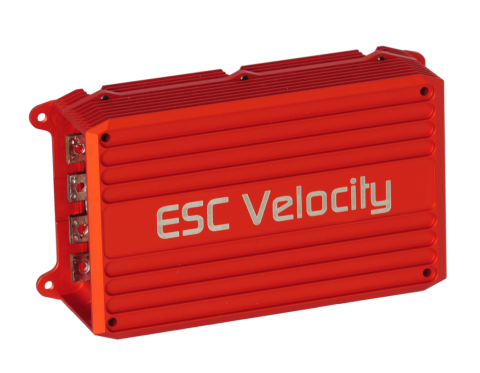
Currawong Engineering's 18S ESC Velocity for UAS applications receives updates
Currawong Engineering has released its updated 18S ESC (electronic speed controller) Velocity, which features the addition of “true hardware interlock and fully isolated PWM input” to its existing design.
Featuring high power and aerospace grade reliability, the ESC Velocity is designed for UAS applications.
According to Currawong Engineering, true hardware interlock is the “ultimate in operator safety,” as it provides guaranteed motor shutdown without the need for bulky inline power switches. CAN communications operate independently of the interlock, which allows for preflight checks with absolute confidence in the safe status of the controller.
Altiscope releases 'Blueprint for the Sky: The Roadmap for the Safe Integration of Autonomous Aircraft'
Altiscope, which is the Unmanned Traffic Management (UTM) group from A³ by Airbus, has released “Blueprint for the Sky: The Roadmap for the Safe Integration of Autonomous Aircraft.”
The Blueprint represents months of careful analysis by Airbus of the future needs for the airspace, the widespread impact of the upcoming changes to the airspace, and the development of the required tools for its enablement.

Queensland University of Technology and others collaborate to develop underwater robot reef protector
The Queensland University of Technology (QUT), Google and the Great Barrier Reef Foundation have collaborated to develop an underwater drone that can not only keep watch on reef health, but also accurately identify and inject the crown-of-thorns starfish, which can be especially dangerous.
Known as RangerBot, the underwater robotic system is ready to be tested on the Great Barrier Reef.
RangerBot can “see” underwater thanks to its high-tech vision system. Operated using a smart tablet, RangerBot won the 2016 Google Impact Challenge People’s Choice prize, allowing QUT roboticists to develop innovative robotics technology into a real-life reef protector.