This Week in the Unmanned Systems and Robotics World
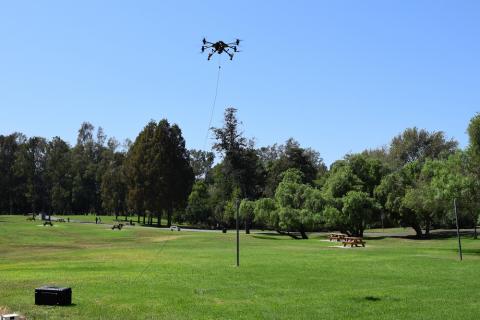
K2 Unmanned Systems is now providing tethered drone technologies for its UAS. The company is working with Elistair, a France-based tether manufacturer, to develop this technology. (K2 Unmanned Systems)
TuSimple is bringing 200 new autonomous semi-trucks to Tucson, Arizona. The company is also expanding its location in Tucson, as it plans on doubling its warehouse size next year. (Tucson Local Media)
Technology
Technology
Sonardyne Inc.'s underwater target tracking technology selected to use at South Florida Ocean Measurement Facility
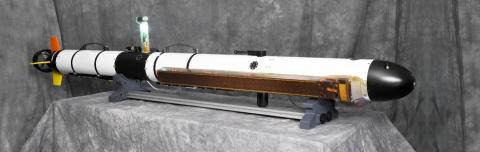
The US Naval Surface Warfare Center (NSWC), Carderock Division has selected Sonardyne Inc.’s underwater target tracking technology to use at its South Florida Ocean Measurement Facility (SFOMF).
Described as the largest, most comprehensive establishment of its kind in the world, Carderock Division is the US Navy’s research, engineering, modeling, and test center for surface and undersea technologies. Located close to the Gulf Stream, Carderock’s SFOMF offers a “demanding open ocean test environment” for subsea systems and UUVs being developed for the Navy, as well as the wider maritime industry.

Northrop Grumman and partners showcase unmanned capabilities during ANTX
Last month, Northrop Grumman Corporation and its industry partners participated in the U.S. Navy’s Advanced Naval Technology Exercise (ANTX).
During ANTX, Northrop Grumman and its partners, which included Physical Optics Corp, Ultra Electronics USSI, Hydroid, Optimum Solutions and Silvus, not only demonstrated advanced capabilities in the “command and control of future unmanned maritime missions,” but they also demonstrated the ability to better deliver important information to the warfighter in contested environments.
Logos Technologies' WAMI system for Integrator UAS successfully completes final test
During the last week of August, Logos Technologies’ Redkite-I wide-area motion imagery (WAMI) system, which is designed for the Insitu Integrator UAS, successfully completed its final flight test at the Insitu flight test facilities in Boardman, Oregon.
According to Logos, the lightweight WAMI sensor successfully demonstrated “complete end-to-end functionality,” including highly stable imagery, live WAMI streaming, vehicle tracking, and real-time forensics.
With this validation, Redkite-I will now be added to the Insitu Inc. catalogue of sensors available for the company’s tactical UAS.

Bryan, Texas to introduce self-driving trolleys to Downtown Bryan in October
In October, the city of Bryan, Texas, in partnership with the Texas A&M Engineering Experiment Station (TEES), will introduce two electric self-driving trolleys to Downtown Bryan.
According to the city of Bryan, this program differs from other programs because the Downtown Bryan location offers a “pedestrian rich environment for both foot and bicycle traffic offering numerous, real-life challenges to autonomous vehicle driving technology.”
The city of Bryan adds that the self-driving trolleys are the first of their kind to be utilized on public rights-of-way in the Brazos Valley, and to the city’s knowledge, just the second in the nation.
Local Motors' Olli self-driving shuttle to provide transport for ITS World Congress
During the ITS World Congress in Copenhagen, Denmark, Local Motors’ self-driving shuttle, Olli, will provide rides for attendees and dignitaries at the conference.
Known for its 3-D printed mobility technologies, Local Motors has delivered two new Olli shuttles to Autonomous Mobility, which provides autonomous technologies in the Nordic countries and the Baltic region.
Additionally, Local Motors announced that it has aligned with Autonomous Mobility exclusively, as a sales and operator partner for the Nordics and the Baltic, as the companies say that they “share the same mission and look forward to shaping how communities think and integrate about smart transportation.”

State Farm granted waiver to conduct UAS operations over people and BVLOS in areas effected by Hurricane Florence
State Farm has been granted a waiver for UAS operations that will be the first of its kind for an insurance company, and will allow it to assess damage in communities effected by Hurricane Florence.
The FAA has granted State Farm a waiver that combines permissions to conduct UAS flights over people and flights beyond the operator’s visual line of sight. Both of these operations are usually tightly restricted.
These provisions are approved over four states impacted by Hurricane Florence. Together, they will “dramatically enhance State Farm’s ability to evaluate hurricane damage and allocate resources,” the insurance company says.
Orange County, Florida to use UAS to locate people with cognitive diseases if they wander away
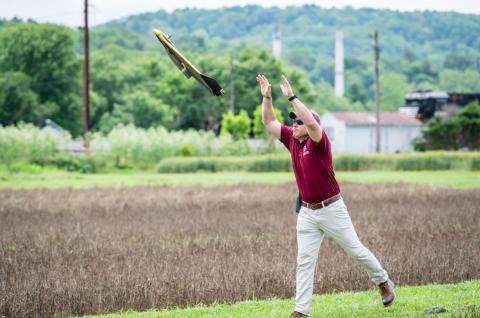
In Orange County, Florida, UAS will be used to locate people with a cognitive disease if they wander away from home or a facility.
A pilot program is being spearheaded by state Sen. Linda Stewart, and $75,000 of state money will be used to launch the initiative.
“This technology will help find people much faster than by foot, by car, even a motorcycle,” Stewart says via the Orlando Sentinel.
Global UAV's wholly owned subsidiary receives authorization to conduct BVLOS operations
Global UAV Technologies Ltd. has announced that its wholly owned subsidiary, Pioneer Aerial Surveys Ltd., has received authorization from Transport Canada to conduct beyond visual line of sight (BVLOS) operations with the NOVAerial Procyon 800E UAS at the UAS test range in Foremost, Alberta.
Transport Canada issued a Special Flight Operating Certificate (SFOC) to Pioneer Aerial, allowing for BVLOS flights at the Foremost UAS Range in Alberta, Canada. With the SFOC, Pioneer Aerial can demonstrate delivery of payloads with the Procyon 800E, and it can also conduct research and development flights, such as radio signal strength testing.
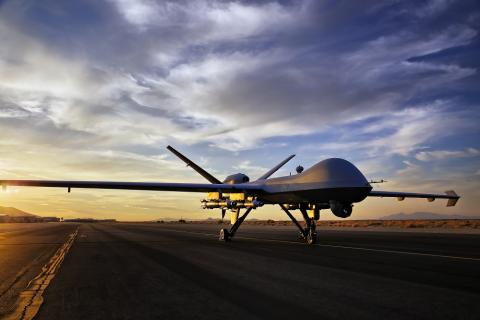
GA-ASI's new Automatic Takeoff and Landing Capability demonstrated on MQ-9 Block 5 RPA
General Atomics Aeronautical Systems Inc. (GA-ASI) has announced that the U.S. Air Force (USAF) completed the first-ever automated landing of an MQ-9 Block 5 Remotely Piloted Aircraft (RPA) on Aug. 7, which was followed a few days later by the first auto-takeoff on Aug. 9.
GA-ASI says that it developed the new Automatic Takeoff and Landing Capability (ATLC) to “enhance mission capability.”
“This new, all-weather capability greatly increases the autonomy, flexibility, combat effectiveness and safety of the MQ-9 Reaper for the USAF,” explains David R. Alexander, president, Aircraft Systems, GA-ASI.