This fall, Transdev will debut the first autonomous school shuttle in the world at Babcock Ranch—the first fully solar-powered community in the country—in Florida.
Transdev, which is the mobility partner for Babcock Ranch, is completing more than two months of testing on school shuttle routes that will augment existing autonomous options within the community.
During the pilot-program, Transdev will offer the service to Babcock Neighborhood School (BNS) students who live within Babcock Ranch. Transdev will use the pilot to evaluate rider behavior and demand.
Technology
Technology
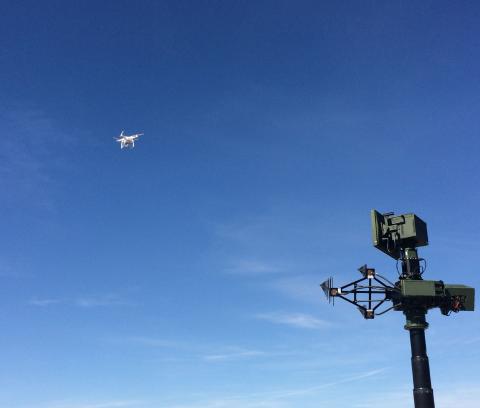
From Unmanned Systems Magazine: Governments seek ways to protect against rogue or enemy UAS
Counter-small unmanned aircraft systems technology has emerged as one of the most prominent growth areas in the defense and security markets in recent years, as governments seek to not only defend critical infrastructure from violent extremist organizations and near-peer adversaries, but also from errant hobbyists.
Threats across the contemporary operating environment stretch from the employment of airborne improvised explosive devices (ABIEDs) by the likes of the self-proclaimed Islamic State in Iraq and Syria, to the breaching of national airspace at major airports by commercially available air frames.
Drone Delivery Canada completes BVLOS UAS test flights in Alma, Quebec
Drone Delivery Canada (DDC) recently completed its beyond visual line of sight (BVLOS) trials in Alma, Quebec.
Conducted from August 13 to 17, the test flights, which took place under both day and night conditions, were the first phase of DDC’s Remote Communities Project.
The goal of the test flights was to stress test DDC’s proprietary FLYTE management system, the Sparrow cargo delivery drone, and DDC’s crews and procedures.
“We are developing a very valuable piece of technology that will enable a drone to safely integrate into Canadian skies for parcel delivery,” says Tony Di Benedetto, CEO.

Smart Ag debuts software that enables tractors to drive autonomously
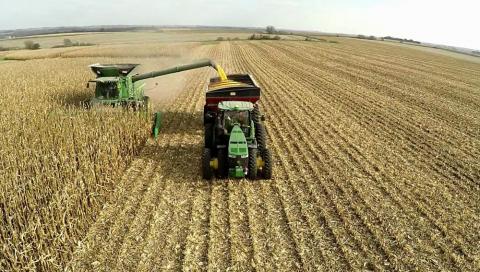
During the 2018 Farm Progress Show in Boone, Iowa, an Iowa-based software company called Smart Ag debuted its AutoCart cloud-based software platform that enables a tractor to drive autonomously.
During a demonstration, a newly autonomous John Deere tractor circled the demonstration field, and paused when a manually operated combine crossed its automated path.
“The first time that I saw a tractor operating without an operator in it, I just thought, ‘It looks like the Headless Horseman,’” says Smart Ag’s Chief Technology Officer Mark Barglo, via the Business Record.
AeroVironment's MacCready Works lab donates Quantix UAS to West Point Military Academy
AeroVironment Inc.’s MacCready Works lab has donated automated Quantix hybrid UAS, spare parts and AeroVironment’s Decision Support System (AV DSS) analytics software to the United States Military Academy, also known as West Point.
The UAS and accompanying parts and software will support West Point’s Center for Innovation and Engineering and Geography and Environmental Engineering Department.
WiBotic announces new wireless power system for DJI Matrice 200 and 210 drones
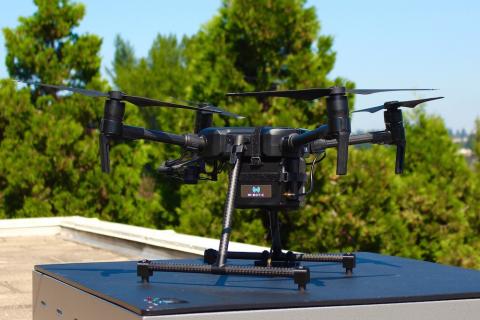
WiBotic, which provides wireless charging and power optimization platforms for the robotics industry, has announced a new wireless power system for the DJI Matrice 200 (M200) and DJI Matrice 210 (M210) drones.
The WiBotic wireless power system enables fully autonomous charging of UAS, allowing UAS to be on constant standby, or fly repeatedly without the need for human or mechanical battery swapping.
The WiBotic wireless power system for the DJI M200 and M210 includes both ground-based transmitter components and onboard charging components. For companies that want a “completely turnkey solution,” the system is also compatible with the (additional) WiBotic PowerPad.
AutoX launches self-driving grocery delivery pilot program in San Jose
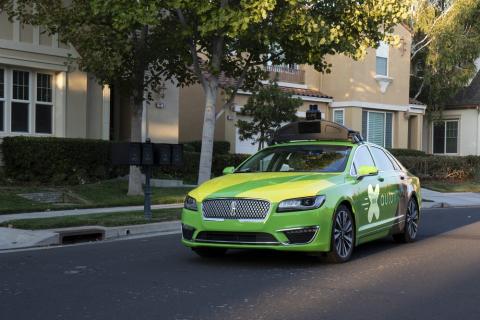
On August 27, self-driving car company AutoX launched its grocery delivery Pilot program in San Jose, California.
The grocery delivery and mobile store pilot allows users to order and receive fresh produce and other goods, with AutoX’s self-driving cars making the deliveries.
The pilot will be available to customers in geo-fenced areas near AutoX’s home in San Jose, and regular expansions are expected to occur every few weeks.
To start, users will download the AutoX app, where they can browse and order items such as, but not limited to, fresh perishables, vegetables, fruits, etc. Throughout their ride over to customers, the groceries will be well-preserved in a temperature-controlled environment.
Phase One Industrial launches new camera series that can be used on UAS
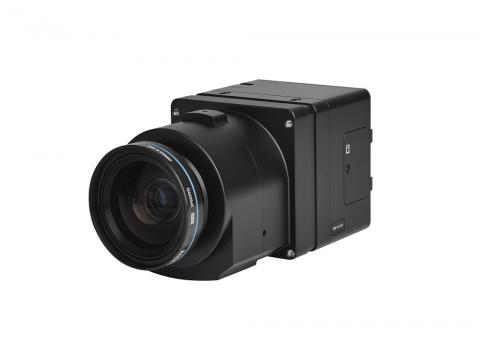
Phase One Industrial, which provides aerial imaging technologies, has launched its iXM-RS metric camera series and new Aerial Systems, which can be used on UAS.
Full frame, 150 megapixels and available in RGB and Achromatic models, the iXM-RS150F camera is capable of increased productivity in a wide range of aerial image acquisition projects, thanks to its “ultra-high resolution (14204 x10652) backside illuminated CMOS sensor, fast capture speed (2 fps) and enhanced light sensitivity.”
Phase One Industrial says that the iXM-RS camera is the “imaging heart” of its Aerial System, which is a fully integrated platform for mapping and surveying.
Farmers don't have to spend a fortune to benefit from UAS
UAS have a variety of potential uses in the agricultural sector, including to scout fields and spot insect infestations, weed problems and nutrient issues.
The technology can be the difference between taking hours to walk a field or seconds to scan it from above, experts say.
“I think that’s what we’re looking at — potential,” says Dr. Jarrod Miller of the University of Delaware Extension, via Lancaster Farming. During the 4R Technology Day held in Queenstown, Maryland on August 15, Miller conducted UAS demonstrations.
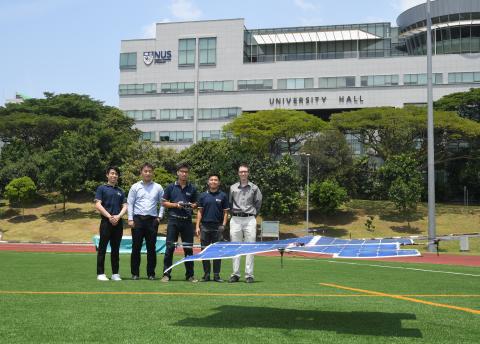
National University of Singapore team develops and tests Asia's first fully solar-powered quadcopter UAS
During test flights, Asia’s first fully solar-powered quadcopter UAS has flown higher than 30 feet in the air.
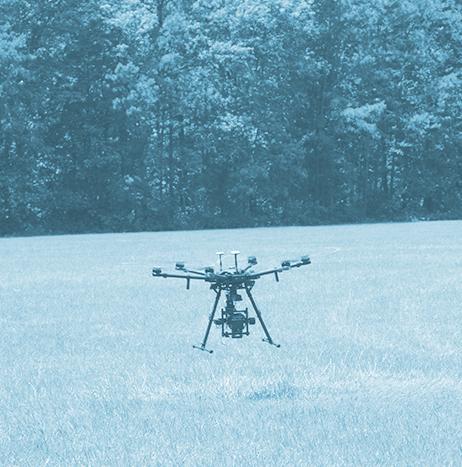
Developed as a student project under the Innovation & Design Programme (iDP) at the National University of Singapore (NUS) Faculty of Engineering, the UAS uses solar power with no battery or other energy storage on board.
The solar-powered UAS is constructed using lightweight carbon fiber material, weighs just under six pounds, and can take-off and land vertically without a runway. It is fitted with 148 individually characterized silicon solar cells and supported by a frame equipped with four rotors.