
With a focus on creating robust, reliable, safe, and secure software for autonomous mobility systems, a company called Apex.AI was officially announced on Nov. 15.
The company recently closed a $15.5 million Series A funding.
“Apex.AI is transitioning autonomous vehicle software from R&D to commercialization so that it meets highest safety and reliability standards, a need for both automakers and consumers,” Apex.AI says in a company blog post.
Autonomous Vehicles
Autonomous Vehicles
Autonomous shuttle service headed to Albemarle County, Virginia
An autonomous shuttle service is headed to Albemarle County, Virginia, thanks to the recently announced $600,000 partnership between Albemarle County, robotics software company Perrone Robotics (PRI), and “XR solutions provider” JAUNT Inc.
The location of the service has yet to be decided, but the partners say that the service will allow riders to get on and off the autonomous shuttle along a fixed route.
The shuttle will operate autonomously, but a safety-trained transit “ambassador” will be on-board to answer customer questions, offer any required assistance, and take over as a driver if necessary.

Ford and Walmart partner to deliver goods using self-driving vehicles
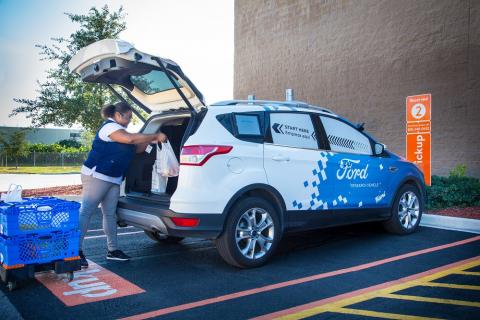
On Nov. 14, Ford announced that it is teaming up with Walmart to explore how self-driving vehicles can deliver everyday goods to people.
The companies are using the infrastructure of Postmates—whom they both had an existing partnership with before—to quickly establish and launch a pilot program that explores how Ford’s self-driving vehicles can complement Walmart’s existing delivery offerings.
“Like Ford, Walmart believes that self-driving vehicles have an important role to play in the future of delivery, and that true success comes from first learning how individuals want to use them in their daily lives,” Ford says in a company blog post.
ComfortDelGro and partners to test autonomous shuttle bus service in Singapore
A land transport company called ComfortDelGro has announced that it will test an autonomous shuttle bus service in real traffic conditions on the National University of Singapore’s (NUS) Kent Ridge campus starting in March 2019.
The year-long autonomous bus shuttle operational trial will include ComfortDelGro and NUS, as well as Inchcape Singapore and EasyMile.
If the trial is successful, the service could be implemented commercially.

Addison Lee Group and Oxbotica begin mapping London's Canary Wharf in prep for autonomous vehicles
A few weeks after agreeing to a “wide-ranging strategic alliance” that accelerates the implementation of autonomous vehicles to the streets of London, Addison Lee Group and Oxbotica have launched a 3D street mapping exercise in London’s Canary Wharf.
With the goal of rolling out Addison Lee’s autonomous services by 2021, this mapping process is expected to create the backdrop for new autonomous services that meet urban requirements for efficient transport, reduced congestion and improved air quality.
Along with their partners Canary Wharf Group and insurer AXA XL, Addison Lee Group and Oxbotica have started the mapping process using a vehicle equipped with mapping technology to record every curb, road sign, landmark and traffic light in Canary Wharf’s 128-acre estate.
Kongsberg Maritime selects Leclanche to provide batteries for its autonomous vessels
Kongsberg Maritime has selected battery company Leclanché as its battery partner and supplier of customized marine energy storage platforms.
Through the partnership, Leclanché will be an asset to Kongsberg’s new generation of hybrid power platforms, which includes “cutting-edge autonomous and crewed vessel newbuilds.”
“The partnership between Kongsberg Maritime, one of the world’s leading providers of electrification solutions to the maritime industry and Leclanché has the potential to be game changing as it brings low and zero-emission solutions to the sizeable and fast growing electric and hybrid marine market,” explains Anil Srivastava, CEO of Leclanché.
Daimler and Bosch to test automated ride-hailing service in San Jose, California next year
Next year, Daimler and Bosch plan to begin testing their fully automated driving (SAE Level 4/5) on-demand ride-hailing service in San José, California.
According to the companies, San José wants to prepare itself for a future where autonomous cars operate on the streets, so Daimler and Bosch will use automated Mercedes-Benz S-Class vehicles to offer their service to a selected user community in the San Carlos/Stevens Creek corridor between downtown and west San José.
Optimus Ride equipping its fleet of autonomous vehicles with NVIDIA DRIVE AGX Xavier computing platform
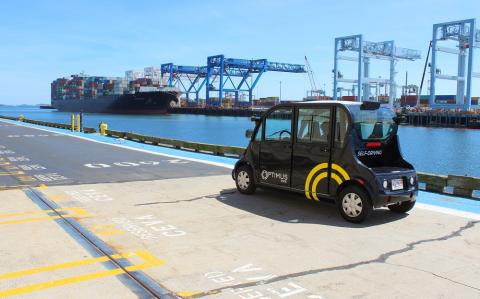
Self-driving vehicle tech company Optimus Ride has announced that it will equip its autonomous vehicle fleet with the NVIDIA DRIVE AGX Xavier computing platform, which is capable of delivering 30 trillion operations per second using new deep learning and computer vision accelerators.
The company says that the NVIDIA DRIVE platform will deliver “unprecedented computational performance and safety” to its self-driving vehicles.
“Building on NVIDIA DRIVE ensures our vehicles are equipped with the highest performance and most efficient processing power available,” says Optimus Ride CEO and Co-Founder Ryan Chin.
Volvo Cars and Baidu partner to develop and manufacture autonomous vehicles for China
Volvo Cars and Baidu have agreed to jointly develop electric and fully autonomous drive-compatible cars, with a mind towards mass producing these vehicles for the largest car market in the world, China.
Through their partnership, Volvo Cars and Baidu will develop and sell these vehicles to potential Chinese customers, which underlines Volvo Cars’ desire to be the supplier of choice for mobility companies across the world.
Ford and Baidu announce two-year joint autonomous vehicle test project in China
Ford Motor Company and Baidu Inc. have announced a two-year joint autonomous vehicle test project in which they’ll work together to further advance the development and on-road testing of autonomous vehicles in China.
According to Ford, the collaboration is aligned with its plans to “further advance and promote autonomous vehicle technologies,” which ultimately supports the company’s vision of designing “smart vehicles for a smart world.”