
The first phase of a project designed to test, operate and evaluate self-driving vehicles has launched in Ohio, as self-driving shuttles began operating on the streets of downtown Columbus on Monday, Dec. 10.
Through the project, residents and visitors will get to experience intelligent transportation first-hand.
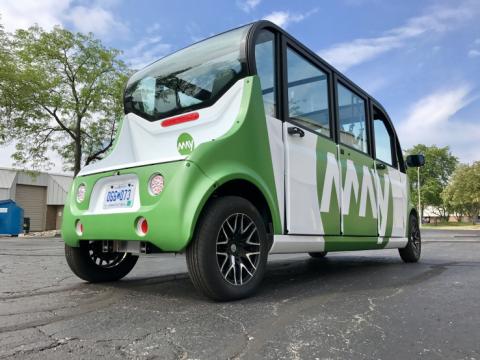
The shuttles are being operated by May Mobility, which began testing and route mapping around the Scioto Mile—an urban oasis made up of more than 175 acres of lush parkland—this week.
“This is an important project for Columbus, but this pilot is a big step in our statewide plan,” says Jim Barna, executive director of DriveOhio.
Autonomous Vehicles
Autonomous Vehicles
The University of Illinois Urbana-Champaign's new Center for Autonomy will focus on autonomous tech
According to the Associated Press, the University of Illinois Urbana-Champaign is launching a new center called the Center for Autonomy, which will be used to focus on autonomous technology such as self-driving cars and robotic assistants.
The university has allocated $2.1 million for the center, while the College of Engineering is providing an additional $2.1 million to recruit new robotics faculty.

ThorDrive introduces commercial vehicle services featuring its autonomous vehicle tech
An autonomous vehicle (AV) startup called ThorDrive recently introduced commercial vehicle services featuring its autonomous vehicle technology.
In partnership with Hassett ACE Hardware, the initial service will support select residents of a retirement community in Palo Alto, California, as well as fire departments in the city.
ThorDrive is utilizing Velodyne Lidar sensors for the services, which will provide rich data content for ThorDrive’s AV software.
May Mobility selected to deliver autonomous transit pilot to Rhode Island
After a competitive request-for-proposals process that started earlier this year, May Mobility has been selected by the Rhode Island Department of Transportation (RIDOT) to deliver a “limited and controlled automated vehicle service” to help fill a transportation gap between downtown Providence and Olneyville.
While the service is in operation, RIDOT will seek to get a better understanding of the potential of new technology to improve mobility options for residents in the state, by testing and researching a variety of factors relating to the service.
The service will be available and free to the public for a year.
Rolls-Royce and Finferries successfully demonstrate world's first fully autonomous ferry
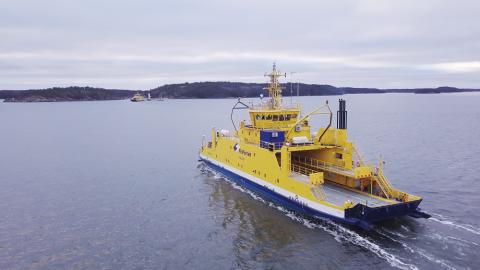
Rolls-Royce and ferry operator Finferries have announced that they have successfully demonstrated the world’s first fully autonomous ferry in the archipelago south of the city of Turku, Finland.
Known as Falco, the 53.8-meter double-ended car ferry, which had 80 invited VIP guests aboard during the demonstration, navigated autonomously during its voyage between Parainen and Nauvo using a combination of Rolls-Royce Ship Intelligence technologies.
The companies note that the ferry’s return journey was conducted under remote control.
University of Alberta evaluating how driverless shuttle performs in cold climate
The University of Alberta’s Centre for Smart Transportation (CST) is testing a driverless electric shuttle on campus to evaluate how it performs in a cold climate.
Known as ELA, the electric autonomous vehicle operates without a driver, is capable of carrying 12 passengers, and drives at speeds up to 12 kilometers (approximately 7.5 miles) per hour.
Designed to operate on existing city infrastructure, the shuttle is currently operating on the University of Alberta South Campus, giving Edmonton residents the opportunity to participate in the tests. The area where the vehicle is operating has been fitted with special signs for the shuttle to “read,” as well as digital signaling equipment that allow the vehicle to understand its environment.
Florida Poly and JTA partner to enhance development of autonomous vehicle tech in public transportation
Florida Polytechnic University (Florida Poly) and the Jacksonville Transportation Authority (JTA) have announced that they will work together to enhance the development of autonomous vehicle (AV) technology in public transportation.
The entities have agreed to work together to boost the research and application of AV technology.
Florida Polytechnic is home to the Advanced Mobility Institute (AMI), which is a university-affiliated research center that focuses on advancing and testing AV technology. According to Florida Poly, AMI is one of the largest university centers in the country that specializes specifically on the testing and verification of AV technology.

Audi, Airbus and Italdesign test flying taxi concept consisting of self-driving electric car and passenger UAS
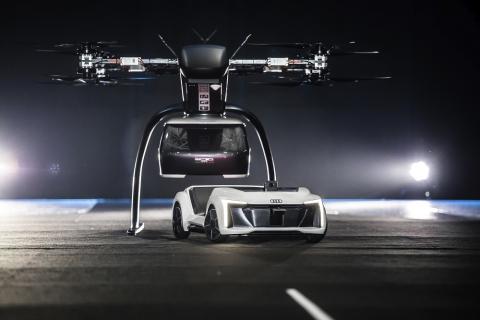
During Drone Week in Amsterdam, Audi, Airbus and Italdesign tested a flying and driving prototype of “Pop.Up Next,” which the companies describe as an “innovative concept for a flying taxi” that combines a self-driving electric car with a passenger UAS.
During the first public test flight, the flight module accurately placed a passenger capsule on the ground module, which then autonomously drove from the test grounds.
The companies say that this concept is still a 1:4 scale model, but they believe that in the near future, a convenient and efficient flying taxi service in large cities—in multi-modal operation, in the air and on the road—could be used by Audi customers, allowing them to enjoy their leisure time, relax, or work, all without having to change vehicles.
Volvo Trucks to provide mine in Norway with autonomous transportation option
Volvo Trucks has signed an agreement with Norwegian quarry Brønnøy Kalk AS to provide its first commercial autonomous option, which will be used to transport limestone from an open pit mine to a nearby port.
Through the agreement, six autonomous Volvo FH trucks will transport limestone on a five kilometer stretch through tunnels between the mine itself and the crusher.
This strategy has been successfully tested and will continue to be tested throughout the rest of the year. The goal is for the solution to be fully operational by the end of 2019.

AUTOSAR's latest version of Adaptive Platform can be used in highly autonomous systems
Real-Time Innovations (RTI) has announced that AUTomotive Open Systems ARchitecture (AUTOSAR) has released the latest version of the Adaptive Platform, Release 18-10, which features a full network binding of the Data Distribution Service (DDS) standard.
The release of the Adaptive Platform allows automotive manufacturers to now implement an AUTOSAR Adaptive framework with DDS and develop highly autonomous systems, such as Level 4 and Level 5 autonomous vehicles.