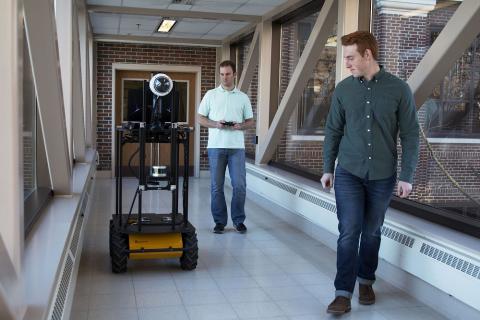
Researchers at Purdue University's School of Electrical and Computer Engineering are developing integrative language and vision software that could potentially enable an autonomous robot to not only interact with people in different environments, but also accomplish navigational goals.
Led by Associate Professor Jeffrey Mark Siskind, the research team—which also includes Doctoral candidates Thomas Ilyevsky and Jared Johansen—is developing a robot named Hosh that can integrate graphic and language data into its navigational process in order to locate a specific place or person.
Hosh is being developed thanks to a grant funded by the National Science Foundation’s National Robotics Initiative.
Robotics
Robotics
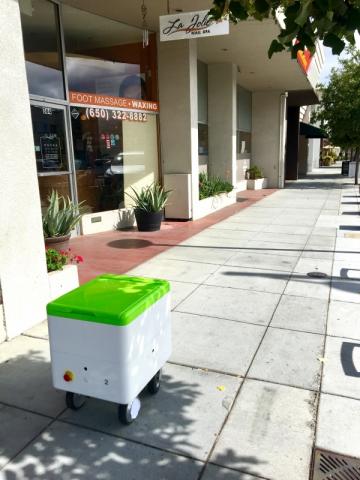
Segway-Ninebot unveils first autonomous vehicle for short distance delivery
Segway-Ninebot has unveiled Loomo Delivery, which is the company’s first autonomous vehicle that is designed for the short distance delivery industry for take-outs, parcels, and goods.
Capable of safely navigating obstacles and crowded environments, Loomo Delivery is described by Segway-Ninebot as “fast, convenient and a fully automated transporter.”
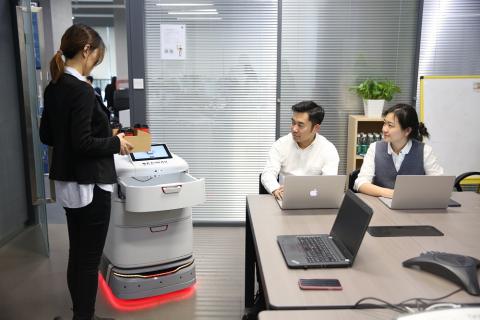
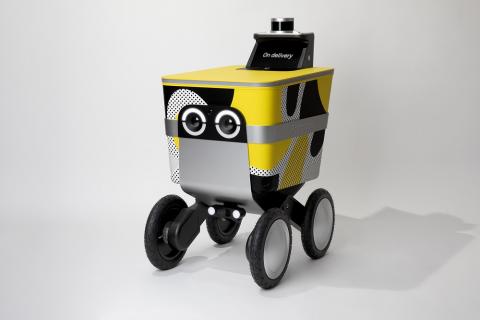
Postmates introduces Serve, its robotic delivery device that it built from the ground up
On-demand delivery company Postmates has introduced the newest member of its fleet, Serve, which the company claims is the first robotic delivery device created from the ground up by an on-demand delivery company.
Postmates says that after seven years and hundreds of millions of deliveries, it realized that it was in a unique position to create its very own autonomous delivery vehicle, which combines a patented Socially-Aware-Navigation system with the company’s proprietary Postmates software.
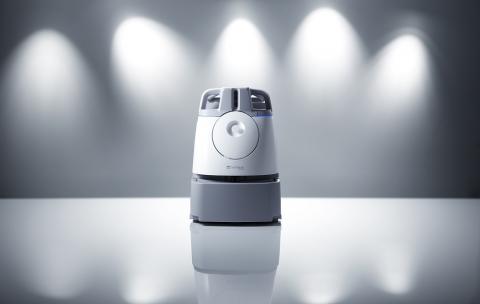
Brain Corp to use NVIDIA Jetson platform for autonomous commercial vacuum cleaner
For its latest initiative—an autonomous commercial vacuum cleaner known as “Whiz” from SoftBank Robotics—Brain Corp will use the NVIDIA Jetson platform, the company has announced.
Whiz will be powered by Brain Corp's proprietary operating system, BrainOS, which provides machines with autonomous navigation and data collection capabilities, all tied into a cloud-based reporting system.
Whiz is designed specifically for commercial spaces such as retail and office environments. It will be sold to the Japanese market starting next year.
Robotiq to use funding to enhance its standing in collaborative-robotics market
Robotiq, which provides tools and software for the collaborative-robotics market, has announced that it raised $31 million in funding during its first round of institutional financing. The funding will be used to develop products, expand internationally, and enhance support of the company’s partner ecosystem.
Robotiq develops equipment such as specially designed, plug-and-play “grippers” that can handle manufacturing tasks previously done by human hands. The company also develops force sensors, camera technology and related software, which can be used to help with a variety of manufacturing tasks such as picking up and placing certain components or products, light assembly, finishing, and quality testing.

The University of Illinois Urbana-Champaign's new Center for Autonomy will focus on autonomous tech
According to the Associated Press, the University of Illinois Urbana-Champaign is launching a new center called the Center for Autonomy, which will be used to focus on autonomous technology such as self-driving cars and robotic assistants.
The university has allocated $2.1 million for the center, while the College of Engineering is providing an additional $2.1 million to recruit new robotics faculty.
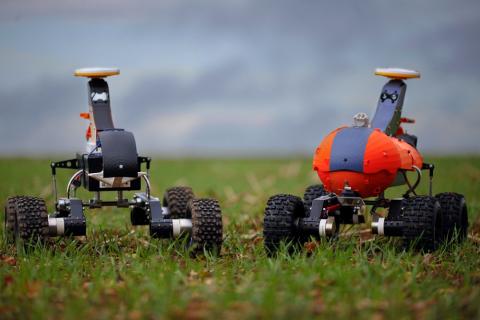
The John Lewis Partnership partners with Small Robot Company to test its farmbots
The John Lewis Partnership, which is an employee-owned UK company that operates John Lewis & Partners department stores and Waitrose & Partners supermarkets, has announced a three-year trial with the Small Robot Company to test its farmbots at John Lewis Partnership’s farm in Leckford, Hampshire.
The Small Robot Company’s three small robots—Tom, Dick and Harry—will be used at the Leckford Estate to learn and test this farming technology on a one-hectare wheat field. The Leckford Estate grows produce for Waitrose & Partners.
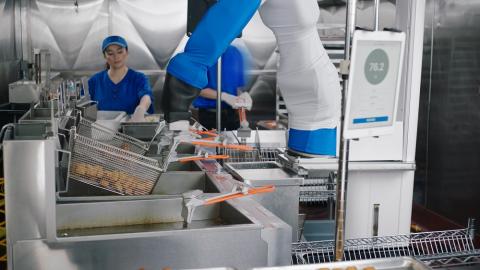
AI robotic arm gets experience cooking fried chicken and tater tots
Robotics and artificial intelligence technology company Miso Robotics has announced that its cloud-connected Miso AI platform now enables its autonomous robotic kitchen assistants to perform fry cooking tasks.
Additionally, NSF International has issued full certification to Miso Robotics’ kitchen assistant product line for meeting sanitation standards for commercial kitchen equipment, and the line has also secured an ETL Listed Mark by Intertek for meeting UL electrical safety standards.
Since July 30, Miso Robotics has been piloting Flippy, the world’s first autonomous robotic kitchen assistant, as a frying assistant at the Chick ‘n Tots stand in Dodger Stadium, home to Major League Baseball’s Los Angeles Dodgers.